
My father didn’t give a shit about American sports. Baseball? Too slow. Too full of crotch-scratching fat guys. Football? Too violent. Too many whistles and timeouts and nonsensical rules for his European brain to comprehend. As for the competitions themselves, well, pity the fool who got Dad started on the idea of a “world champion” in sports only played in America.
“Vorld champion?” he would say, his German accent mixing with an always incredulous laugh. “Vorld champion of vhat?”
Dad had one exception to this rule: basketball. To Dad, basketball might just have been the most beautiful team sport in the world. It possessed all the grace and rhythm and magic of his beloved skiing. For this, he had Larry Bird to thank. My father begrudgingly moved to America from Austria in the late 1970s. He came here for two reasons: my American mother and, as a byproduct of his having fallen head over heels for her, to run ski schools, which short of farming was the only job for which he was qualified. At the time, American ski schools were run by Austrians in the same way that gourmet restaurants usually had a Frenchman in the kitchen. Dad started at a place in Vermont, and then — shortly after I was born in 1980 — brought our small family to an isolated winter resort in New Hampshire’s White Mountains. The clientele — weekenders, we called them — almost hailed exclusively from Massachusetts. One such was a Celtics fan, a season tickets holder, and he became close with my father. They started going to games together. Boston stood two hours south of our town, a straight shot down Interstate 93. The first time my father witnessed Bird play he returned home mesmerized. He returned to the Garden a great many more times after that.
On one of those times, Dad finally took me. It must’ve been around 1988. From the upper deck in the Garden’s nosebleeds — a place so high it seemed we had to hunch underneath the rafters from which the Celtics’ then 16 championship banners hung — I watched Bird and the rest of his boys square off against the New York Knicks. The Knicks would’ve been my Brooklyn-born mother’s team had she given a damn about the game (the only game she spoke of was baseball, the Dodgers of her youth and Ebbets Field). And so I cheered that night for the Celtics guilt free. Bird was well past his prime by then, already hobbled by the bad back that would end his career, but it didn’t matter. I forget which team won. What I do remember is the yellow interior of the old Garden, the steepness of the conical stadium itself, how in the crowded men’s room I witnessed grown men pissing in sinks for the first time in my life and the horrible things the fans shouted at Patrick Ewing.
“Don’t listen to them,” my father said, moving to cover my ears. I fell asleep on the two-hour ride home that night, a newly minted Celtics fan.
From then on, every time we drove past the Boston Garden — maybe on our way to Logan so that we could fly to Austria for the summer, where my father spent six weeks farming, or down to the Cape for a weekend to visit wealthy friends — Dad would look to his right and say with reverence in his voice, “That’s the Boston Garden, vhere the Celtics play.”
My own Celtics fandom did not endure like Dad’s did. Growing up in a ski town made me a skier, and Dad — a 6’4” showboater, in possession of a silvery mane and an equally handsome style on snow — was the most recognizable skier on the mountain. I wanted to be just like him, and the best way I knew how to do that was by racing.
Austrians are the best ski racers in the world (don’t tell the Swiss), and while my father might’ve talked about basketball, his Celtics stories paled in comparison to the ski racing lore he rattled off nonstop. Sailer, Schranz, Klammer, Girardelli — these were the exotic names I grew up on. I could recite their stats and stories with all the uncanny ability of a parrot. I knew that my father harbored bitterness for having left Austria, for having left his mountains and his skiing — real skiing — behind, and so I did my best to recreate it all here in America. Our resort had a legendary race program, founded by an American Olympian, and I joined its ranks. My succession was slow at first, but soon I was winning races, going to state championships and Junior Olympics. Dad’s instructors took notice. Dad did, too. We spent late hours tuning and waxing my skis, and on race day — if my father wasn’t too busy — he would attend races with me. We would slip the course together, noting the placement of the gates and the nuances of the hill. When it was my turn to go, Dad would position himself beside what he had deemed the most critical gate on the course, and point the tip of his ski pole to exactly where I should start my turn. At first this didn’t bother me until, in the way most things seem to happen in life, one day it did.
The Knicks are all my sons know. That is to say, these New York Knicks … No one has passed this fandom down to them. There is no complicated inheritance. All they know is the magic they see unfold on the court every night.
By the time I got halfway through high school, a specialized school for skiing in which we trained gates five days a week and raced on both Saturdays and Sundays, I was a full-blown head case. It didn’t help matters that I’d shot up to 6’6” and that my coordination hadn’t caught up with the rest of me — skiing favors those blessed with a short center of gravity. Skin-tight speed suits looked ridiculous on the goon-like figure with which I’d been cursed, no thanks to my father’s robust genes. My self-consciousness wasn’t unwarranted. I once overheard a coach laughing about how I skied “like a giraffe.” I was voted captain of our ski team senior year, but inside I was a mess, throwing up before my runs and often failing to place inside the top 50, or finish at all. I completed that final season dejected, not even eligible for any of the end-of-season races that I used to qualify for, and despite spending the next four years in Vermont for college, I probably stepped into a pair of skis less than 10 times.
I moved to New York after graduation for a magazine job, but it took me a long time to love the place. I related to the city through opposition, and the easiest way to do this was through sports fandom. To me, New York sports fans seemed spoiled, arrogant. The 2004 Red Sox comeback in the ALCS to beat the Yankees secretly thrilled me, as did the Garnett/Pierce/Allen Celtics of 2008, and the Pats dynasty proved a good excuse to drink beer on a Sunday. Still, my allegiance to these New England teams remained fair-weather at best, as did my appreciation of American sports in general. I went to a Knicks-Raptors game once and sat courtside thanks to a girlfriend who worked in MSG’s marketing department, but I nearly fell asleep out of boredom. I started skiing again, mostly recreationally, though sometimes I’d head to the Vermont ski school that my father had taken over to teach for him on busy weekends. When I met my wife, I taught her how to ski, and it was rewarding to see the sport through fresh eyes.
In 2017, we had our first son. Six months later, my wife’s company offered to move us to their headquarters in Switzerland — a town just on the Austrian border. She’d received a big promotion. I practically signed the offer letter for her. My parents didn’t share my enthusiasm, especially not my father. He worried about his age, his health, the distance, the fact that no sooner had his first grandchild arrived and — bam! — we were absconding across the Atlantic with the poor thing. But mostly he just couldn’t understand why we’d do it — what was the appeal? I was incredulous. What was the appeal of the place, those mountains, that he’d filled my head with for decades? I dreamed of hiking and biking and skiing the Alps that he’d mythologized for so long. I dreamed of living the life he’d given up. I dreamed of passing it all down to my son.
A year into our Swiss adventure my father got sick, and three months later he died. I spent much of that autumn at home in Vermont, and I held his big hand when he finally went while laying on a rented hospice cot in our living room. I returned to Switzerland in early December. My wife and I skied when we could that winter, our second in the Alps, but my son was still too young to learn, and I spent much of it — on drives and walks and chairlift rides — bursting into tears over some detail that reminded me of Dad. Three months later, COVID hit, the ski areas closed, as did the borders. We had our second son in September of that same year, and by that December we moved home to America, both boys having never set foot on skis.
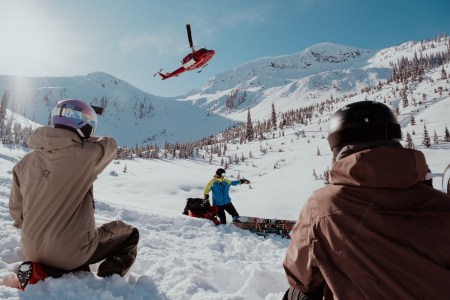
Why Heli-Skiing Isn’t Just for the One Percent
A four-day powder quest changed my perspective on this style of skiing and snowboarding. Here’s how you can do it, too.We relocated back to New York, renting a place on the Upper East Side. When they were both old enough, I got my boys up to Vermont to ski whenever I could, and also across the Hudson to New Jersey, where the artificial slopes of the American Dream Mall became our indoor classroom. No wind. The temperature set to an unwavering 28 degrees Fahrenheit. Snow year round, all within walking distance of a Toys “R” Us and a Lego store. Here I was passing down the sport of my father — really the sport of our family — to my two sons, not in the Alps of Austria or Switzerland, as I had once envisioned, but at a mall in the Meadowlands.
As I happily discovered, the terrain hardly mattered. A slope is a slope, and the two boys benefited. I could see moments of my younger, more agile self in the easy, natural way they both skied. I could see the ghost of my father, too. He was there, somewhere in the cant of their hips, how they bent their knees, how they tipped their skis up on edge, all in one loose, fluid movement from turn to turn. On drives back to the city, up and over Weehawken and down the section of 495 that loops into the Lincoln Tunnel, with the barbed skyline of Manhattan dramatically announcing itself to the left, like the walls of some impossible empire, I would play Tyrolean “oom pah pah” après-ski music and the three of us would sing along as best we could. “Schifoan!” we would shout in unison, butchering the chorus of our favorite tune. We would sing it as if it were a spell, one strong enough to conjure my father, right then and there. Or at least I did.
Somewhere around this same time, that is the winter of ’24-’25, my wife signed our oldest son up for basketball. Games were played on Saturdays at a school gymnasium in the east 60s — steps from Memorial Sloan Kettering Cancer Center, where my father had received some of his treatment. As I expected, my son wasn’t a strong player. He lacked the game’s necessary eye-hand coordination, much in the same way that used to get me ridiculed in gym class, and he lacked the aggression required by team sports played at such close proximity. These details hardly mattered. He was having fun. He was trying. Through my cousin, I scored Knicks-Lakers tickets that February and surprised my eldest son by taking him. He wanted to see LeBron, but he left with a Brunson jersey. Brunson was a player neither of us had ever heard of prior to the game. It was a late game, with an 8:30 p.m. tip-off, and I plied the boy with Pepsi all night long in a bid to keep him awake. It worked. Every time we vacated our seats to hit the concessions for more snacks and soda, fully grown men would see my son and high five him. “Let’s go Knicks!” they’d shout, then give me a smile and a nod. I remember one especially New York-looking wise guy shouting, “That’s how you pass down the tradition, Dad!”
There was no mistaking my lack of basketball acumen on the actual court, however. That spring, my son would ask to go to a nearby park, one in which his friends invariably congregated, and I always obliged. When we showed up, I could tell the other dads figured I had serious chops given my height. They were of course wrong, and I’d quickly dispel any of their respect by lobbing air ball after air ball at the hoop. After one such humiliation ritual, I gave my son’s basketball a super bounce on the sidewalk during our walk home to get a laugh out of him. It bounced 15 feet or more, and came down— despite my scrambling to catch it, and much to the horror of my wife — on the windshield of a parked Mercedes. The windshield didn’t shatter or even crack, but my son did, laughing hysterically at Dad’s clumsiness. I knew then that my days as his athletic hero, a man seemingly in complete command of all his physical faculties, were numbered.
Our time in New York was also up. My wife had had enough of the place. In July, we moved to a burb an hour north of the city, which also made us an hour closer to Vermont. By the end of August, like all good skiers, my mind turned to winter. I began looking into seasonal ski programs for the boys, season passes for the whole family, a winter condo rental, doing the mental math on how we could somehow afford it all. Or maybe, I thought, we could all cram into the condo my mother had finally downsized into after my father’s death.
In the end, my oldest son — now eight years old — had us sign him up for basketball, and his five-year-old younger brother followed suit. In fact, the eldest enrolled in two leagues, which, between practices and games, had him on the court five to six times a week. This left little time for skiing, but we managed to get him and his brother out as much as we could. I still saw those shadows of myself and my father in the way they tipped and turned their skis. And yet, my wife and I spent more time with our eldest shooting hoops at a local park than skiing. He hadn’t made the A team in the more competitive basketball league, something that I told him was no big deal — good, even, given that he could hone his skills and become a leader among the less seasoned kids — but privately it pained me. I hated seeing that look of dejection on his face. It was the same face I had returned home wearing, ski race after ski race when the thing I wanted so badly became too much for me to conquer. Whenever it was my turn to take the boy to the basketball court, I would feed him balls, one after the other, straining as I reached down to fetch them, my old skier’s back in agony, and then toss them his way so that he could keep working on his shots. “Let’s cook,” we would say to each other, with a glimmer in our eyes.
Later that winter, he got bumped up to the A team, and in the other league they made him point guard. I can’t claim any credit. It was his work, not mine. My wife got him an indoor hoop for his birthday and a “silent” basketball made of foam rubber. Night after night he and his brother would shoot hoops in the loft that serves as their playroom. Seated on the couch below, my wife and I would listen to them talk trash above, both boys lost in a fantasy, each taking turns pretending to be their favorite players: Brunson, Hart, Bridges, KAT, Anunoby. My eldest has handles, as he calls them, and the youngest flashes three fingers in front of his face — just like Brunson — anytime he hits a shot (this usually involves a disgusting amount of traveling that gets him directly below the basket). This past April, during their school break, we went to Boston for a few days. We hit Fenway, the New England Aquarium, Faneuil Hall, the Museum of Science and, of course, the TD Garden to catch a Celtics game. I took photos of the boys, made them smile in front of the court. I thought of my father. I heard him say in my ear, “That’s the Boston Garden, vhere the Celtics play.” I was startled by the memory. The boys, however, were thoroughly unimpressed by it all, the youngest even booed, and despite my offer to buy them each a Tatum jersey (the one Celtics player they’ll cop to liking), they both refused.
The Knicks are all my sons know. That is to say, these New York Knicks. They don’t know heartbreak and drought and whatever else the beleaguered franchise has endured. They don’t truly understand the fact that a championship hasn’t been brought home since 1973. No one has passed this fandom down to them. There is no complicated inheritance. All they know is the magic they see unfold on the court every night. They caught their Knicks bug during last year’s playoffs, when I was still a fair-weather Celtics supporter. This year, well, here we are. Every night during this improbable playoff run, we have gathered as a family in our living room to watch miraculous game after miraculous game. Sometimes I start on the floor, doing back exercises, while the rest of the family posts up on the couch. Mom and sons wear their jerseys, the boys surround themselves with their stuffies — not stuffed animals, not the ones I passed down to them from my own childhood in the hopes that they would love them as I once had, but stuffed New York Knicks, the same ones they sleep with every night. My eldest clutches Brunson, my youngest clutches Ewing, or “Patrick,” as he calls him.
And so there they are, there is my family, sitting on the couch, the boys clutching their stuffed good luck charms. My youngest son will watch me doing my old man stretches and tease me of my Celtics fandom. I laugh but I don’t like it. I don’t like being so visibly not part of the fold. And so I slowly get up from the floor, my back creaking, my bulging discs aching, and join them all on the couch. We settle in. The game flickers to life on the TV screen. For a moment we are silent, but you can almost hear us collectively chanting our favorite anthem: “We are the New York KNICKS!” I do not feel guilty. I do not feel like I have betrayed some family legacy. I am a New York Knicks fan. The Celtics were my father’s team.

More Like This

Twice a week, you'll find proven advice and tips, expert interviews, deeply reported features and personal essays on living better — for however long you’re here. Subscribe to Champ now.