
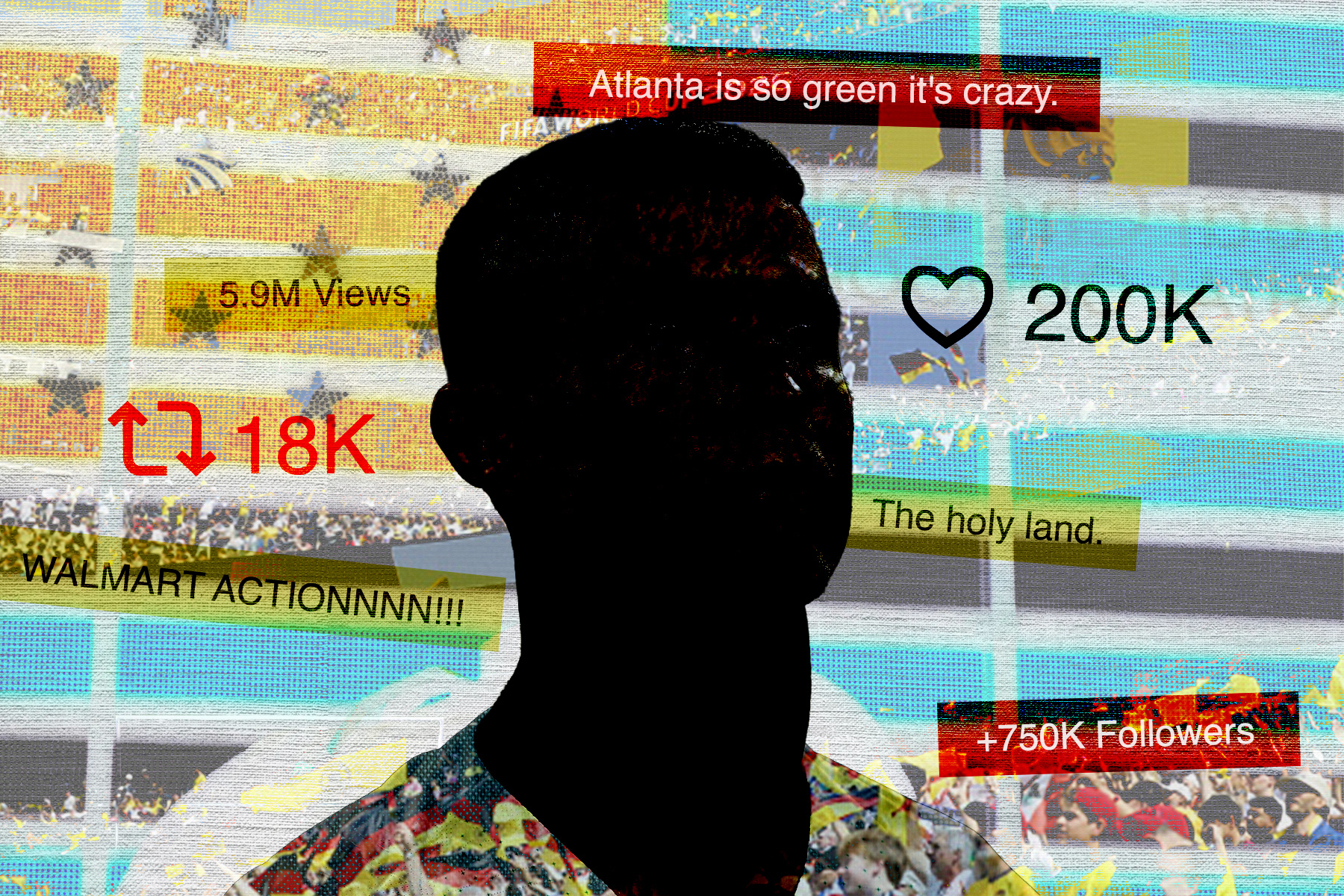
The legitimacy debate has come to a head this summer amid Knicks championship fanfare, Wired music-industry exposés and, of course, the 2026 FIFA World Cup. Who’s a real Knicks fan? Whose popularity on the charts is organic? And who the hell is @FreddyLA7?
Since the World Cup kicked off on June 11, the internet has been gifted a tidal wave of content from foreign fans who are experiencing ordinary American life and finding it to be extraordinary: breaking bread at Waffle House, blasting Avicii on the open road, “discovering” ranch. It’s the little things, really. The algorithm eagerly latched onto these displays of cultural exchange around all of North America and promptly filed them under the hopecore tab. Compilations backed by heartfelt soundtracks flooded feeds and comments sections filled with reactions along the lines of “This is the America I was promised as a child.” And it’s true. Social media the first two weeks of June was basically that graphic of children circling the world holding hands.
Much of the positivity was circulating around one specific account: @FreddyLA7, a German soccer fan who arrived in America for the World Cup and took to X to document his roadtrip. From a semi-anonymous account featuring a Cristiano Ronaldo profile picture, he shared his childlike wonder of American biomes, the sheer scale of Walmart and the “holy land” (that is, Taco Bell). About two weeks after his arrival in the States, he had not only garnered hundreds of thousands of followers, but also a private NASA tour and even an invitation to the White House. It’s not exactly shocking that the psyop allegations promptly followed.
Freddy began his travels on June 5 in Atlanta, where he tweeted one of my favorite World Cup takes: that American public transit is like a GTA lobby. Fair play. By the time he arrived in Houston on June 14, J.J. Watt had made him up a bed in a luxury hotel suite. Then came the Johnson Space Center tour from astronaut Anne McClain, the Ella Langley concert and the Gordon Ramsay dinner.
Flanked by lighthearted invites to American cultural institutions, the summons from Nick Adams, Trump’s Special Presidential Envoy for American Tourism, Exceptionalism, and Values, stuck out like a red, white and blue thumb. The internet instantly turned on Freddy, from anonymous tweets and Reddit posts to podcast fodder on the Adam Friedland Show and Men in Blazers surmising Freddy was associated in some way, shape or form with the Feds, FIFA marketing or prediction markets. Despite valiant attempts from internet sleuths to verify @FreddyLA7 as a soccer fan account with German origin and pure intentions, the “plant” seed was planted, and that was enough for digital echo chambers to do their thing.

The Best Kit From Every World Cup of the Modern Era
The tournament doesn’t just mint global champions, it’s responsible for some of the best uniforms of all timeFreddy struck a nerve through no fault of his own. He’s an intentionally anonymous individual who had a national narrative thrust upon him, on the country’s semiquincentennial no less, so it became personal. Some equated his whirlwind saga to the American Dream embodied. Other Americans hungry for validation while grappling with the country’s less-than-favorable reputation on the world stage hoped he could do some damage control. Above all, Freddy turned out to be a case study on the voraciousness of digital consumption.
In the early 2010s, going viral meant enjoying 15 seconds of fame on The Ellen DeGeneres Show. It was an event and then it was over. Today, virality looks different. It’s an ecosystem where corporations and institutions can run personified, trend-aligned social media accounts and lurk in comments sections waiting to capitalize on the previously engaged demographic. Undisclosed ad loopholes surface daily, generative AI is integrated on every major platform and bots officially outnumber humans online. A suspicion-based mindset is now cyber street smarts 101 — a digital self-defense, if you will. The learned distrust is a symptom of the internet’s evolution from a democratized frontier separate from the physical world to a boundary-less commercial space deeply embedded in it.
It would be quite the story if we eventually find out Freddy is an employee of the CIA, FIFA or Kalshi. But I believe the answer is less tinfoil hat-y, yet equally calculated. It’s not his fault that cross-sector opportunists saw his virality as a promotional entry point. That’s the thing about engaging in popular spaces online in 2026: anything is potential ad space — even a living, breathing, tweeting German soccer fan. Those critiquing his existence are not all crazy conspiracy theorists. The term “psyop” has simply been adopted as internet shorthand as more users are desperate to label the discomfort around how manufactured digital culture feels. Even if a viral event online is genuine, most are hard-pressed to let their guard down and run the risk of falling for a scam or slop. Calling something a psyop satiates the craving for clear cause and effect, which provides a sense of control amid all the online absurdity.
One Facebook user put it pragmatically: “So Freddy has just reached the third phase of the internet life cycle.” Bingo. The internet fixates on an entity, chews it up, regurgitates it and is inevitably unsatisfied with the result. Freddy made it through to the other side, but at what cost? By June 29, Germany was knocked out of the World Cup by Paraguay; by June 30, Freddy’s X account went dark. He released a statement on Instagram addressing the deactivation of his X account at more than 751,900 followers and clarified it was the plan all along, but cited online toxicity as the catalyst. Initially, the exit did seem like a sensible bow to tie on all of this. But despite passionate attempts on his Instagram Stories to clear up resurfaced tweets, outline payout transparency and declare his time on X as over, his public narrative is somehow still rolling on.
Remember that invitation to D.C. that got lost in the mail? As The Atlantic noted on July 1, “Freddy’s savviest decision may have been to quietly turn down an invitation to the White House.” Yet the same day, Nick Adams took to X to release an official statement declaring Freddy would indeed visit and that political opponents were responsible for his digital excommunication.
“Freddy’s only ‘crime’ was loving America and documenting his travels in a completely non-partisan way,” Adams wrote, while simultaneously sprinkling partisan rhetoric throughout the statement. He reiterated his political posturing in an X article titled “Freddy And The Fight For Freedom,” stating, “The scourge of Leftist hatred, which manifests itself in the form of censorship, denied opportunities, threats, financial retribution, physical violence, and even murder,” was the culprit for Freddy’s disappearance from X. Alas, the anonymous German has been given a crash course in America’s new favorite pastime: political polarization.
Freddy ended up in D.C. on the Fourth. He posted about fireworks and monuments, but there was no trace of Nick Adams or the West Wing. It’s unclear if the White House visit took place, or if it ever will. If it does, the vicious cycle of our attention economy will almost certainly repeat, and it will be harder to find an exit this time. Or perhaps after being conscripted as a faceless pawn, there is no exit. As one online comment read, “Welcome to the internet, enjoy the ride Freddy.”
More Like This

Twice a week, you'll find proven advice and tips, expert interviews, deeply reported features and personal essays on living better — for however long you’re here. Subscribe to Champ now.