

Professional athletes have long maintained a robust love affair with their counterparts in other sports. It’s common to see Lakers at a Dodgers game or golf stars at Wimbledon.
For one, they’re fans, just like us. It’s an easy way to endear themselves to home fans, spend their millions — if they have to pay for anything at all, who knows — or find inspiration in the battles of fellow athletes.
But players also often seem interested in explicitly playing (or practicing) other sports. Whether casual (Odell Beckham Jr. taking batting practice) or semi-professional (Steph Curry’s golf career) I’ve always found this delightful. And little wonder that those clips are so common — these are some of the most competitive people of the planet, many of them former three-sport stars. It’s a point of pride to prove that they can do absolutely anything with their bodies.
Beyond this playful love affair, though, multi-sport practice might have a more tangible purpose: it can help prepare players for the sport they’re actually paid to play. Let’s walk through this growing trend, with some fascinating examples.

Ohtani, Stroud, Djokovic
The Los Angeles Dodgers’ $700m man, Shohei Ohtani, swatted 55 home runs and won his fourth MVP this year. You’d assume someone with such a superhuman blend of size and speed doesn’t need to rely on any training gimmicks…but according to an article from The Athletic, he keeps offbeat props in a “bag of tricks.”
Among them: a cricket bat. “[It’s] a hybrid that had the handle of his typical bat but the wider, flatter barrel of a cricket bat,” the article explains. “He then placed a baseball on a tee and began taking swings. The idea was to emphasize his bat path, keeping a flatter swing through the zone for longer to maximize his thunderous finish.”
His Dodger colleagues watched him tear apart the batting cage with the thing…then watched him hit a triple and a double in an 8-1 drubbing of the Minnesota Twins. Across the clubhouse, meanwhile, Ohtani’s World Series MVP-winning teammate Yoshinobu Yamamoto is famous for throwing a piece of track and field equipment — a “training javelin” — in order to prepare for his starts on the mound.
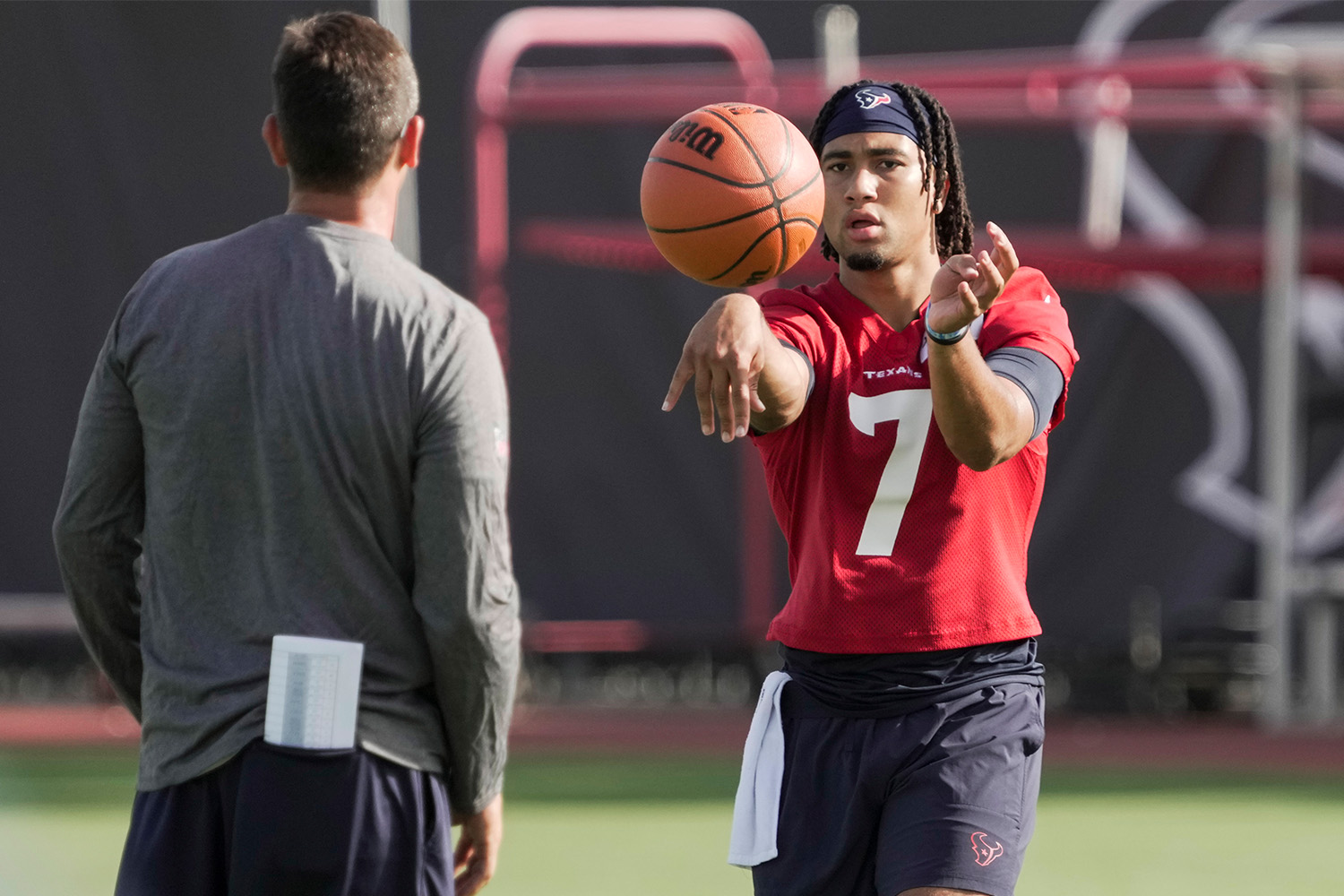
In a different league entirely, Houston Texans quarterback C.J. Stroud made waves during his torrid rookie campaign (throwing for 4,108 yards), for his irregular pre-game routine. He practiced shooting free throws with a basketball, and swung the Orange Whip trainer, a flexible club that’s popular on the PGA Tour.
Throughout a variety of leagues, it isn’t uncommon to see players throwing around an American football, or kicking around a conventional soccer ball. When our tennis correspondent visited Indian Wells last year, in fact, he spotted Novak Djokovic and one-time world no. 3 Stefanos Tsitsipas playing pick-up soccer.
Staying Loose
There is a method to this multi-sport madness. Some players are trying to train a niche skill or attribute. In the case of Ohtani and the cricket bat, an offbeat tool is being used for a specific endgame: flatten the swing.
But many others are sourcing unconventional equipment in order to take advantage of their bodies’ full capacities. According to this Wall Street Journal profile, Yamamoto throws javelins in an effort to warm his entire body — “not just his shoulder and arm.” And in an analysis of the Stroud warm-up video, one broadcaster said: “Drew Brees and Philip Rivers [always] talked about throwing with every fiber of your being.”
In other words: if you’re going to throw, swing or kick something — and do so with power and without injury — it really helps to feel loose and lithe. Warming up, as the phrase suggests, means increasing muscle temperature and blood flow, which aids in oxygen deliver and elasticity. And it helps to have every muscle available and at the ready, considering sports compel wildly unpredictable plays.
In that vein, this sort of work also trains the nervous system, improving reaction time and kinesthesia. Players have long described “blacking out” during competition — their instincts take over and they produce a highlight they’ve never done before (let alone practiced). If you can “train” for these highlights at all, it’s through irregular drilling, by catching or hucking equipment of all shapes and sizes.
And finally, this sort of thing is just fun, isn’t it? Athletes need their brains as relaxed and loose as their muscles. Playing a sport is a job, but if it starts to feel like a chore, they’re probably not going to play as well. Next time you see your favorite player trying their hand at a different sport in your social feed, don’t fret. It could be just what they need.
More Like This

Twice a week, you'll find guinea pig features, personal essays and expert interviews on living better — for however long you’re here. Subscribe to Champ now.