
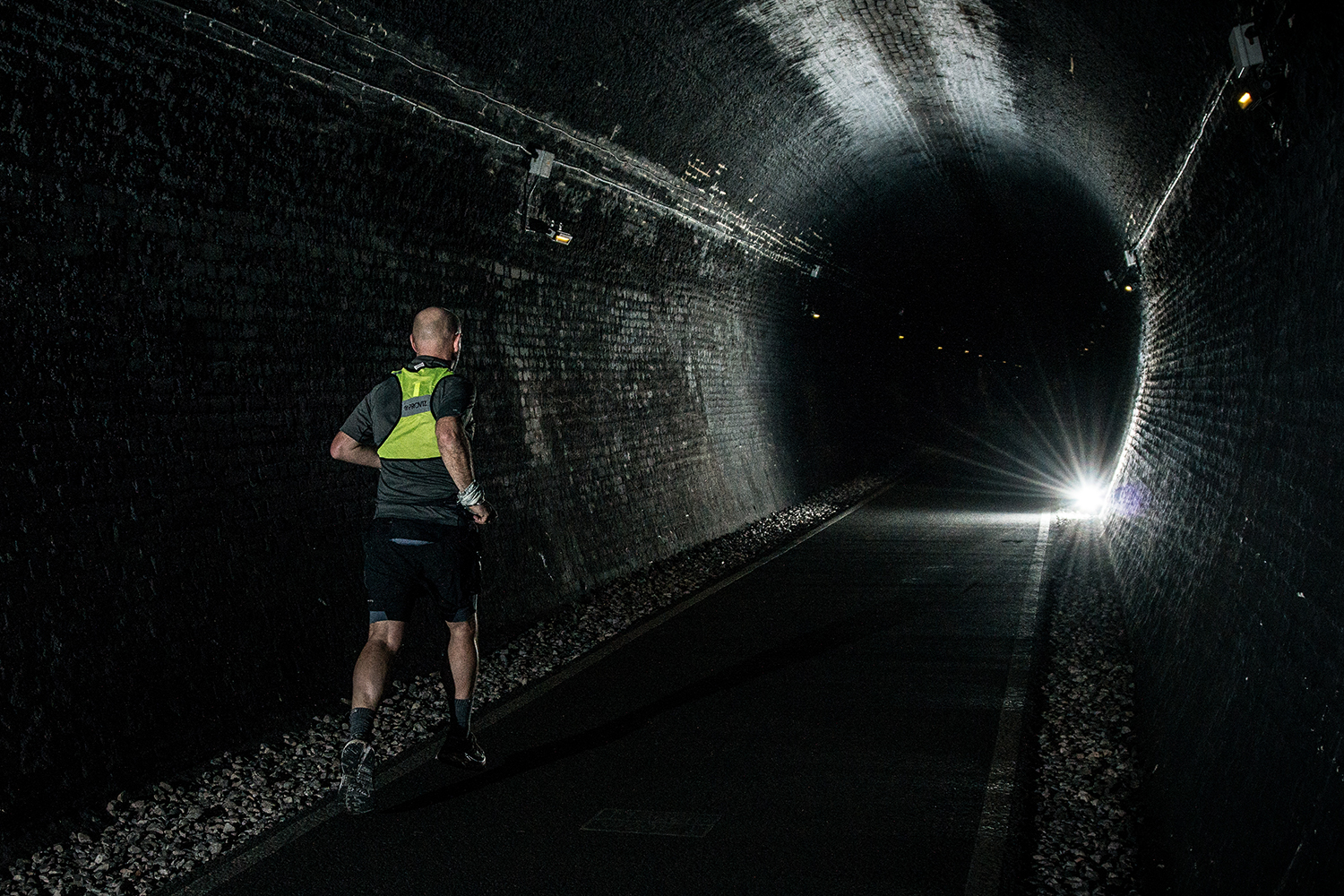
The first time Agnes Kaminska ran “The Tunnel,” her legs hurt so much that she screamed when she stopped. But she finished. The third year, she dropped out after hallucinating lights flashing on the walls. This year, she returned, becoming just one of eight to complete the 200-mile subterranean ultramarathon, and the only woman to cross the finish line.
“It’s a very special place for me,” says Kaminska, who lives in the South West of England. “The Tunnel teaches you things.”
Every March, a handful of dauntless runners attempt 100 “out and backs” through the grotty, mile-long, moss-covered Combe Down Tunnel in Bath. It’s the longest ultramarathon run almost entirely underground; it has a 55-hour cutoff; and it is, by all accounts, a brutal experience. Not only are you devoid of light other than a headlamp, but headphones are banned and there are no way stations. For 200 miles, it’s just you and your thoughts alone in the dark. Your mind will suffer. You will hallucinate. And you will question your very reason for existing.
Organizer Mark Cockbain, himself a former ultrarunner who set up the event in 2019, has a warning for anyone who thinks they’re up for it. “This is a very low key, no nonsense extreme test of running ability and endurance,” he writes on the event’s website. “THIS IS NOT A SEE HOW FAR YOU CAN GET IN 55 HOURS EVENT (you will be timed out if not at 100 miles in 27:30).”
As per Cockbain’s rules, you’ll need to have completed at least one 100-miler to qualify. Should you win a place, you’ll pay $360 for the pleasure of taking part. There is no mollycoddling or chill-out area, just a fold-up table outside of the tunnel entrance. You’ll need to bring your own comforts, and be happy sharing a single portable toilet. Water, tea and the British staple of Pot Noodles are all you can expect in the way of hospitality.
“I cut back on delicacies,” Cockbain once told the BBC. “You can get through any of these races with a bit of water and food. I wanted to make it all about the running.” Rather than flashy Instagram race pics, Cockbain seems interested in separating the wheat from the chaff, the diehards from the blowhards. The finish rate is not high. Thirty one men and women went into the Tunnel that first year. Only two completed it.

Into the Dark
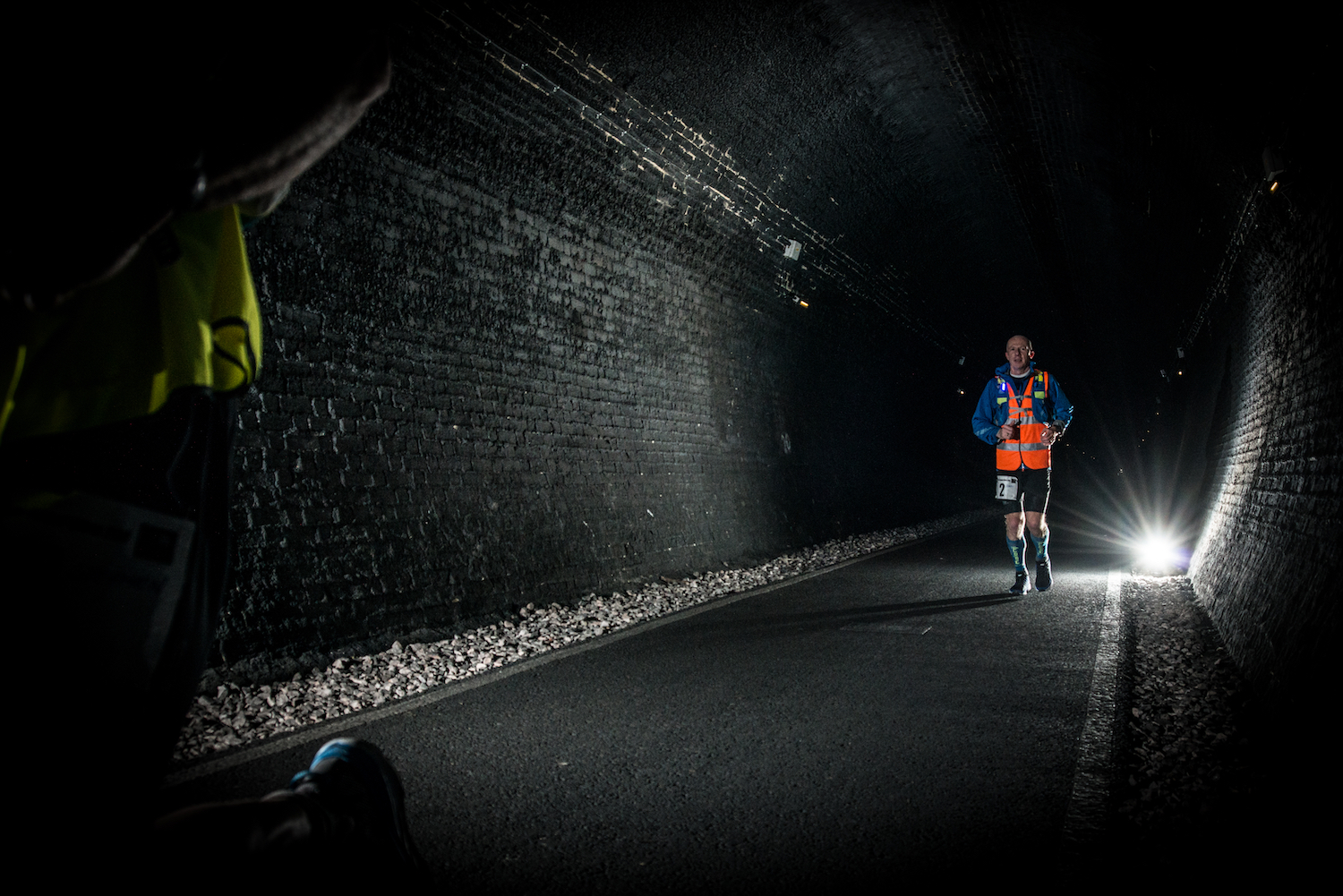
The first thing to know is that the Tunnel is flat, and while there is low lighting in effect most of the time — extremely low, reportedly to protect the tunnel’s bat population — the hours of 11 p.m. to 5 a.m. will see you run in pitch blackness. Because it isn’t an A to B race, you’re running the same, slightly-longer-than-one-mile stretch of tunnel over, and over, and over until you drop down, or cross the finish line. Because of the narrowness of the tunnel, runners start out in single file. There is no conversation, and they quickly get separated by distance anyway.
“There isn’t much to see or hear. You’re just up and down the same stretch of tunnel,” Kaminska says. “There was this art project playing music over speakers for pedestrians in the middle of the tunnel. It was very spooky — it sort of sounded like cats being strangled — but it let you know you’d reached the halfway point each time.”
There’s also a bend just before the end of the tunnel going in one direction. As Kaminska says, many runners have taken a Did Not Finish (DNF) due to the psychological strain of repeatedly thinking they’re nearing the end of one “lap” only to turn a corner and find they still have more dark tunnel to do. “Mark’s events are exceptionally hard,” she says. “It’s you, the tunnel and your thoughts.” By the time the event enters its second night, Kaminska says your brain constantly questions why you’re there. “You have to have a strong reason for doing this, otherwise you talk yourself away from the tunnel.”
“On any other run, you’d use different senses to distract yourself. You’d look around, see the view. But in the dark there is no hiding place.”
– Colin Searle, Who Completed The Tunnel in 2026
For Ian Luker, his “why” became stronger than ever after his daughter, Ani Rose, was born without a heartbeat and passed away in 2010. He started running ultras in 2022; this year was his first Tunnel. Despite the brutal reputation of the race, he chose to look on the bright side. “There’s no rain in a tunnel and you’re only ever one mile from the toilet,” he says.
On March 6, Luker set off with everyone else at 3:30 in the afternoon. Fueling with roughly 80 grams of carbohydrates per hour, he envisioned the race as 10 sets of 20 miles to make it seem manageable. It was going well until he caught his foot on a lump of concrete 60 miles in, suffering a tibialis injury. “With 36 hours still to go, I was preparing to DNF,” he says. He made peace with this, but thanks to a long break, some acetaminophen and some tape, he was back at it, pushing through 140 more miles.
By the second night, the hallucinations began, the walls of the tunnel changing from black bricks to sandstone carved with monkeys, trees, turtles and horses. “They kept my mind occupied, at least,” he says. “People don’t tend to train the mental side. That’s what usually ends people’s race. If you don’t like the dark, or your own company, or are claustrophobic, it’s probably not the event for you.”
Spurred on by thoughts of Ani and his wife Helen, he limped over the line in 50:56 — in second place, no less.
Back for More
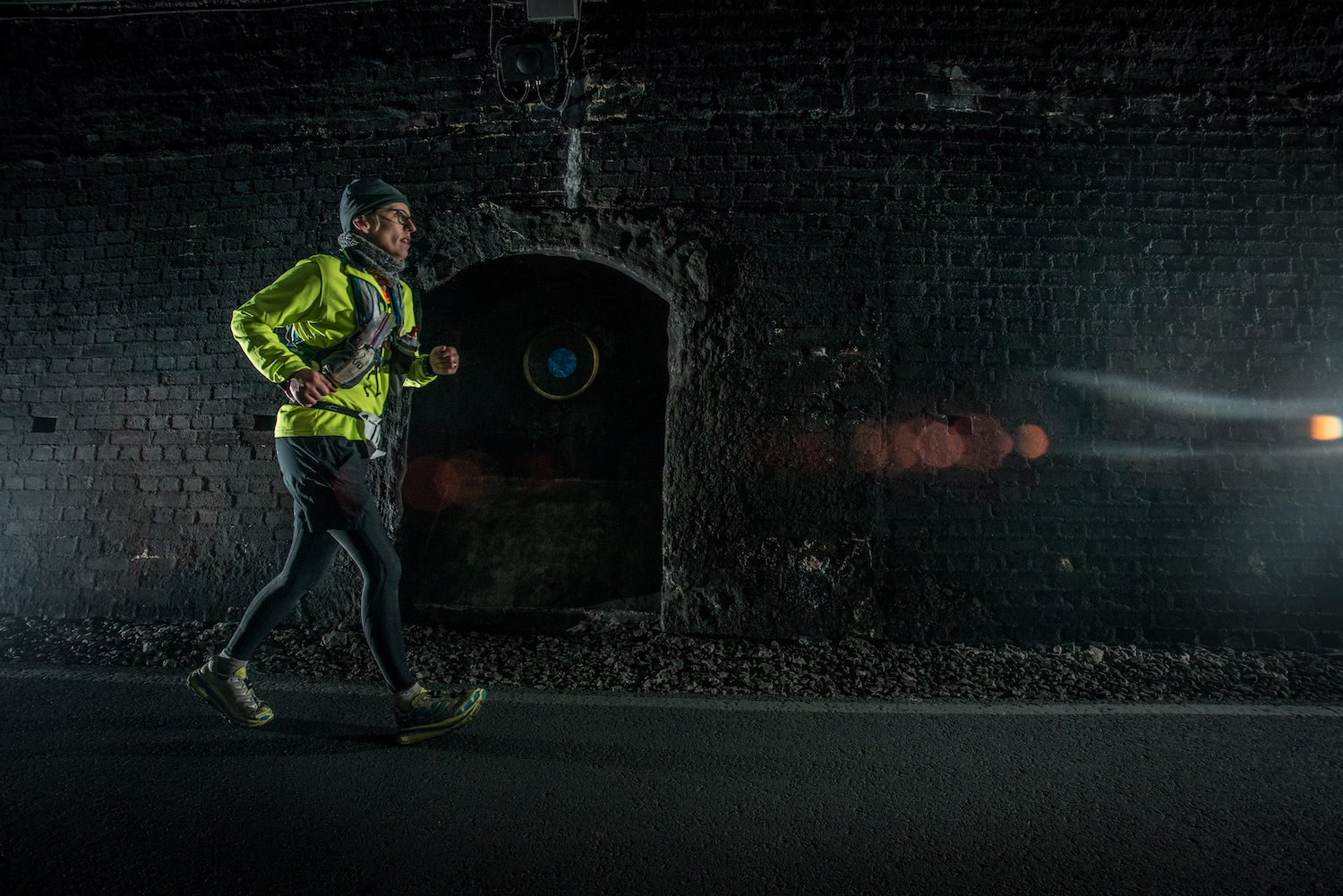
The finishers agree that the sensory deprivation and the images your mind makes to fill the darkness are the hardest part of the run. “I always felt in control of my mind, but you can see other runners completely lose it in there,” says Scotsman Martin Heggie, a 36-year-old runner who has completed over 30 ultramarathons but DNF’d 158 miles into his first Tunnel in 2025.
Returning in 2026, he dropped all other races from his calendar and spent six months running up and down a one-mile stretch of path near his home to prepare. “It’s mostly a race of problem solving: blisters, chaffing, GI distress, nausea, fatigue,” he says. Heggie turned up with a 50-liter box with his race fuel, a sleeping bag and mat, and three pairs of trainers. He says having no crew means a lot of faff time whenever he needed anything from his bag, especially in the dark. This year he finished in 54:49, eighth place, just over 10 minutes before the race cutoff. “It’s like no other race in the world. It almost feels like a dream after you have completed it,” he says, praising the sense of community and encouragement between runners.
For Colin Searle, a 59-year-old runner from Essex, this year’s Tunnel was his second attempt after a DNF at 132 miles in 2025 following bursitis, a painful inflammation of the fluid-filled sacks at our joints, on his hip at 110 miles in. This year, he finished third. He also had a pretty big “why.” “Having watched my stepdad, Brian, die just a few days before the race, I really didn’t know if I had the mental strength to do it,” he says.
He decided it was worth giving it a shot. Also dealing with a groin injury, he started slow, eating lots of calories to protect his body. He started at the back, averaging a top speed of four miles per hour and using a run-walk policy. He managed the first 50 miles in 12 hours. “It takes guts to go slow, because you feel so far behind everyone else who are continually overtaking you on such a small course,” he says. “I kept telling myself that it’s me versus the course, to just do my race.”

Inside Scotland’s Most Beautiful (and Brutal) Trail Race
The Highland Ultra is a 78-mile odyssey through rugged terrain — and ends with a pint at Great Britain’s most remote pubHe tried to keep his pace consistent, living on liquids and salt tablets for the next 50 miles. Calls with his wife didn’t exactly keep morale up — they were both feeling sad after Brian’s death — but they did keep Searle on track. “I was thinking of Brian a lot, and when in pain, I told myself that this wasn’t pain compared to what I had seen those few days before.”
Barring a few issues with his left small toe, the first 100 miles went largely to plan, and hallucination free. “I didn’t feel great but I wasn’t broken,” Searle says. He describes the other runners as “a tunnel mostly full of zombies moving slowly along all trying desperately to finish.” Around 2 a.m, Searle realized he was running in a huge pirate ship, and that the white road markings in the tunnel had incredibly complicated designs of small dogs tattooed on it.
He struggled on until he was down to the last 20 laps. “I had such deep, deep pain in both lower legs,” he says. A brief chat with Heggie spurred him on, but also confused him; so many people were moving faster than him, but seemed to have fewer laps under their belt. Perhaps they’d rested when he’d pushed on? With two laps left, Searle says his mind — knowing he would finish — handed the reins back to his body, leaving him to deal with the pain in his legs. He finished in 51 hours and 45 minutes, in third place. His main takeaway? “You can’t hide from the pain.”
“On any other run, you’d use different senses to distract yourself. You’d look around, see the view,” he says. “But in the dark there is no hiding place.”

“You Will Become Stronger”
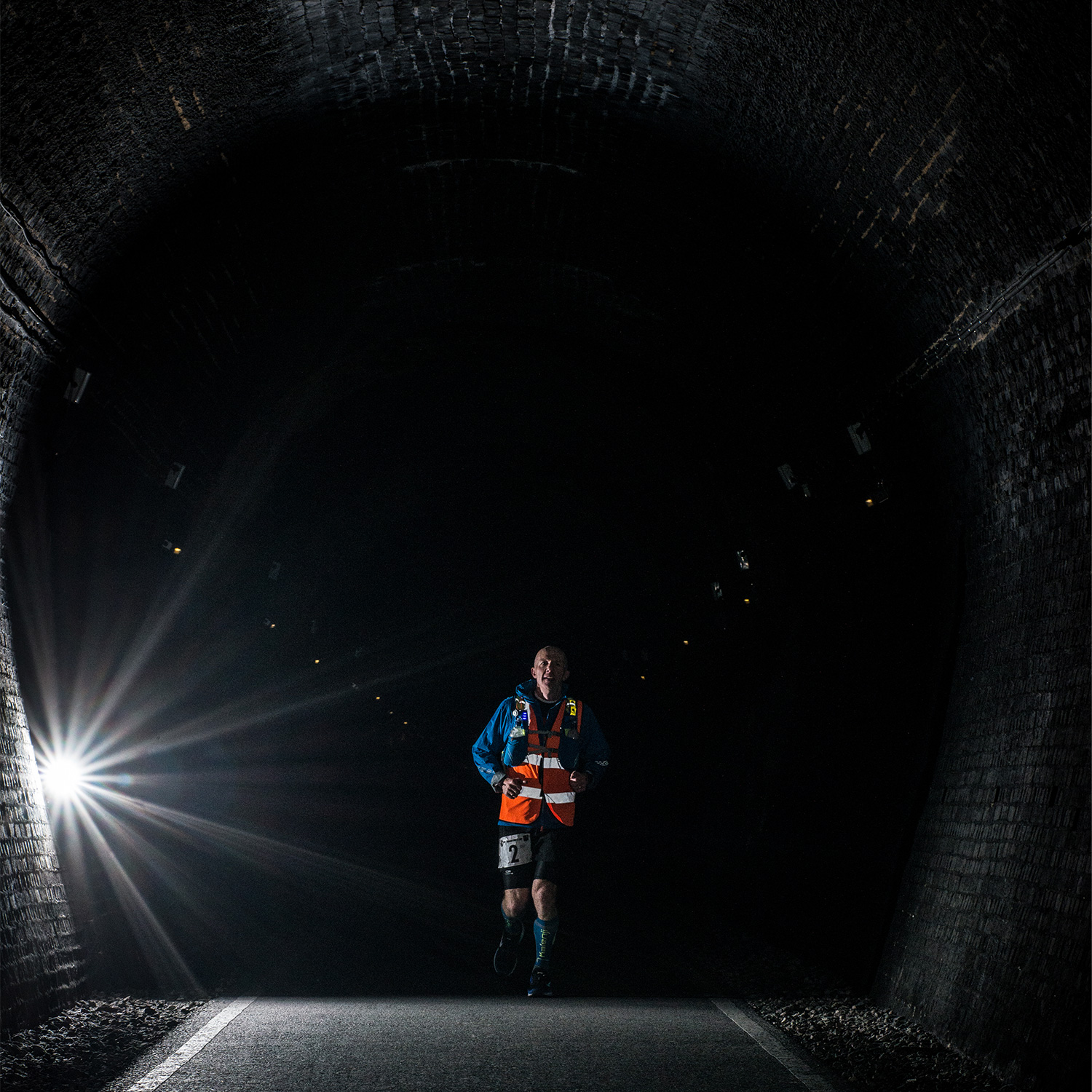
Kaminska plans to sit out The Tunnel in 2027. When she started four years ago, an email to Cockbain was enough to bag a place. Now, the race has grown exponentially with hundreds of runners applying each year. Holding a place when she’s already competed four times doesn’t sit right with her, but she’ll be back eventually.
“Mark has made this community of crazy runners,” she says. “The type of runners who don’t say ‘This is crazy, why would you do it?’ but ‘How can we do it?’”
Her advice to runners asking exactly that question? Put the miles in, and get used to being in your own company, with just the pictures dancing in the dark to occupy you.
“Even if you don’t come back with a medal and a T-shirt, you bring this knowledge, this feedback about yourself back from the Tunnel,” she says. “If you act on what you learn, you will become stronger.”
More Like This



Twice a week, you'll find proven advice and tips, expert interviews, deeply reported features and personal essays on living better — for however long you’re here. Subscribe to Champ now.