
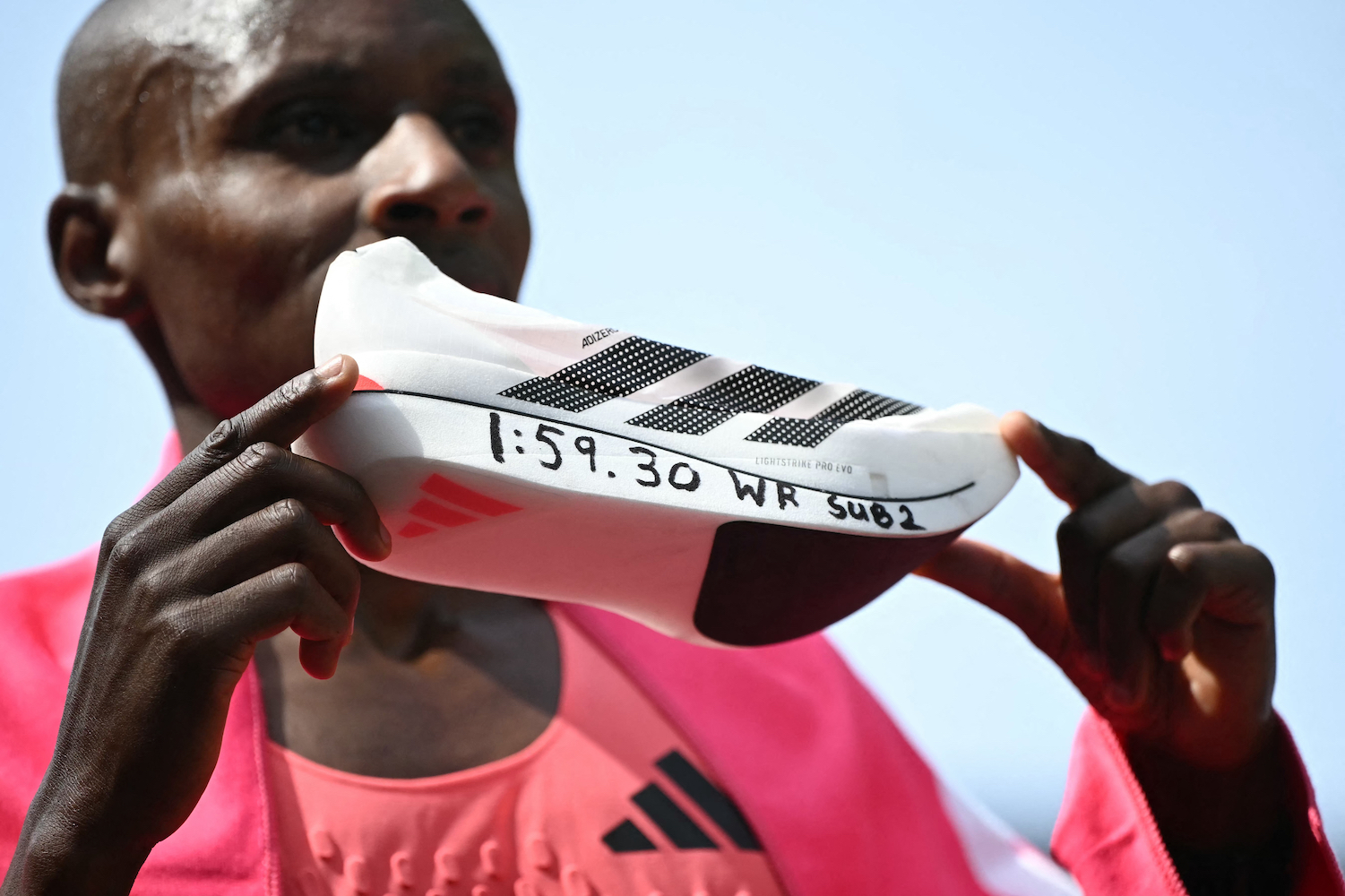
Last Sunday in London was an all-timer in running history. I don’t think it’s hyperbole to place it right next to May 6, 1954, when about 60 miles to the northwest, a 25-year-old medical student named Roger Bannister broke the four-minute-mile barrier. In case you somehow missed the recent feat, Kenyan Sabastian Sawe set a new world record in the marathon, running an unfathomable 1:59:30. And not far behind him — in his debut at the distance — was the Ethiopian Yomif Kejelcha, who finished in 1:59:41.
Quick rewind here to the late 2010s, when marathon legend Eliud Kipchoge attempted to break the two-hour mark in two separate events. First came Nike’s Breaking2 project: Kipchoge and other top runners ran loops of Italy’s Monza circuit; he got the closest, but fell short by 25 seconds. Later, there was the Ineos 1:59 Challenge, a mad dash along a flat and fast course in Vienna. This event was designed for Kipchoge alone; pacers subbed in and out of a chevron formation, to reduce wind resistance, and he raced to a 1:59:40. The mark went unratified by World Athletics because it wasn’t a recognized race and he received assistance along the way. Even still, the running world was left dizzy by the achievement.
Seven years later, there shouldn’t be any asterisks for the efforts of Sawe and Kejelcha. Their performances occurred in the middle of the largest marathon ever. Still, the nitpicking discourse has begun anyway.
Some are asking, “Is it the shoes?” (Both runners raced in the Adidas Adios Pro Evo 3, a foamy, carbon-plated super shoe lighter than a deck of cards. (Tigst Assefa, winner of the women’s race, also wore the shoes.) Others are wondering, “Is it the sugar?” (Elite runners now suck down unprecedented amounts of carbohydrate fuel on race day and in training in order to optimize their guts; Sawe works with Swedish nutrition company Maurten.)
These advancements have revolutionized endurance sports, no doubt about it — Tour de France riders are also all over gut training — and put untouchable barriers firmly in play. But that line of thinking also feels reductive to me, a little uninspired. Why must we have ready-cooked excuses to explain record-breaking performances? Is it fatigue from years of performance-enhancing drug headlines? (Both Sawe and Kejelcha observe rigorous drug testing.) I wonder if we’ve become somewhat jaded to the triumph of old-fashioned willpower.

The Scene at the Super Bowl of Trail Running
Cowbells, headlamps and fondue: We spent a wild week in Chamonix spectating the apex of the red-hot sportWhen Bannister ran a sub-four mile, he triggered what wellness writer Steve Magness called the belief effect. “John Landy got under the mark just 46 days later,” he wrote. “The next year 3 more men got under. And within 2.5 years, there were 10 runner who were now sub-4 milers.” Three of those men actually trained with Bannister. “When we see someone we train with (or have competed against) who isn’t too dissimilar from us do something that once seemed crazy, we start to think, ‘If he or she can, why not me?’”
In other words, I wouldn’t be surprised if Sawe’s countrymen in the Rift Valley, or Kejelcha’s fellow distance phenoms in Addis Ababa, begin to see the sub-two marathon as an attainable mark within their own careers, maybe even inevitable. (Sawe himself said he could run much faster.) There are so many other factors at play on race day, obviously — health, luck and tailwind to name a few — but self-belief deserves a spotlight here, right alongside shoes and sugar.
If we can marvel at their grit, maybe we can marvel at their talent, too. This is an unscientific metric, but I’m likely a top 5-10% runner in the world. (I finished top 2% when I ran the New York City Marathon a few years ago. Thousands of other runners would’ve beaten me had they been there that day.) Anyway, yesterday I went to the track and tried to sustain Sawe and Kejelcha’s pace for as long as possible. I made it two laps and change. Two. Laps. And. Change. A full marathon on a track would be 105.5 laps! The mile pace they averaged for 26.2 (4:33) is faster than my fastest-ever mile by two seconds.
The fuel is turning into rocket fuel and the shoes will be light as a USB stick one day. But for now and hopefully forever, running remains a thing that humans do, with their legs and their lungs and their brains. April 26, 2026 was one of the greatest days in that tradition. No asterisks.
More Like This



Twice a week, you'll find guinea pig features, personal essays and expert interviews on living better — for however long you’re here. Subscribe to Champ now.