
Who should be more stressed about getting a good night’s sleep tonight: a project manager with a 9 a.m. presentation, or an Olympian who will be launching their body 60 feet into the air, desperate to land a trick they’ve spent four years perfecting?
Most sane people would say the latter. In practice, it’s usually the former. The overwhelming majority of Americans deal with stress-disrupted sleep. We toss and turn, anxious about how crucial tonight’s rest is for tomorrow’s performance. And that anxiety becomes cyclical: every time a deadline inches closes on the calendar, it’s the same vicious song and dance.
Research shows Olympians worry about sleep, too. They’re only human. The difference is they have a game plan for that anxiety — one they repeat consistently, whether the next day brings a medal event or just another training run. They use visualization techniques, lean on tech (within reason) and learn to fall asleep anywhere, even on the Olympic Village’s infamous mattresses.
Here’s the good news for ordinary Americans: sleep isn’t an extreme sport. Hell will freeze over before the average project manager lands Ilia Malinin’s one-foot backflip, but anyone can borrow from his sleep routine. Here are some of Team U.S.A.’s best wind-down habits.
1. Try Some Rhythmic Breathing
Who: Julia Kern, cross-country skier
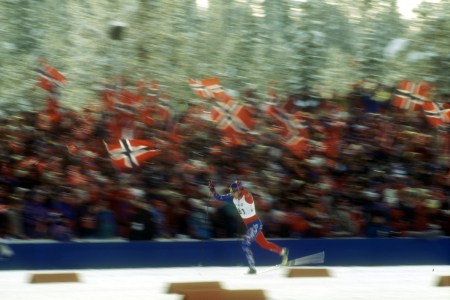
Why it works: The 28-year-old finished sixth in the sport’s classic sprint category, a big step for Team U.S.A., considering Scandinavia’s dominance in the sport. Kern told The New York Times that she regularly practices box breathing in order to calm down at the end of the day. It specifically helps her stop “replaying races” in her head.
The method involves inhaling for four seconds, holding for four, exhaling for four, then holding for four, repeated on a loop. It’s a proven stress-reliever, and popular with Navy SEALs.
2. Take Your Reliables on the Road
Who: Hilary Knight, ice hockey captain
Why it works: Knight is one of countless Olympians who’s environment-proofed her sleep routine. She informed Bustle that she always packs melatonin, and winds down by listening to a book on Audible, which came in extra handy on a “17-day road trip where we were in different locations a lot.”
Other competitors report bringing personal pillows, humidifiers, white-noise machines. Big-air skiing sensation Eileen Gu applies the same mindset to nutrition; she brought her own rice cooker to Milan. And the true king of these games, Norway’s Johannes Klaebo (now with nine gold medals to his name), brings a console so he can unwind with Battlefield each night. “It’s a great way to switch your mind off,” he said.

Meet the VO2 Max Kings of the Winter Olympics
Nordic skiing turns lungs into super engines — these athletes can out-breathe anyone on Earth3. Stop Wearing a Sleep Tracker
Who: Tess Johnson, freestyle moguls skier
Why it works: The Vail-born mogul specialist is skeptical of sleep tech after experimenting with trackers for a stretch. Johnson grew weary of “waking up and being told I slept poorly when actually I felt fine.” It’s a sentiment that has slowly crept through the wellness world, after years of unchecked positivity for companies like Oura and WHOOP. Their wearables are really useful, but can trigger a “nocebo effect,” which compounds sleep anxiety.
Johnson is Team U.S.A.’s analog hero, and not just for eschewing sleep trackers. She also journals twice daily, even carving out time to write before her big races, saying, “It’s a way to stay present and get off my phone from time to time.”
4. Recharge With Well-Placed Naps
Who: Chloe Kim, snowboarder
Why it works: “I find I’m a lot moodier when I don’t sleep well,” the 25-year-old snowboarding star told USA Today. She has a solution: “On those days I just try to lock myself away and try to get a nap in and try to reset.” This sentiment is shared by figure skater Amber Glenn: “I end up just sleeping whenever I can.”
How long is the perfect power nap? If you’re determined to land on an exact length of time, look to NASA. The agency’s pilots take 26-minute naps, which (according to the research, at least), can improve performance by 34% and alertness by 54%. Countless studies support power naps between 10 and 30 minutes in length. That range is capable of revitalizing the brain and restoring energy, without leading to grogginess.
5. Remove Guilt From the Equation
Who: Ilia Malinin, figure skater
Why it works: The “Quad God” has pulled off one spectacular move after another at these Winter Games. But one of his best occurred off-screen, when he skipped a scheduled practice session in order to rest. According to a story in The Athletic, “[Malinin] chose sleep over getting to the rink early. He arrived fresh. He took the ice feeling revived. Having skated twice in the team event, being fresh mattered. He conserved his energy.”
Chalk up his impunity to his absurd talent, perhaps. (Professional athletes are often fined for sleeping in.) But give him credit for knowing his body needed more sleep and going for it, internal guilt or external judgment be damned.
6. Don’t Fixate on the 8-Hour Mark
Who: Team U.S.A.
Why it works: The United States Olympic & Paralympic Committee (USOPC) came into these Olympics prepared to alleviate its athletes’ sleep anxieties, releasing literature from a team of clinicians and service providers. There’s some great advice in there on caffeine timing and adjusting to jet lag, plus a bit of myth-busting. Myth #1: Athletes need eight hours of sleep to perform their best.
The USOPC points out that sleep duration is only part of the story. There’s also sleep latency (how quickly you fell asleep) and whether or not you woke up in the night, not to mention nutrition, hydration and your emotional well-being before and after that single sleep. “[O]ne night of poor sleep is rarely enough to derail your performance when you have adrenaline on your side and good sleep banked from prior nights.” As Swedish IndyCar driver Marcus Ericsson once told InsideHook, “I try to get eight hours of sleep, but as long as I get six I’m in a good place.”
7. Make Sure You Love Your Mattress
Who: Team U.S.A.
Why it works: Team U.S.A. partnered with Saatva, the bedding brand, to provide all American athletes with a personal mattress topper. They’re taking no chances, which is the right call — Olympic Villages have a notorious history of making sleep a lot harder than it needs to be.
We’ve long maintained that the right mattress is worth your money. You’ll spend a third of your life in it (ideally) and depending on your sleep position, body weight and pain points, it could be of critical importance that you commit to a firm or soft mattress.
More Like This



Twice a week, you'll find proven advice and tips, expert interviews, deeply reported features and personal essays on living better — for however long you’re here. Subscribe to Champ now.