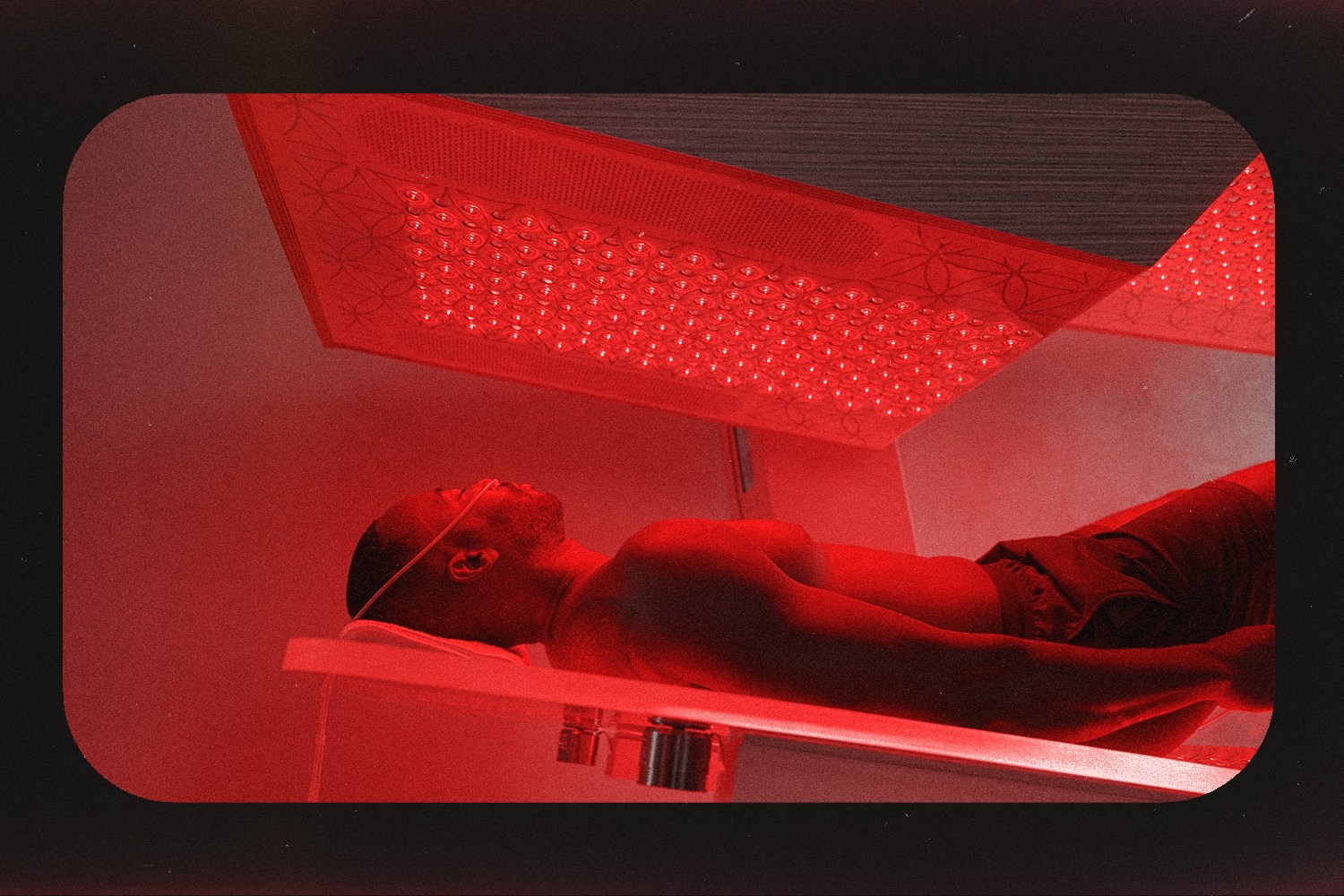
The woman who climbed out of the Ammortal Chamber just before me likened the experience to getting abducted by aliens. But as I reclined on an acrylic glass bed in a pair of boxer briefs, tubes up my nose, dozens of burning bulbs inches from my cranium, I felt like I was the alien. I imagined a scalpel flaying open my chest, a team of scientists waiting to see what might come oozing out.
I’d made my way down to SoHo on a humid Wednesday. On one side of the street, hundreds of bargoers with Union Jack cheeks were celebrating a Jude Bellingham goal. On the other was a converted metal workshop that contained a rumored “human-charging station.” I was booked for 5 p.m.
Part of me wanted to join the crowd. It looked fun. But fun’s been my problem this summer: everyone I’ve ever met is getting married, and in the middle of that my beloved Knicks decided to win the NBA Finals. So I honored my prior commitment — with rare, tangible hope for a full-body factory reset.
Demos like these always make for a more memorable excursion than another pull day at the gym, but I’ve become a weary, wary guinea pig over the years. I no longer expect each fresh wellness innovation to change my life. At my most jaded, I’ll wonder: How different are today’s longevity “experts” from those quacks hawking cholera cures circa 1900?
And yet, the ballyhooed Ammortal Chamber had me daring to dream again. Matthew Stafford, quarterback for the Los Angeles Rams, used one en route to winning an NFL MVP at the creaky age of 37. Shohei Ohtani, the greatest baseball player on the planet, is such a devotee that Japan has clamored for Ammortal, which is based in North Carolina, to start shipping units across the Pacific. The Seahawks brought one to Super Bowl LX and promptly won the game.
I’d wager there will soon be few Division I wellness centers — to say nothing of tech billionaires’ backyards — that won’t have this $169,500 unit within walking distance of the gym.
Inside the Chamber
The Ammortal Chamber I tested out was built into a silver-bullet Airstream trailer. It had a surprisingly uncluttered interior, considering its size. Over half of the camper was just a carpeted waiting area, with little benches and artisanal waters lining the walls.
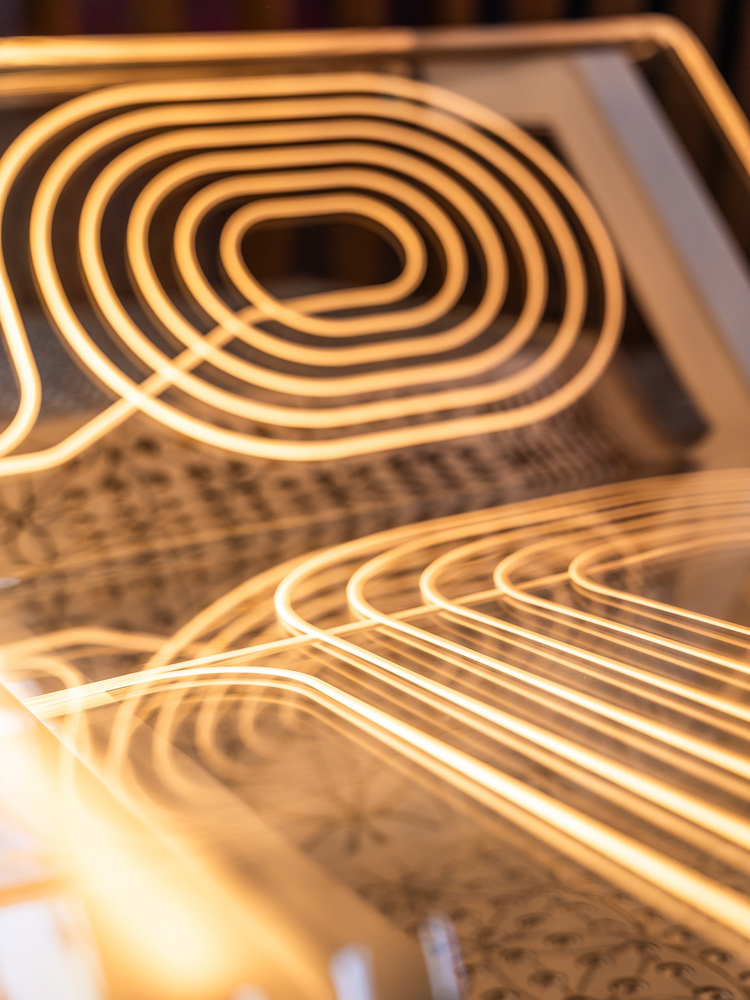
Beyond a privacy curtain on the far end was the main event, a decapitated tanning bed underneath a thick, motorized monitor fitted with hundreds of bulbs — soon to be emanating a fiendish red. After I stripped down to my skivvies, as instructed, and started to feel these lights on my skin, I was reminded of the heat thrown by Broadway’s sidewalk-zapping marquees.
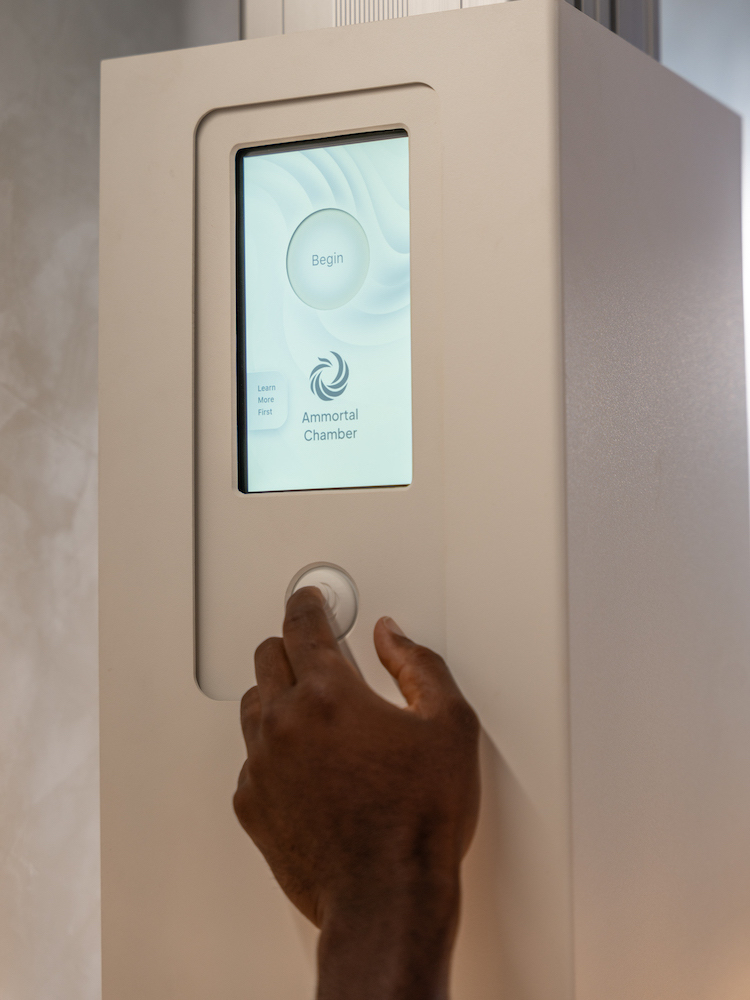
To the left of the bed was a touchpad, which Kenzie, an Ammortal strategist, used to queue up my experience of choice. I opted for Restore (“Healing frequencies help you release tension and emerge feeling renewed and refreshed”) and “female accent” (I was feeling extra dystopian).
After I put a cannula up my nose and goggles over my eyes, Lady Clanker started whispering sweet nothings and the overhead slab descended closer and closer to my chest. This is when I was convinced I’d been suckered into a waking dissection. The carbonite freezing of Han Solo came to mind, so did a Breville panini press. But then I gave myself over to the experience.
Five experiences, actually. This is Ammortal’s big pitch, the reason that elite athletes and executives want units on their patios: a session of just 25 minutes stacks five distinct modalities, including red-light therapy, pulsed electromagnetic field therapy (PEMF), molecular hydrogen inhalation, vibroacoustic sound therapy and guided breathwork meditation.
In other words, it’s like getting run over with recovery. The red (and infrared) lights are meant to support circulation; the PEMF to heal tissue; the hydrogen to reduce inflammation. Then those low-frequency sounds come swooping in to induce a parasympathetic state, which increases the chance of all of this making an impact. (The same could be said for the meditation component.) How legitimate is that impact, though?

The Gospel of Contrast Bathing
Sauna, ice bath, repeat. Here’s how the wellness world got obsessed with cycling between hot and cold.Quackery or Cutting Edge?
I’ll give you some boring answers first: each modality has its own encouraging science. But the efficacy of feasting on all of them at the same time needs more research. We can say the Ammortal Chamber is a non-invasive recovery play that’s worth trying; we can’t say yet if it’s the massive game-changer that elite athletes want it to be.
Not that they especially care. “Star athletes don’t have time to wait for the peer-review process,” The New York Times wrote in a story on recovery tech, “so even if some of the benefits are psychosomatic at best, nearly all the players…got a twinkle in their eye at the mention of some particularly beloved recovery toy.”
This, I think, is where a lot of longevity-obsessed executives (and run-club yuppies, and HYROX coeds) are finding themselves these days, too. Life is short, each quarter is busy, races and deadlines loom. In pursuit of performance, they’re willing to try stuff — and eager to believe that it works.
Matthew Stafford, quarterback for the Los Angeles Rams, used [the Ammortal Chamber] en route to winning an NFL MVP at the creaky age of 37 … The Seahawks brought one to Super Bowl LX and promptly won the game.
The all-powerful placebo effect plays a huge role here. But so does presence. By their very nature, recovery methods require you to shift out of fight or flight, to cede control and breathe. Ammortal’s iteration fits the bill; it’s a noisy, tingly whirlabout that disintegrates time. Within minutes I forgot where or who I was and just weathered the ride. I felt like I was encased in a bubble in the middle of a tornado.
In some cases, the Ammortal Chamber is so effective at cultivating relaxation that its patients simply fall asleep. This happened to Tommy Paul, one of the 25 best tennis players in the world, when he tried it for the first time at Wimbledon. “I’m not sure what it does,” he said. “But it felt great.”
Personally, I have a tough time easing into an empty half hour in the year 2026. I often feel like the attention economy’s taken a cheese grater to my brain. I self-medicate with deep work and tough workouts, but over time, this uploads a lot of stress onto my brain and calves. Sometimes it does take a highly staged central-nervous-system intervention to step out of this churn — to properly zoom in on nothing at all, which is usually where the healing begins.
This is how I feel about cold plunges, too, by the way, and why I think the “cold plunges aren’t great for recovery” discourse sort of misses the mark. Maybe the science isn’t so watertight. But what if the practice feels good? What if you head home convinced you’ve reclaimed the juice?
“Decaffeinated Power”
Ammortal has a name for that juice: “decaffeinated power.” When top-tier athletes step into Ammortal days or hours before a game, they typically pick one of the more invigorating journeys, like Expand or Energize, which are scored to pounding drums. Then they sprint into battle, without fear of caffeine jitters (or an eventual crash).
A little science experiment I didn’t plan, but came in handy nonetheless: I entered the Ammortal Chamber with a headache. It was gone when I left. I arrange words for a living, and I was humbled by the disembodied voice in the camper, which ended my experience by describing the exact sensations I’d registered over the last few minutes of my experience. “Most feel a warm mix of profound calm and energetic potential,” she declared.
Yes. For sure. I felt low-key high-key. (This was something I wrote down in my notes; made perfect sense to me at the time.) I left the showroom and walked for an hour around Lower Manhattan, surprised both by my lack of late-day misanthropy and an uncharacteristic Curious George-esque desire to walk in and out of the many shops. I then sat on a stoop on Mott Street and people-watched for a while. No AirPods, no nothing. I felt calm and oddly wise.
I already want to get back to try out the “Hells Bells” version of an Ammortal half hour, ideally in the morning, and on the day of a big writing or running effort. Fortunately, there’s now a unit accepting bookings at 113 Spring St. at $95 for 35 minutes. If you don’t live in New York, check if a fitness center near you has got one. And if you can afford to buy one for your backyard, lucky you. You’ll save a small fortune on coffee.

More Like This
Twice a week, you'll find guinea pig features, personal essays and expert interviews on living better — for however long you’re here. Subscribe to Champ now.