
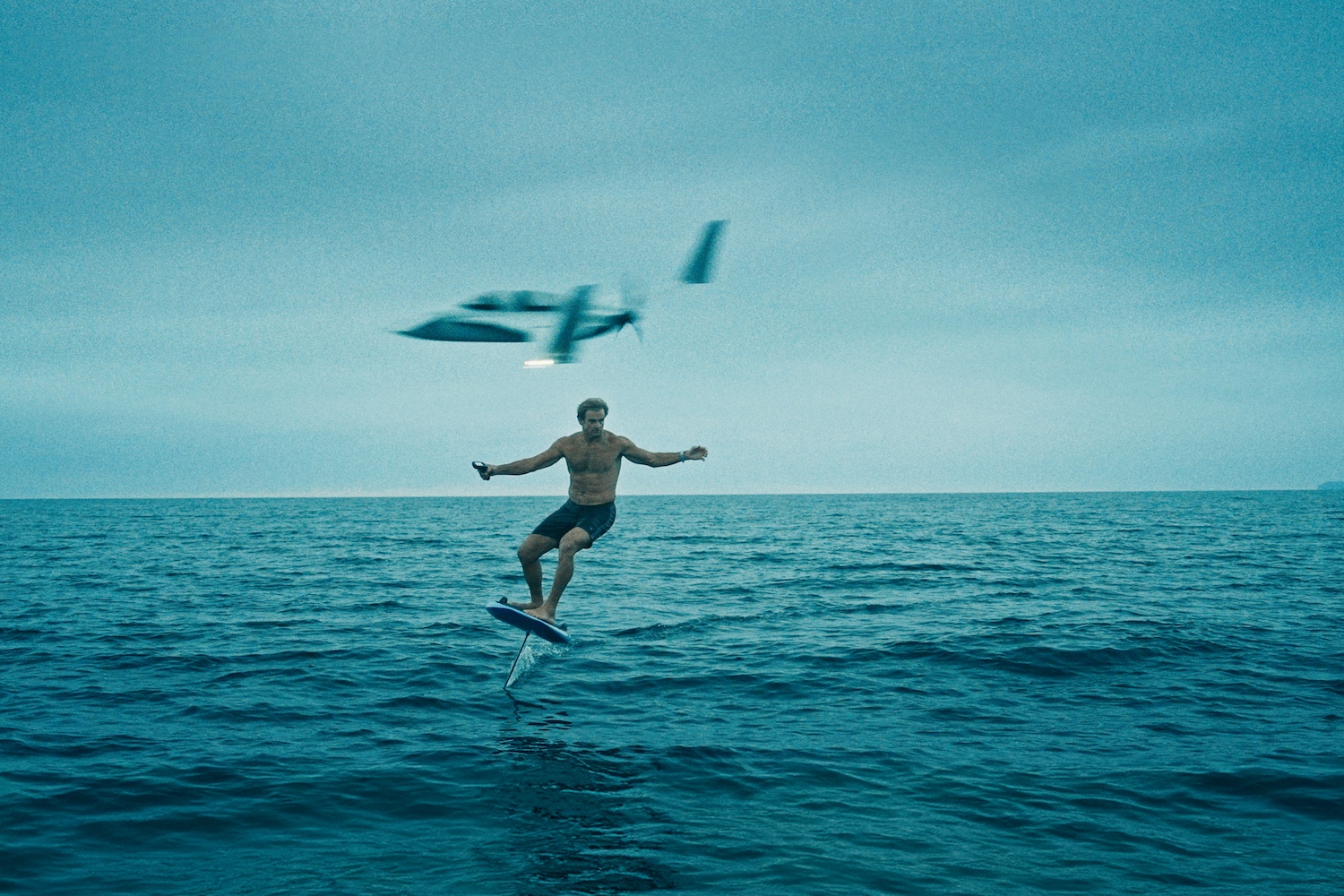
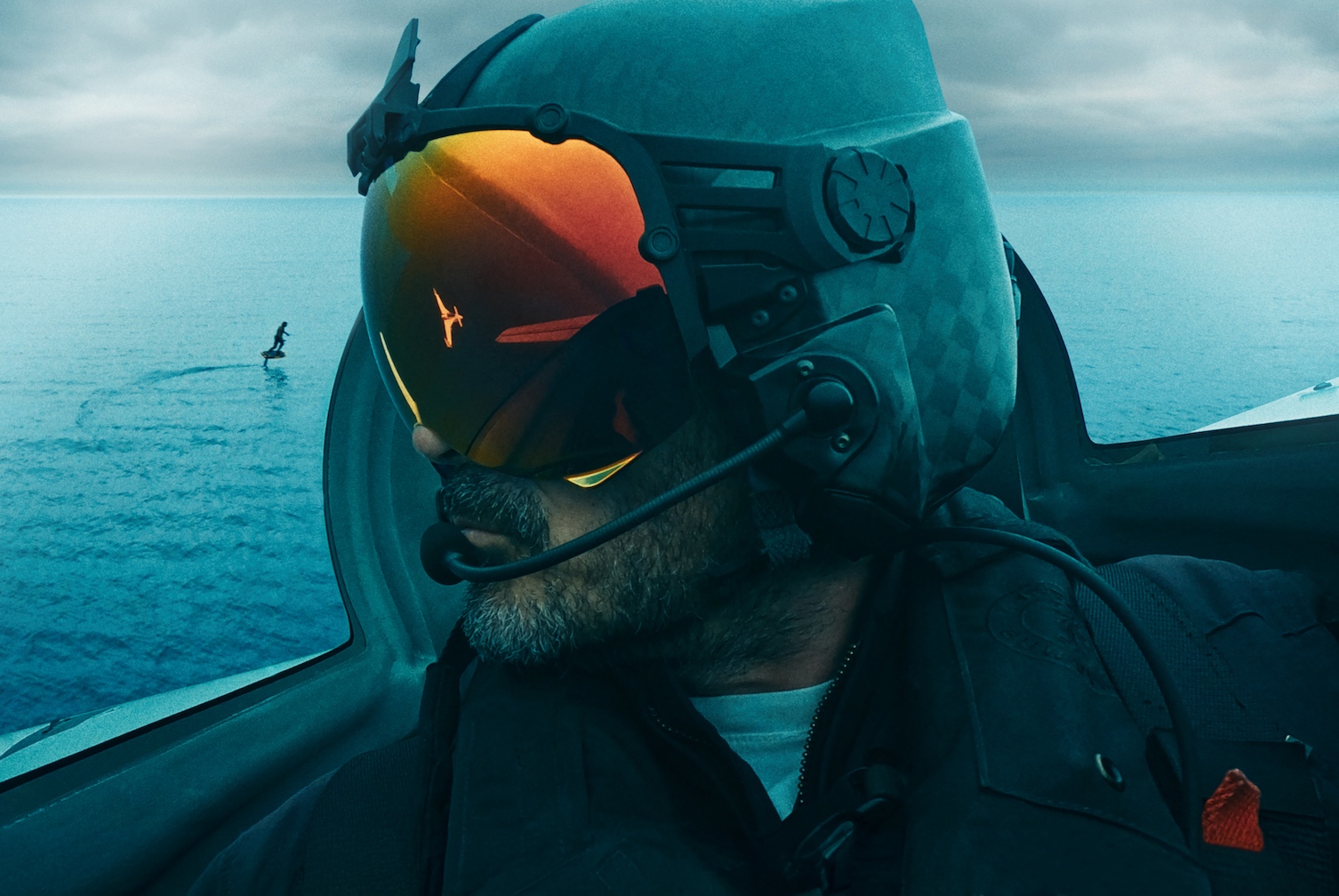
What do a fighter jet pilot and a big wave surfer have in common? The independent short documentary Dawn Ready attempts to provide an answer to that question — and in the process offers a nuanced examination of the philosophy of doing dangerous things.
The award-winning film was written, produced and directed by William and Jennifer Cawley; it stars renowned big wave surfer Laird Hamilton, alongside veteran fighter jet pilot Daniel Robinson.
Both men lead lives of innovation while chasing extremes. For many years, Hamilton has been at the forefront of developing new wave-riding techniques, while chasing larger and larger swells. Robinson transitioned from a career flying some of the most advanced jets in the world to developing augmented reality technologies that will help train new generations of pilots.
We caught up with Hamilton to talk about the film, how he finds his flow state and why “biohacking” is a misleading title.
InsideHook: Tell me about the film. Where did the idea come from?
Laird Hamilton: Well, I have a friend that I work with on Laird Apparel, and he told me about this guy [Daniel Robinson] and what he was doing. I’ve always had a connection with aviation — my mom started a helicopter company when I was a kid, so I grew up kind of around helicopters and aviation.
When we started talking, it seemed like there were some real parallels within our experiences, and that’s really where the idea for the film came from. There are similarities of belief and experience — in Daniel’s case, as a fighter jet pilot, his equipment is obviously a lot more elaborate and takes a lot more infrastructure — but philosophically, I think we have a lot in common.
You and Daniel come from very different, though similarly intense worlds. Was there something you learned from him that shifted your mindset?
I think maybe, if anything, it was a confirmation that you’re not alone in your feelings, that maybe these are just human conditions that arise when you’re put on the edges of any area where there are consequences.
His consequences, getting shot out of the sky, are a lot different than getting held under a wave, but at the end it’s still about survival, and about vulnerability. All those things. Sometimes it’s reassuring when you have people in other fields with whom you share a common through line in your beliefs and in your experiences. I have a tendency to believe that life is a formulaic process — there’s a certain formula to success, there’s a certain formula to doing dangerous things, to failure. It doesn’t really matter the genre — you can find it in a mountain climber, a base jumper, a fighter jet pilot, an extreme snowboarder. Whenever I run into these guys, I find that we have a lot of similarities. I have a lot more in common with someone like Daniel than I do with most surfers, even.
With many of those pursuits you mentioned, there is a conversation around the flow state — and preparing for “go moments.” How do you prepare for them?
It’s lifestyle, for me, partly because my optimal situation is so reliant on nature. It’s not a mountain that’s there, it’s not a plane waiting on a runway. I feel like mine is a bit like the fire department: you don’t know how it’s coming, you don’t know when it’s coming, but you know that it’s coming, and so you better be ready. You might need to be ready tomorrow, and you might need to be ready in six months. Lifestyle is a big part of that — having heart, having spiritual harmony with yourself, having harmony with family and in relationships. Obviously being in shape and taking care of your body. You try to mitigate the things you have control of because there are so many things that you don’t have control of.
Meet the NFL Player Who Flies Planes in His Free Time
Pharaoh Brown is earning his wings — and finding surprising parallels between football and flyingYou’re waiting for a big swell that you can only predict so far in advance. How do you deal with that uncertainty?
I’ve gotten better at what you can call the spaces between the heart beats. I don’t know that I’m good at it yet but I’m better than I was when I was younger. It’s a skill: you learn how to navigate the mundane and the waiting. There are ways of doing it, filling your time by learning or doing things that don’t undermine your performance. That’s been the biggest lesson for me — having faith. It takes a certain amount of faith to know that it’s going to be there at some point, and to do what you need to do in order to take advantage of the opportunity when it does arrive.
When the moment arrives, and you lock in, can it sometimes be a battle to stay in the flow state? What do you do if you feel yourself coming out of it?
As soon as you’re injected in it, because of the time put in and experience, you just shift into that gear and you’re able to go. I mean ultimately, true flow state arrives from a level of experience and expertise that allows you to not have to engage consciously; you’re able to engage subconsciously. A certain level of threat, a certain level of danger, a certain level of consequence, demands that — whether you’re a football player running down the field, knowing someone’s trying to knock your head off, or a race car driver going around a track at 150 mph. Whatever the threat is, it demands a level of disconnect. They say that the unconscious mind moves at 32,000 times the speed of the conscious mind. It’s so much better at reacting and responding once you have the information thoroughly embedded in your psyche.
In the film you talk about fear and your relationship with it. When did you first encounter that fear and push to overcome it?
I think my discomfort started very young because I grew up spending time in a very dangerous ocean. You know if you’re a fighter pilot, you can’t take your fighter jet up when you’re five years old, you don’t have that option. I was really really young when I started to build a relationship with the ocean and develop the skills to help me survive it. Eventually you get to a point where not only do you seek it out on purpose, versus being subjected to it, but you also become better at being in those dangerous moments. I think there is also a certain level of submission.
There is an interesting thing that happens when you slow things down. To make slow motion you actually speed up the film, and the way we create slow motion in stressful situations is by speeding up our assessment. So what would be perceived as slow could be a split second reaction, because you had the time to make that decision or adjustment because the assessment is sped up. There is also an element of that which is a little bit like a muscle, where you can actually strengthen it and get better at that over time. Some of the stuff we do around stress, whether it be overheating or an ice tub or breath work or long endurance things, these are self induced stressful situations that allow you to build the skills to be prepared for the situations that aren’t under your control.

In terms of overcoming fears and seeking out greater risks, you also have to account for the inherent danger. How do you reconcile all of it?
I always say there’s three ways to go about doing dangerous things, right? There’s ignorance, denial and experience.
So, people go in and do dangerous things, and maybe they have a lot of denial, and they have a lot of ignorance and very little skill. Maybe they have a lot of skill, a little bit of ignorance and a little bit of denial. I mean it just seems like those three things are always the major factors. There’s a certain level of denial, that you try not to give certain things traction because in the end they would only be a distraction. It would distract you if you really sat back and consciously assessed all of the dangers. Half of this stuff you probably would never do. You probably wouldn’t get in the cockpit, you probably wouldn’t paddle out. So at a certain point you kind of have to turn that off and ignore it, which I think can be a useful skill.
I think [Daniel and I] have the skill to do that. And without that skill, the species might not even exist. It is an inherent thing that we have. It’s something that we’re either gifted with or cursed with, depending on who you are, and not everybody has it but we don’t need everybody to have it. We just need a few people to have it and be able to do it so that we can overcome things that are much greater than ourselves. Otherwise we would probably have never left the first cave we were in.
In the film, you’re riding a hydrofoil board. What exactly is it, and how does it differ from surfing?
In a way it’s an evolution of surfing. If we think about surfboards, a big breakthrough in surfboard design was the fin. We put a fin on the bottom and that allowed us to control the board. The hydrofoil is just an extension of the fin, where now we’re riding the fin. If you look at the designs, they’re very aerodynamic, almost like airplanes. We’re technically standing on an airplane and riding it through the water.
What that does is it eliminates the biggest drawback of a surfboard: drag. Drag slows you down, but when you allow the board not to touch the water, you eliminate surface tension and eliminate all the friction. You’re kind of set free, and it just opens up a whole new kingdom.
My initial interest in hydrofoil was for riding big waves. I got to a point in my evolution as a big wave rider where I realized that there was a threshold, a barrier, that after a certain size a regular surfboard would not be able to actually descend down a 150-foot wave. My solution for that was to start foiling, and that ended up affecting the way we ride little tiny waves. It allowed us to ride waves at sea. It has opened up a new frontier of what kind of waves are possible to ride. It’s a whole new world for us.
You were so instrumental in pioneering new forms of wave riding like tow-in surfing and standup paddleboarding. Is hydrofoil the direction you see things moving towards? Is there something new coming down the pipe?
I mean if you look at hydrofoiling and board sports in general, you have about seven disciplines within water sports that have all stemmed from hydrofoiling — standup paddle hydrofoiling, prone paddle hydrofoiling, downwind hydrofoiling, electric hydrofoiling, kite hydrofoiling, tow surfing hydrofiling, windsurfers with hydrofils, and they’re doing wakeboard hydrofoiling from behind boats. So in a way, hydrofoils have penetrated every discipline within water sports. For me, I have some other ideas, but I also haven’t exhausted my interest in hydrofoiling yet. I spend most of my time in the water on a hydrofoil, whether it’s electric, on a wave, or being towed in.

Michael Easter on How to Live the “2% Mindset”
The bestselling author of “The Comfort Crisis” names the small, intentional challenges that lead to a stronger body and sharper mindIt seems similar to how, as surfing developed, different fin configurations allowed for greater capabilities. The same thing is happening with hydrofoil — it’s elevating the level of what’s possible.
Absolutely. We go a lot faster, and you’re able to ride non-breaking waves. You can make waves that are unmakeable on a surfboard. You can go into the sea and be out in the middle of the ocean riding swells that are moving much faster. There are so many frontiers within it; it just opens up your mind to so many possibilities, especially in a world where most surf spots are really crowded. It’s another tool in the toolbox, and a very useful tool.
The film showcases some of the interesting approaches you have towards training and using weights in the water. What does your routine look like these days?
This time of year is kind of the pre-season coming into the winter, summer time is usually kind of the peak of the training routines. Around three or four days a week, I’m in the pool, doing a bunch of different kinds of weight and swimming based training.
I have an interesting scale of training where we’ve taken this pool work and kind of flipped it on its head, by using weights underwater and swimming with weights and jumping and lifting in the water. The water-based training is unique because the compression of the water changes your blood flow; the breathholding allows you to work with hypoxia which makes you better at moving in the water. Water also allows you to do some more aggressive things because you’re protected by the lack of gravity. I’m also always doing a bunch of heat training, lifting in the sauna, assault bikes in the sauna, that kind of thing. I do ice work as well, and all kinds of breathwork.
Do you find that the strength training in the water removes a lot of the stress on your joints?
Yeah, because the gravity is not there, you don’t have the momentum that usually causes injury. You can also be more aggressive underwater with load and still be protected. So because of what you can do in the water and the protection it provides, I get a lot of athletes from every different genre that come through here and train with me.
I also have people come out after injuries, and they can start to load or do stuff they wouldn’t be able to do, because of the protection from the water. The pool is one of those magic things — there is something unique and special about water in general, and the kind of work you can do, and the kind of protection you have in that environment, and then ultimately just the exhaustion it provides. I can exhaust myself while also minimizing hurting myself.
For a lot of people, their sport training is their sport, and for me I’m just doing all this stuff so I can keep doing what I really want to do, which is ride big waves.
What are some biohacking protocols that you feel have given you the most benefit?
I think sometimes that term is a bit abused, I think people are trying to hack their way through the work. I think you can’t avoid the work. I think that hacking can support your work, so if you said sauna and cold plunge, I wouldn’t allow those to be considered hacking. If you said hyperbaric chamber and red light beds, those feel more like hacks to me. Then there is grounding and being out in the sun, and good supplementation. All of these things that we had during our evolution or in our past that now we have to hack our way into.
So maybe hacking is a bad title for it?
I think it gets abused because people are trying to figure out how to not have to train hard, or get good food, or good sleep, or spend time in the sunlight. If they were just doing everything the way they should be doing it then there would be no need to “hack” anything. But a lot of it we really are not able to do either because our lifestyles or environments have been changed so much. So hacks are just ways to supplement our systems with the things that we aren’t getting but would be if we were living closer to nature.
It’s trying to strike that balance. I guess that’s what we’re all doing.
It’s a never-ending process, trying to keep the balance. I think that’s what we’re doing, just being alive here every day. Just standing up is balancing. Our whole lives are in pursuit of trying to keep everything in balance — not too far right, not too far left.
More Like This


Twice a week, you'll find guinea pig features, personal essays and expert interviews on living better — for however long you’re here. Subscribe to Champ now.