
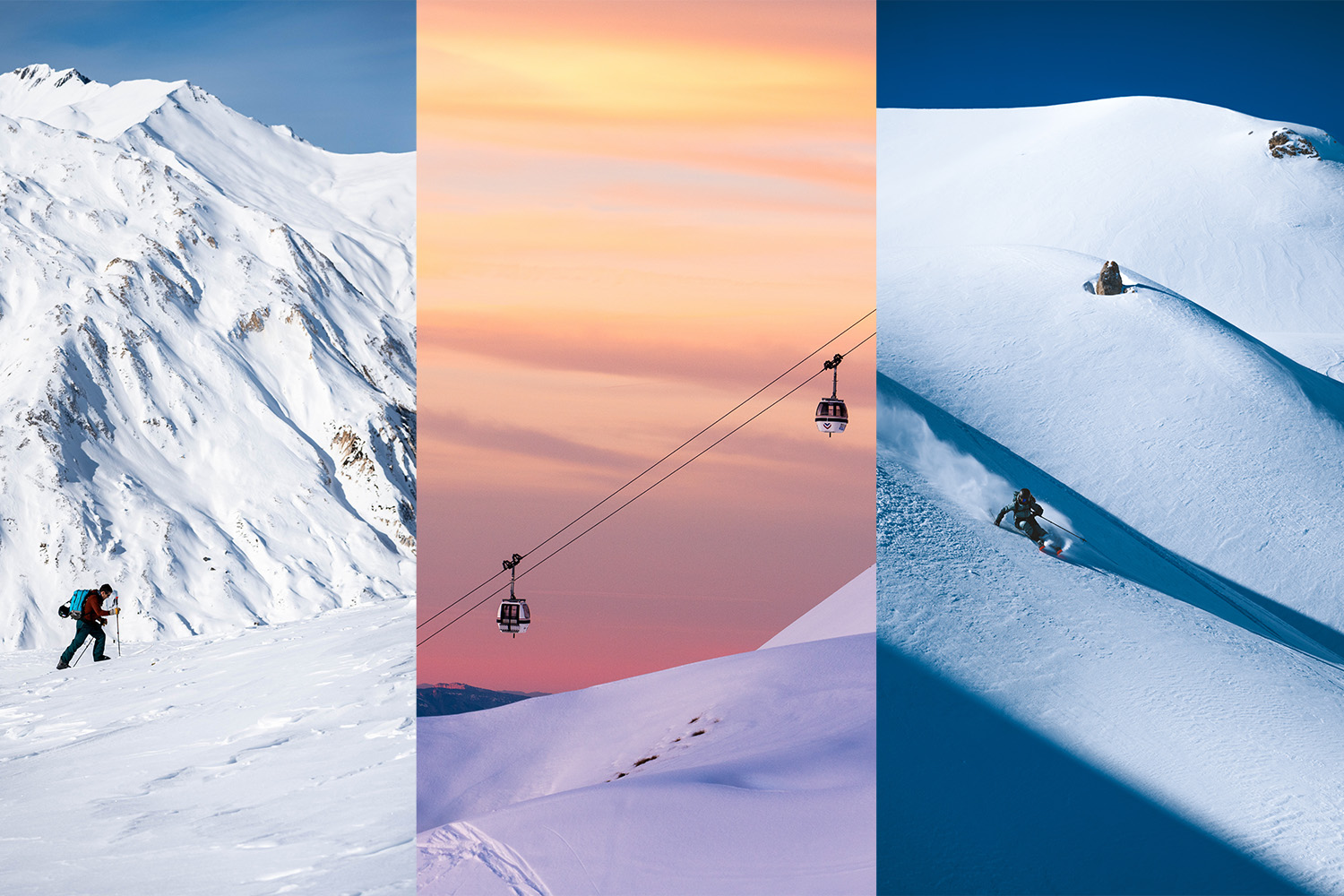
The treeless, snow-covered valley drops away like a silk quilt, contours of white and shadow billowing toward chalky peaks that erupt from the distant horizon. Between us and those summits: a few ski tracks but mostly unblemished powder. And somewhere way down there, far from sight and still hours ahead: a French village, a cold beer, a bowl of onion soup.
Welcome to the world’s largest interconnected ski area, Les 3 Vallées (The Three Valleys, or L3V), a mind-boggling expanse of skiing, culture and good living cast across the French Alps, 100 miles southeast of Geneva, Switzerland. I’ve come here in early February with two other ski writers to learn how this colossal resort compares to the marquee mountains of North America, and whether the French Alps are indeed a worthwhile value-adventure proposition for American skiers.
The Three Valleys at a Glance
The numbers at Les 3 Vallées tell part of the story:
- 370 miles of named trails
- Nearly 26,000 acres of skiable terrain
- Almost as big as the five largest ski areas in North America combined
- Served by 161 (mostly high-speed) lifts
- Seven villages, each of which has its own vibe
- All of it is now included on the Epic Pass, which entitles passholders to seven days here a year
You’ll Need a Guide
“Good snow!” says our guide, Timy Théaux, as we descend into Vallée des Encombres, one of the many “fourth valleys” here, endless playgrounds just outside the resort boundaries. Théaux, a former racer who has guided here for 25 years, arcs flawless turns through powder still feathery despite the fact that it hasn’t snowed in five days and this sliver of the valley is easily accessible from a groomed run.
Our good fortune is a symptom of the immensity of this place and the bizarre reality that most skiers in Europe stick very close to the groomed runs, although this is slowly changing. So even though hundreds of thousands of visitors fill the chalets, hotels and lodges across L3V, the opportunistic powder hound can usually sniff out fresh lines, and even more so if one is willing to hike a bit for the goods.
As we sluice through aprons of boot-high fluff, knolls of wind-buffed snow and undulating traverses, cradled in the intoxicating scenery of this alpine wonderland, it becomes clear that hiring a guide is essential here.
“In France, you’re free to die,” says Eric Lipton, whose company Destination Ski Camps runs high-performance coaching trips; Lipton and a group of clients spent a week in L3V this season. “They don’t have all the rules and closed areas that we have in the States, so you really need someone to show you around if you’re going off-piste. But the ability to ski village to village, to experience this massive environment, with the food and the scenery and snow quality — that’s why I bring people to Europe.”
To his point, I’ve skied all over the U.S. and Canada and have never seen such grandeur — toothy pinnacles, 1,000-foot cliffs, glaciers and icefalls adorning every view — or so many high-quality, affordable, cabin-style bistros dotting the hillsides.

L3V, a History
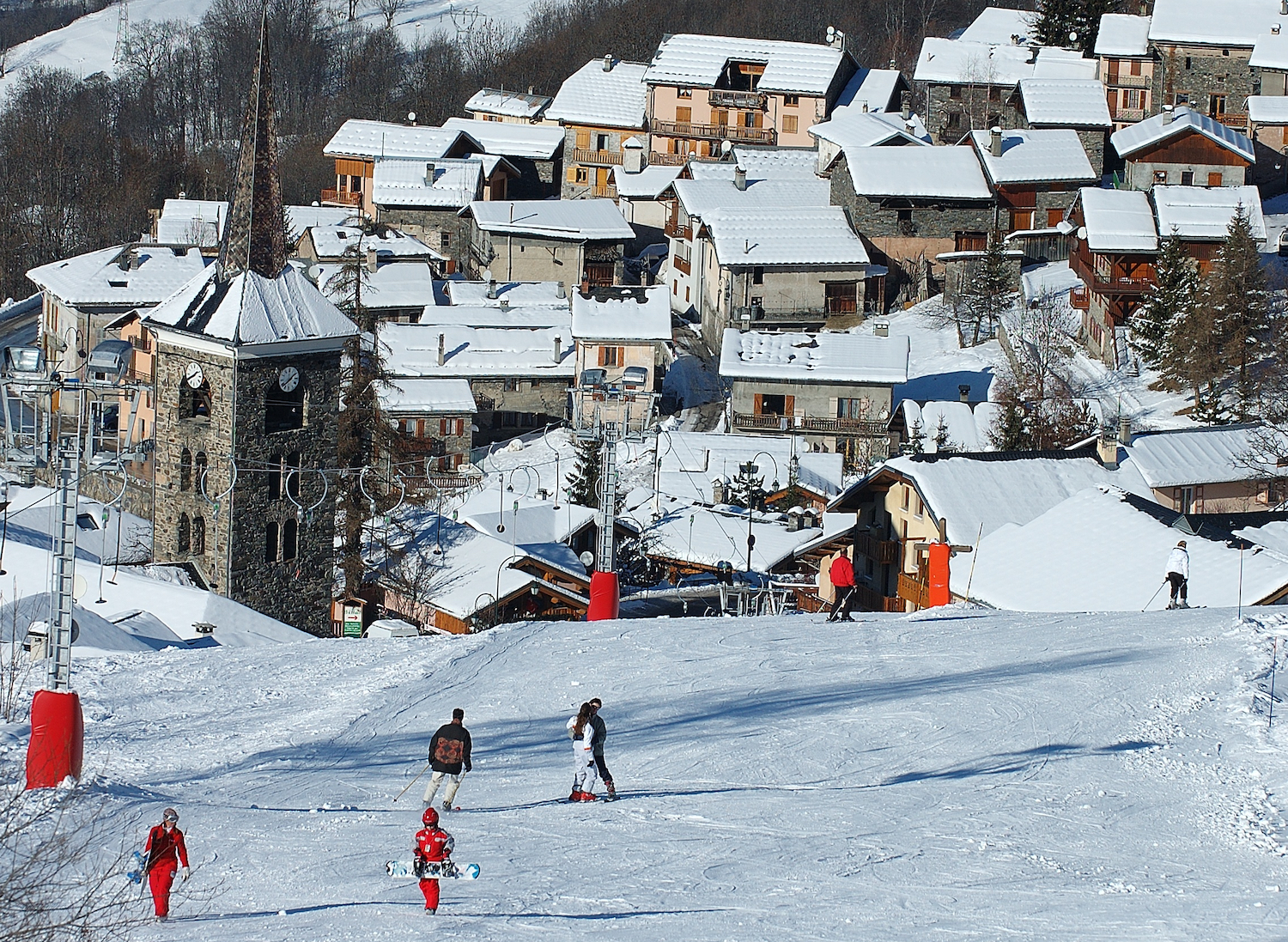
Skiing began to take hold here in 1938 with the development of Méribel, today the largest village in L3V. The first “lift” was a 19-passenger, open-air car driven on a train-like track. Courchevel, one valley west of Méribel, followed in 1946, with both areas quickly subsuming the sparse farming settlements that had existed in the region for centuries. Next came Les Menuires, constructed in the 1960s as part of the French government’s Plan Neige (or “Snow Plan”) to grow winter tourism, and the present-day resort evolved quickly from there.
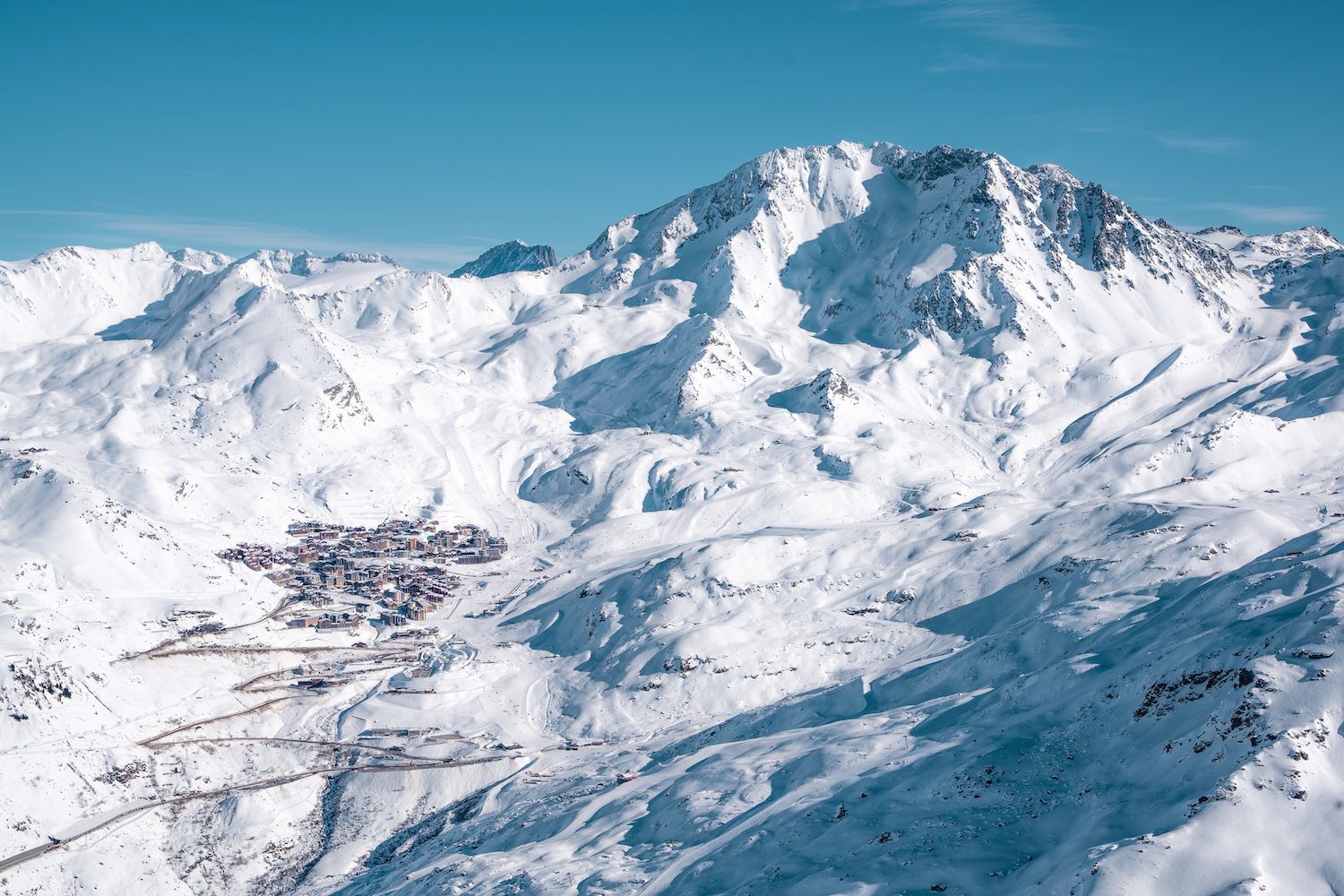
We’re staying in the newest — and highest — of the villages, Val Thorens, which was built in 1971 despite skepticism among some in the French ski community that the base elevation of 7,545 feet was too high for people to safely vacation. Each of these hamlets has its own charm, with Courchevel and its $10 million chalets drawing the luxe set, Méribel appealing to those who want a mix of nightlife, skiing and dining (at different price points), and Les Menuires known for its family friendliness.
Val Thorens, the only village that sits entirely above the treeline, is renowned for its consistent snow from November to May, views across the Alps from Italy to Switzerland, and raucous nightlife. As such, the village is popular among young adults who possess the enviable fortitude to ski and party hard on the same vacation.
A Pilgrimage to Portillo, South America’s Hidden Skiing Paradise
Slingshot lifts, Pisco Sours and a legendary yellow hotel. Welcome to heaven on earth.What’s the Scene Actually Like?
When we arrive, at 2:30 p.m. on a Sunday, an electric violinist in a mirror-ball jacket and shades is rocking out to a clubby backbeat on the deck of the Fahrenheit Seven hotel, sending soaring riffs into the mountain air and tempting skiers from the slope just below to step out of their bindings and party.
The clientele at Val Thorens needs little encouragement. The village, an amalgam of tightly packed, modern-looking buildings, is heavy on clubs and bars, many of which thrum late into the night with DJ sets. In fact, the revelry begins on the slopes at a spot called La Folie Douce, an indoor-outdoor bar perched on the final descent into town, where revelers gather in early afternoon to pop champagne and dance until well after the lifts close.
But Val Thorens also has a civilized side.
“I love two things: skiing and eating,” says Dan Rosenblatt as we sit in the outdoor hot tub of the Fahrenheit Seven, watching the alpenglow seep across the mountains. Rosenblatt, a 60-something man from Boston, had planned his L3V stop en route to a business conference in Spain, and was delighted with the value he’d found here.
“In Massachusetts, it costs me more to take my kids to our local mountain than it does to ski here for a day,” he says. A full-day adult lift ticket at L3V costs around $90 USD, with discounts for multi-day passes and kids. “I can ride high-speed lifts all day, ski myself out, then sit down to a gourmet meal. What’s not to like?”
This small parcel of L3V makes the entire backside of Alta, Utah — a formidable piece of terrain — look like a kiddie ride at an amusement park.
His story checks out. Our dining highlights include La Maison, a low-lit, farmhouse-style restaurant where I should have ordered more escargot; the lively La Cabane, home of a smoked trout appetizer I could eat every day for the rest of my life; and Chez Pépé Nicolas, a working cheese farm and storybook stone-and-wood restaurant, which claims two of the 17 Michelin stars sprinkled across L3V’s eateries.
On the ski hills we sample smoked-salmon Parmentier and sauvignon blanc at the highest wine bar in Europe (Caron 3200, at 10,498 feet), scratch-made onion soup at Cabane De Sul’Lys in Courchevel while sled dogs pull tourists along an adjacent trail, and at Le Corbeleys, a converted pasture chalet in St. Martin de Belleville, a quiche so delicately cooked it dissolves in my mouth.
But enough about the food.

One Final Run
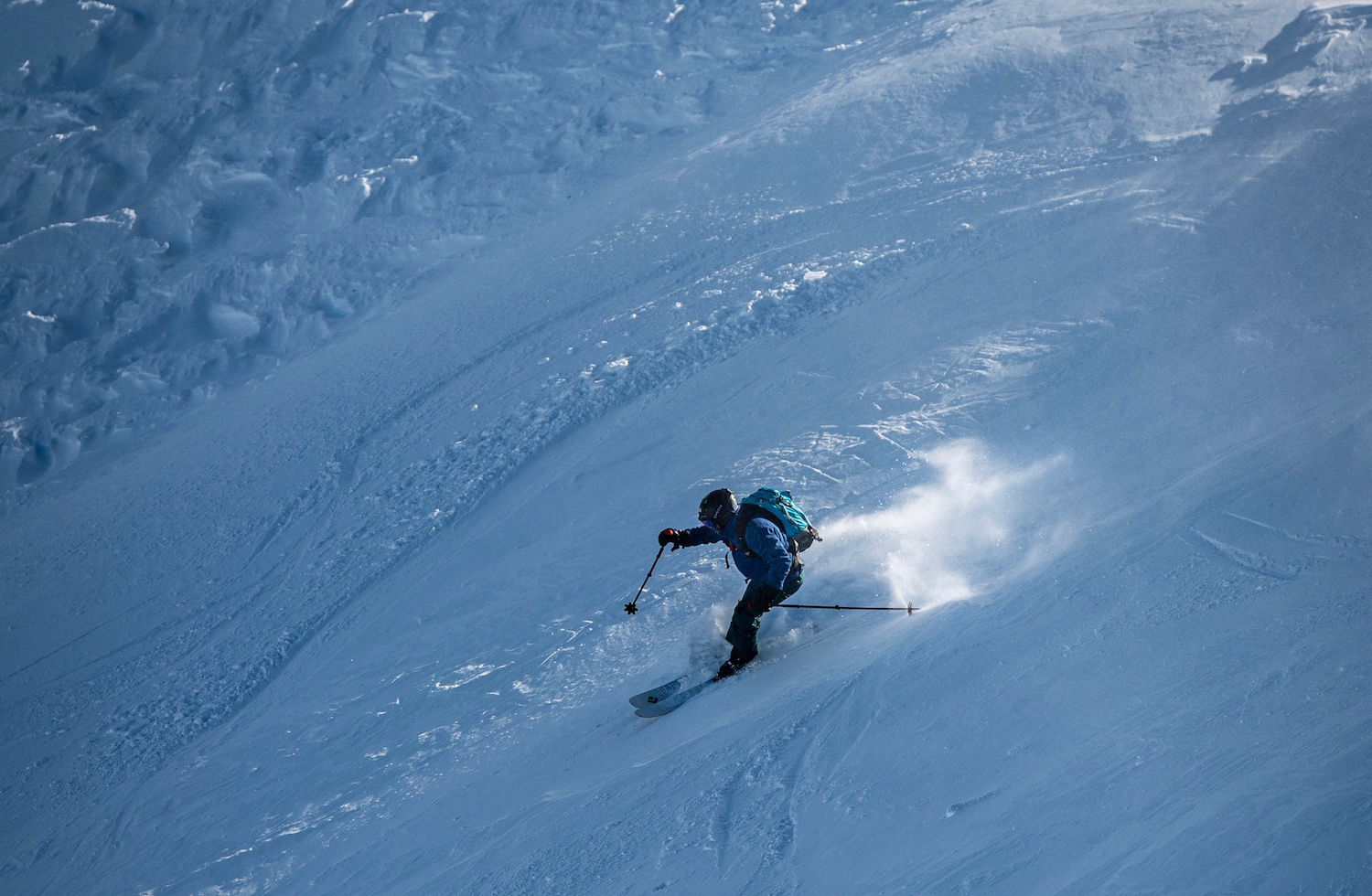
“Are you ready for some steep skiing?” Théaux asks as our gondola car slides into the unloading dock 9,000 feet above sea level on a ridge between Courchevel and Méribel. We step into the thin air and stare down to see a lone skier. He’s as tiny as a Lego figure next to a hulking spire, paused in still life atop the steepest named run at L3V, the nearly 40-degree pitch of the Grand Couloir.
The chute has been tracked, but once we pick our way through a maze of icy moguls, the snow quality is sublime. A 10-turn sequence brings us to a short traverse into the adjacent couloir, then another 15 turns and a lateral move into a vast snowfield that funnels us to yet more skiing and, finally, some 3,500 vertical feet later, a lift. As we ascend I survey the burly lines we just skied and realize that this small parcel of L3V makes the entire backside of Alta, Utah — a formidable piece of terrain by any assessment — look like a kiddie ride at an amusement park.
If there’s a downside to L3V, it’s that old law of physics about what goes down must eventually find its way back to the hotel, often at rush hour. Because this place is so immense and because we are in explorer mode, each of our ski days ends with us linking multiple lifts and frenetically crowded piste runs back to Val Thorens, where we skitter and slide past the surging energy of La Folie Douce and into the welcoming bough of the Fahrenheit Seven.
On my final night in Val Thorens, amid a steady snowfall, I stroll through a market along the main pedestrian way — street vendors selling cured meats, cheeses, olives, local Génépi liqueur — and into the Belleville Diner, the closest thing I’d seen to an American ski-bum bar in France.
Amid the din of conversation from all corners of the globe — French, Swedish, English, Arabic, Chinese — I sip a beer at the bar with Tom, a ski instructor who alighted here 10 years ago and has no plans to leave. Looking out the window at the thickening storm he checks his weather app, announces that a foot of snow is inbound, and asks me why in the world I’m going home tomorrow. I have no good answer.
More Like This

The Charge will help you move better, think clearer and stay in the game longer. Subscribe to our wellness newsletter today.