
I don’t know what else to call it but a campaign.
A successful campaign is manufactured chaos. A perfect storm of attacks on multiple fronts. It is creative. It dances on the edge. Its gaze is long and wide but ultimately fixed, unwavering, on its goal.
When Yago Dora arrived at Cloudbreak in late August of this year, the Brazilian was composed and prepared, armed with a uniquely lethal style and a sheath of Matt Biolos Mayhems. With experience scarred on his furrowed brows and a mischievous smile on his face, he even growled. This was going to be fun.
But to understand how we got here, to the year that Yago donned the yellow jersey and lowered his head to assume the crown as the best competitive surfer in the world, we must look back — and follow the many-colored strings of his campaign all the way back to the beginning.
Fertile Beginnings
Dora was born away from the beach in Curitiba, Brazil in May of 1996. He wanted to be a soccer player. At the age of four, his family moved to Florianópolis — a Brazilian paradise of sandy beaches and beautiful, healthy people — but it wasn’t until he turned 11 that he actually started surfing.
He progressed quickly, a natural athlete with a surf coach for a father and Pedro Barros, a future national champion in skateboarding for a best friend. Dora and Barros spent the mornings surfing together and the afternoons at the skatepark.
“Where surfing is measured by how much water you’ve displaced and how much rail you’re getting in the water,” skating is defined by the screech of truck on rail, Dora tells me.
So: punchy ramps in Floripa’s aquatic wavepark in the morning, airs in concrete pools in the afternoon. Dora liked to pretend he was surfing while he skated, and the influence played in reverse as well. You can still see it today. He is fluid but aggressive, his airs are tweaked and his grabs inspired. Just watch this clip of a Stalefish he did in Portugal this season. Note his subtle reminder to the judges: This grab was not like the others — I am not like the others.
His father, Leandro Dora, is the creator of the Aprimore Surf Program. He’s coached Adriano de Souza (2015 World Champion), Lucas Silveira (2016 World Junior Champion) and current WSL Championship Tour competitor Jack Robinson.
Within the younger Dora’s eyeline, then, was direct evidence for life as a championship-tier athlete. He’s a self-proclaimed “surf nerd” who has watched film and dissected technique alongside his father since the beginning. He went to contests and took trips with his friends, a collection of young, hungry Brazilian rippers eager to prove themselves against one another.
It was only a matter of time before someone took notice. Dora signed with Volcom Brazil just four short years after he first started surfing.
Another Brazilian for the International Surfing Pond
The past decade of competitive surfing belongs to the Brazilians. Since 2014, Brazil has had nine World Champions. Gabriel Medina, Andriano De Souza, Italo Ferreira, Filipe Toledo and now Yago Dora. How? The answer could fill a book. But it’s worth turning the lens on the United States.
American surfers enjoy an unmatched wealth of resources and opportunity. While the sport as a whole has welcomed surfers from more diverse backgrounds in recent years, competitive American surfers typically hail from a racially homogenous, upwardly mobile coastal crust. It’s the sort of demographic that simply has less to lose. And I’m afraid to say it’s molded us into a fairly risk-averse crowd.
If champions tend to be forged in the fire of experience and failure — and if the Championship Tour results over the past years are any indicator — our fire does not currently seem to be hot enough. To state the blindingly obvious, Brazil is different. I asked Dora to help me understand how.
“I remember just going to California for the first time and seeing every little kid with a bunch of stickers on their boards,” he remembers.
Unlike in the U.S., where surf sponsors adopt a “throw shit at the wall and see what sticks” approach, Brazil sponsors surfers based on results. Stickers and support come after success. There’s less bread for the same number of hands. This environment has fostered an eager collective of amateur surfers.
It’s the kind of competitive lesson that many athletes only internalize once they climb the competitive ranks far enough to encounter their first cold-blooded, true predator. (Surfing’s best example being Kelly Slater). But Brazilians? They develop this ferocity from a young age. That hunger is inevitable.
“Brazil loves champions, they love winners,” Dora says. “They love surfing but their favorite thing is a champion.”
There’s long been a trend of Brazilian surfers with professional ambitions emigrating to the U.S. or Australia. The move is a logistical one, fueled by a desire to bring their talents to a more global audience, to position themselves closer to the deep pockets of their sponsors’ headquarters. They leave Brazil behind, but bring the fire with them. In 2015, Dora seized his opportunity, making the strategic decision to leave Florianópolis for San Clemente, California, surfing’s industrial hub.
Dipping the Competitive Toes
“That move to California changed my life,” Dora says.
Proximity to LAX meant that he could easily drop everything to join a trip and chase a swell. He began stacking clips and bagging impressive parts in films like Volcom’s groundbreaking Psychic Migrations. This was the early days of YouTube and Instagram; his notoriety on the international stage grew day after day.
Besides, his surfing was blossoming. He was traveling monthly to surf the biggest swells, at the best waves, all over the world. The cat was out of the bag and there was no putting him back in. He surfed fast and fluid, but with a merciless aggression that left each wave gasping, bleeding and waving the white flag.
Around this time Dora began competing occasionally on the WQS — the qualifying series for the World Championship Tour. It is a toiling slog through subpar surf, a place where promising surfers burn out, where their dreams fizzle away. Dora took it slow. He continued to improve, taking advantage of the growing support of his sponsors to go on every trip he could.
Brazil loves champions, they love winners. They love surfing but their favorite thing is a champion.
Yago to Insidehook
But his hunger never went away. “I always wanted to do the best air of the session, to get the best shot. I was always competitive in that way and that’s what pushed me to evolve so much.” Up to this point, competition surfing had lived somewhere in the corner of his mind. Now it started to make the trip to the front, bit by bit, as his confidence grew. In 2016, he decided to focus all his energy on qualification.
At some point in the life of any professional surfer, the path splits. You are a competition surfer or you are a free surfer. A competition surfer earns their bread on tour. A free surfer earns their bread through films, internet content and sponsorship promotion. They generally enjoy a creative freedom that the competitive surfer does not. Their style is unconfined by the influence and constraint of the judges. There are exceptions to every rule, but a transition between the two usually occurs in one direction — from competition surfer to free surfer, Rob Machado, Dane Reynolds, Michael February all being famous examples. Very few pass the other way. Dora is one of these exceptions.
“If I make a heat at 60 percent, I’ll try to make the next one at 80,” he told Surfer way back in 2017. “If I end up in the final, then maybe that’s when I go 100 percent. And I think that’s a good way to do it, because in each round you’re hopefully showing the judges something different.”
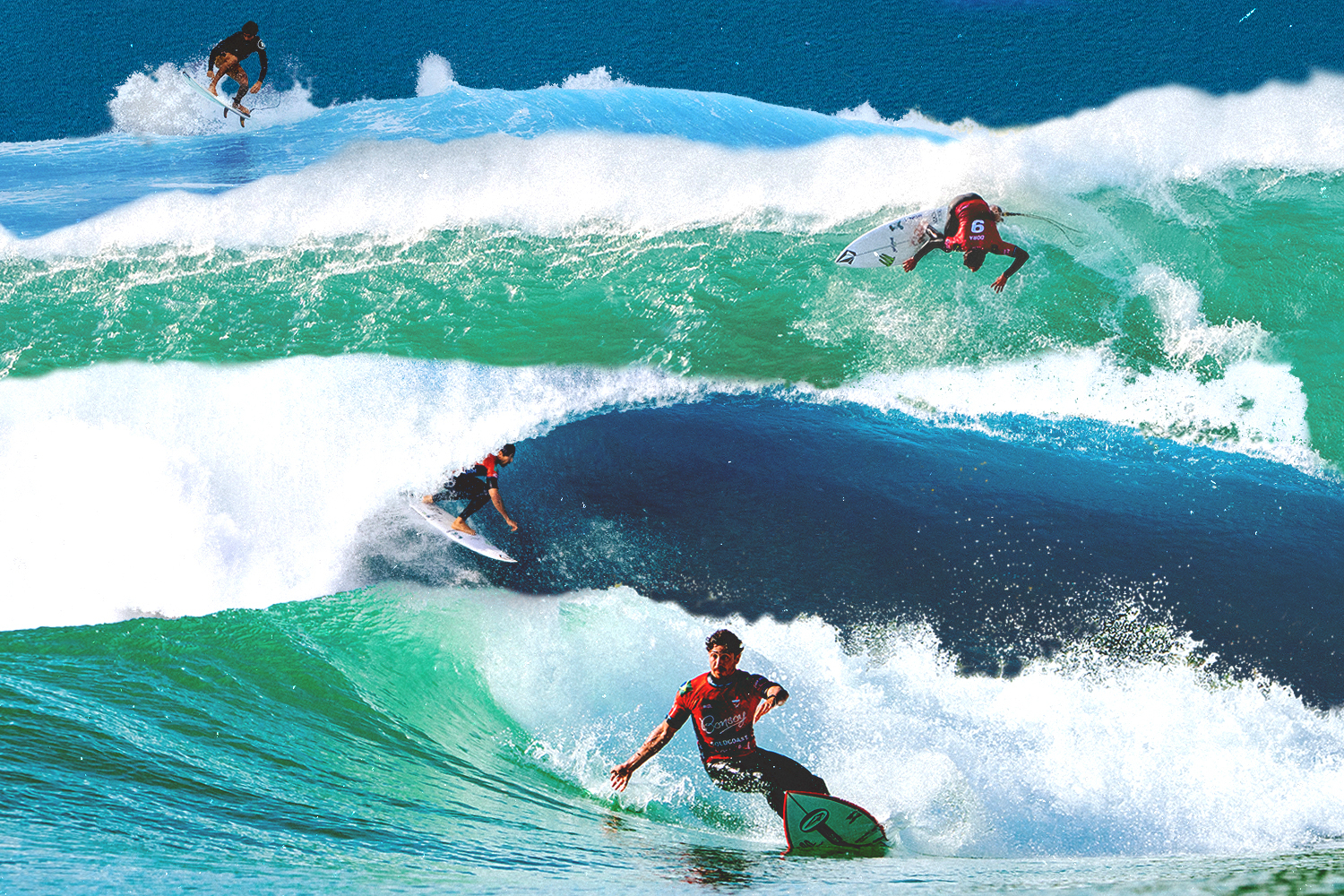
His style was allowed to develop largely free of the influence of any contest criteria. His dictation was to surf with strong fundamentals, as hard and radically as possible. Find the line and blow right through it. He brought an ingenuity to the table that many of his competitors lacked. And as he learned the strategy of contest surfing, the results began to show. In 2017, his first full year on the WQS, Dora qualified for the 2018 World Championship Tour.
From “Ciclo” to Top 10 Finishes
Dora’s quick qualification in 2017 is rare. But to call it lucky is incorrect. This luck was born of the holy matrimony of preparation and good timing. “I took my time to get ready to qualify for the tour,” he says. “I took my time to get ready and fight for a world title.” The 21-year-old waited until he felt ready, again bringing a stoic sensibility to his decision making that is so uncommon in our modern age. (Who waits for anything nowadays?) Dora did.
By his own admission, in his first years on the WCT, he was “just happy to be there” and did little more than requalify. He was quietly growing accustomed to the life of an athlete on tour. He’d moved back to Brazil, and for those of us not paying close attention to competition surfing, sort of fell off the radar.
Until he released Ciclo in 2021.
Ciclo is a 10-minute, 48-second slap in the face to anyone who dared forget about him. The video was cold, hard evidence. He was absolutely shredding. He was moving so fast, the video looked to be playing in double time. (It is not.) Adding to the clip’s effect — the size of the waves. These weren’t giant, howling inhospitable barrels, untouchable to the average surfer. These were about head high or below: rippable, “mind surfable.” We could see ourselves in these waves; and yet, at the same time, what he was doing in them was untouchable, almost incomprehensible. This was surfing at a new level. The statement of a world title contender.
“This is who I am now,” he says, recalling his mindset at the time. “I’m ready to go, to fight for a title, to fight for event wins. This is how I surf.” In big and bold red letters, he’d sent a single message: Watch me.
Behind the scenes, he’d become a proper athlete, throwing his full weight into his out-of-the-water training. He’d grown stronger, faster and more flexible. Discipline of routine was hard-fought at first, but he soon fell into a rhythm. “I fell in love with it,” he says. “And my level of surfing went a couple of notches up.”
Barring an ankle injury that kept him out for most of the 2022 season, the following years brought steady movement up the rankings. He ended the season in the top 10 for the first time in 2021 and would repeat the accomplishment in the following seasons. In 2023, he won his first CT event, defeating Ethan Ewing at the Rio Pro. In 2024, he narrowly missed the final five, coming in at a particularly painful sixth place, missing the playoff by one spot.
At the championship level, every inch counts. The difference lies in the margins, sometimes the unconscious. What would bring the extra 1% he needed? Beyond putting together a championship season in the coming year, there was one other thing he could do. A gnawing at his ear that had been steadily growing in its intensity.
2025: Manhood, a Yellow Jersey and a Heavy Hunk of Metal
At its most basic, what is manhood other than stepping out from the influence of your parents and taking full responsibility for your life? As much as his career was his own, Dora had spent its entirety under his father’s guidance. Leandro Dora was inseparable from both his personal and professional life.
“I felt like I was evolving, getting better, but in some way I felt like I was stuck to that system, to that little bubble we’d created,” he explains. It’s difficult enough to separate the opinion of others from your own. When one of those important opinions is that of not only your coach, but also your father, that weight is multiplied.
Not to say that their partnership was unsuccessful. Entirely the opposite. Dora built his career alongside his father’s guidance and he makes his gratitude abundantly clear. This was a man’s decision, a champion’s decision. It came time for Dora to step out on his own.
His new coach would be his friend Leandro da Silva. da Silva had coached many of his friends in those early days in Florianópolis. They’d even experienced some shared success as a duo: at a 2014 WQS event that brought the best result of his career up to that point, and again for two Championship Tour events in 2024 (El Salvador and Brazil). In the end, Dora describes the difference as a feeling: “[Leandro] puts me in the right space mentally to be able to perform my best.”
Dora entered 2025 galvanized by the partnership. On January 3, he wrote a collection of goals in his notebook, amongst them: Win two events, make the Final 5, win the World Title. When the buzzer sounded on that sunny afternoon in the South Pacific, he’d achieved all he’d written.
Look back from this moment, follow the colored strings to the beginning and it’s obvious that this was no accident. The achievement was the crescendo to a masterful campaign.
Dora surfs like he lives his life. There’s the influence of his upbringing in Florianópolis. His early experience as a free surfer. Flawless technique born through years of dissection alongside his father. Consistent elevation of challenge and skill. The maturity to develop a routine, the discipline of an elite athlete when the time called. He is neither the vicious predator of Kelly Slater, nor the exhibitor of explosive raw emotion like Italo Ferreira, nor even the prodigious serenity of John John Florence. He is all of these and he is none of them. He’s Yago Dora — the architect of his own style.
After a difficult start at Pipeline, he made fifth in Dubai and won in Portugal. A series of top 10 finishes were followed by a rough go in May at Margaret River. He responded by winning at Trestles, his former haunt, a third of his prophecy now fulfilled. A fifth-place finish in Rio rolled into a second at Jeffery’s Bay, made especially sweet after months of hard work consciously working on his backhand. It was there that he seized first place and would never let go.
A Prophecy Fulfilled
At 3 a.m. on Final’s Day, Yago Dora was wide awake. A building swell meant the contest would run. In the past few years, the WSL switched to a much-disputed playoff structure; the format is based on your end-of-season rankings. As men and women compete in alternating heats, Dora would have to watch seven heats before it was time for his own. But all he had to do was wait — and that’s what he’s good at.
Italo Ferreira quickly dispatched a sluggish Jack Robinson. A joyous and measured Griffin Colapinto beat Italo, who spent the heat forcing Superman airs. And unfortunately for the beloved Jordy Smith, he was once again close but no cigar. He would remain without a title. Griffin Colapinto had caught fire and was putting on a clinic with his backhand carves.
This would be Dora’s long-awaited opponent. A poised, already warm, San Clemente hometown hero who’d come bouncing into the finals on the balls of his feet. He looked sharp.
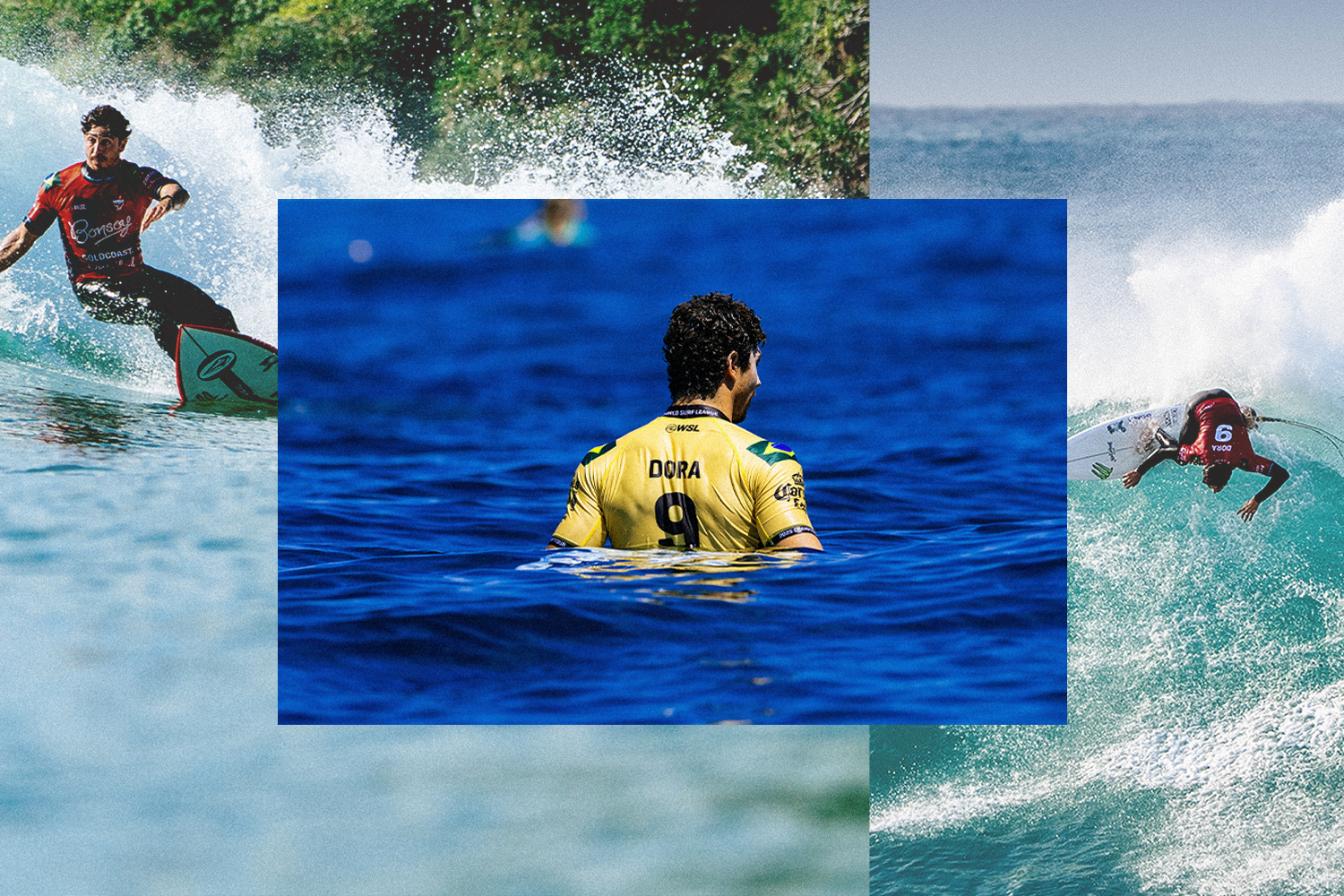
From the first wave, Dora silenced any doubts. He was in control, in flow. He put together a balanced and strategic heat. He protected priority and allowed Griffin to score some points on intermediary waves. When the ocean sent him what he was looking for, Dora found the edge and pushed the rail of his Mayhem to its limits. He had an answer for everything Griffin threw at him. Each score Griffin put up brought a strong response from Dora. As the clock wound down, a solid set swung through and Griffin launched a Hail Mary that would fall incomplete as the inside barrel clenched shut.
When we spoke last week, I was unsurprised to find him as easygoing and kind as he was rumored to be. He was tired, but glowing with the tranquil confidence of someone who knew he’d earned the crown he’d claimed. He seemed equally proud and grateful.
In an episode from his YouTube series Skinny Goat, he made an offhand comment I haven’t been able to forget: “Life is what I asked God for.” Is there any sentiment as beautiful as that? With his goal achieved, I asked him what life he would be asking God for now. He smiled and didn’t skip a beat: “I know I have a lot of years left on tour. I feel like I still haven’t reached my highest level. I’m still evolving, I’m still getting better. That’s what I want to keep doing.”
He wants his masterful campaign to be allowed to continue. I really don’t think that’s too much to ask.

More Like This

Twice a week, you'll find proven advice and tips, expert interviews, deeply reported features and personal essays on living better — for however long you’re here. Subscribe to Champ now.