
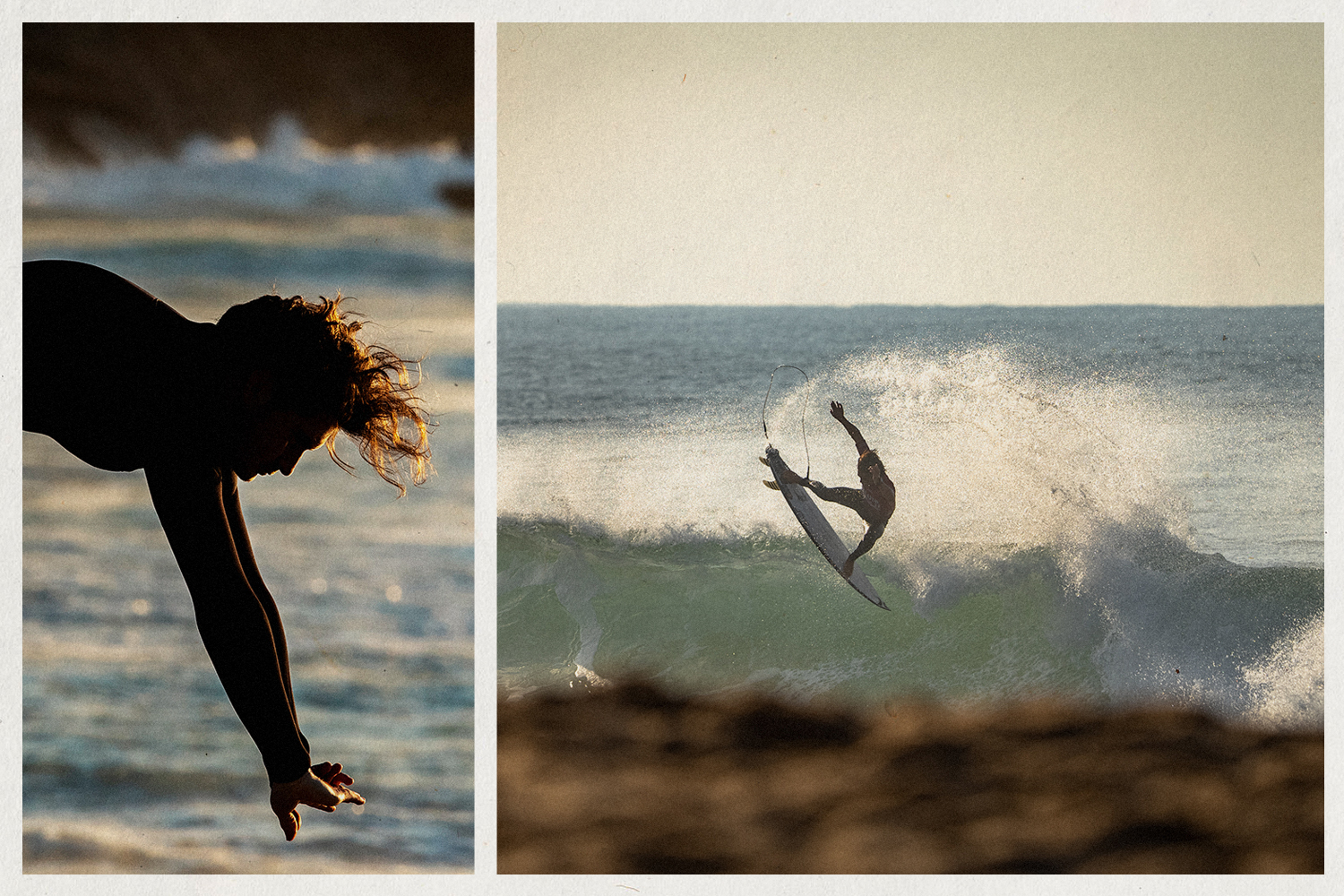
Surfing, in many ways, is like golf. Both sports can be pursued over a lifetime. They require condition-specific equipment that’s far from intuitive. They engender obsession. In both instances, the fundamentals involved are like few other sports, and when performed at the highest level they are revered as art.
But you can hit a million shots on the driving range or in front of a mirror. It’s possible to replicate conditions and practice your swing over and over and over again. To a certain degree, you can practice golf in a vacuum. In surfing, you cannot. There is a magical, confounding component so elusive and finite that it adds to the sport’s seduction.
In an average hour-long surf session, let’s say you catch 10 waves. (That’s generous.) These waves last maybe three to five seconds, quality aside. Each wave may call for different maneuvers — one for down-the-line surfing, another for vertical turns and another for patient, wrapping carves. Given these variables, you’ll spend 50 seconds, at most, riding waves — for a whopping 1.39% of the total session.
Surfing is more finesse than power (again, like golf). The sport’s foundational movements require transfers of weight and energy throughout the entire muscular chain at precisely the right moment. But in a sport with so little guaranteed action, the only way to appreciate this truth is through repetition. Most surfers of quality only stumble upon proper technique through dogged dedication. Very rarely is there any coaching involved or training outside of the water, unless you’re surfing competitively. A large majority of surfers have likely only ever seen footage of themselves a handful of times.
I’m a surfer, but I also spent my adolescence playing mainstream American sports. Football, for instance, involves countless hours of reps, review, drills and off-field training. Surfing’s lack of attention to technique and detail should have manifested as ludicrous, but it didn’t even occur to me until recently.
Discovering Wave Ki
I first heard of Wave Ki while listening to a podcast from The Surfer’s Journal. The guest was Brad Gerlach, a former world tour pro from San Diego, a competitive force in the ’80s and ’90s, and the founder of Wave Ki. The program was described like this: “A martial art-like focus on slow, precise movements that embeds a powerful surfing pattern deep within you, helping you extract every ounce of energy from the ocean so you can surf better.”
I was intrigued. At the time, I was in a surfing rut. I love New York City but by god is it a tough place to be a surfer. One or two sessions per month was not enough to improve, and watching from across the country as my little brother and best friend did so by leaps and bounds bothered me more than I’d like to admit. I wasn’t ready to move, nor did I want to stay any longer in my inertia. It took me over a year before I gave it a try.

How Does It Work?
The program is composed of two parts: Wave Ki and Wave Ki Body.
Wave Ki breaks surfing down into its most fundamental movements. Alongside an extended demonstration of each maneuver, there are both short and long practice videos accompanied by specific warm-ups. A PDF provides a written description that includes, among other things, a practice schedule and a training log with space for notes. Each maneuver is divided between both frontside (chest towards wave) and backside (back towards wave). The first phase addresses the most foundational maneuvers: the take off, bottom turn and top turn. Each maneuver is practiced, frontside and backside separately, for three weeks before the next phase avails itself.
The movements are intended to be performed slowly and methodically, very much like yoga, and the intention is to feel the transfer of weight and energy as it passes through the body. In between sets, Gerlach shows clips of himself performing the maneuver in the ocean and guides your attention through the movement. In practice, the whole thing feels a bit like surf tai chi. Lebowski would be all over it.
Wave Ki Body, meanwhile, is the flexibility and strength side of the program. The idea is to establish longevity and to prepare your joints to withstand and transmit increasing force as you improve. Alongside Jack Walchessen, a licensed physical therapist, Gerlach guides the user joint by joint through the entire body using controlled articular rotations. CARs movements aim to isolate the joint in question to test range of motion and flexibility. Depending on which areas require additional attention, there are specific CARs exercises for each joint. You’re encouraged to partner these with your daily practice and take video of yourself performing them so you can map your progress over time.
My Thoughts
The real wisdom of Wave Ki lies in its holistic framework. Consideration is given in equal parts to the mind, body and soul. It builds space for healthy rituals. The prescribed daily practice videos run between three and eight minutes long, preceded by a warm-up of similar length. A slow build to a low burn, wrapped in under 10 minutes. You’re then encouraged to forget about your practice. If you get to go surf, just have fun! Play around! Allow the repetition to gestate in your subconscious and form into habit. Couple this with a five-minute meditation and you have a very solid start to your day.
Wave Ki has been a godsend for me. It’s given me a newfound understanding of the fundamentals of surfing and a way to practice while I’m away from the water. It’s guided my focus and provided me with a morning routine that leaves me feeling satisfied and prepared for the day ahead. It’s a toolkit, a way to put a pebble in the jar and demonstrate dedication to the craft. These lessons are not only for surfers, either. This is a framework for building habit through dedicated, conscious focus.
Right now, I’m actually in Peru chasing waves, getting better and falling deeper and deeper in love with my favorite pastime. Wave Ki is one reason I’m here.
More Like This




Twice a week, you'll find proven advice and tips, expert interviews, deeply reported features and personal essays on living better — for however long you’re here. Subscribe to Champ now.