
Welcome to The Groom’s Guide, our expert-led handbook to help you navigate the proposal, the wedding and everything in between. Find all the stories here.
Before last summer, Sarah Roth had never given a wedding speech. She had never been a bridesmaid or been in a wedding of any kind. So when her older sister called on her for just such a toast, she needed guidance. Thankfully, she knew just where to get it.
“I ended up taking all of his advice,” Roth, a 30-year-old Minnesotan, tells me over FaceTime. “He wrote out a full five-minute speech, and I took most of that and wrote it down verbatim.”
“He,” in this case, is ChatGPT.
“I call him ‘Chat,’” she says of the AI chatbot. “I love him so much.”
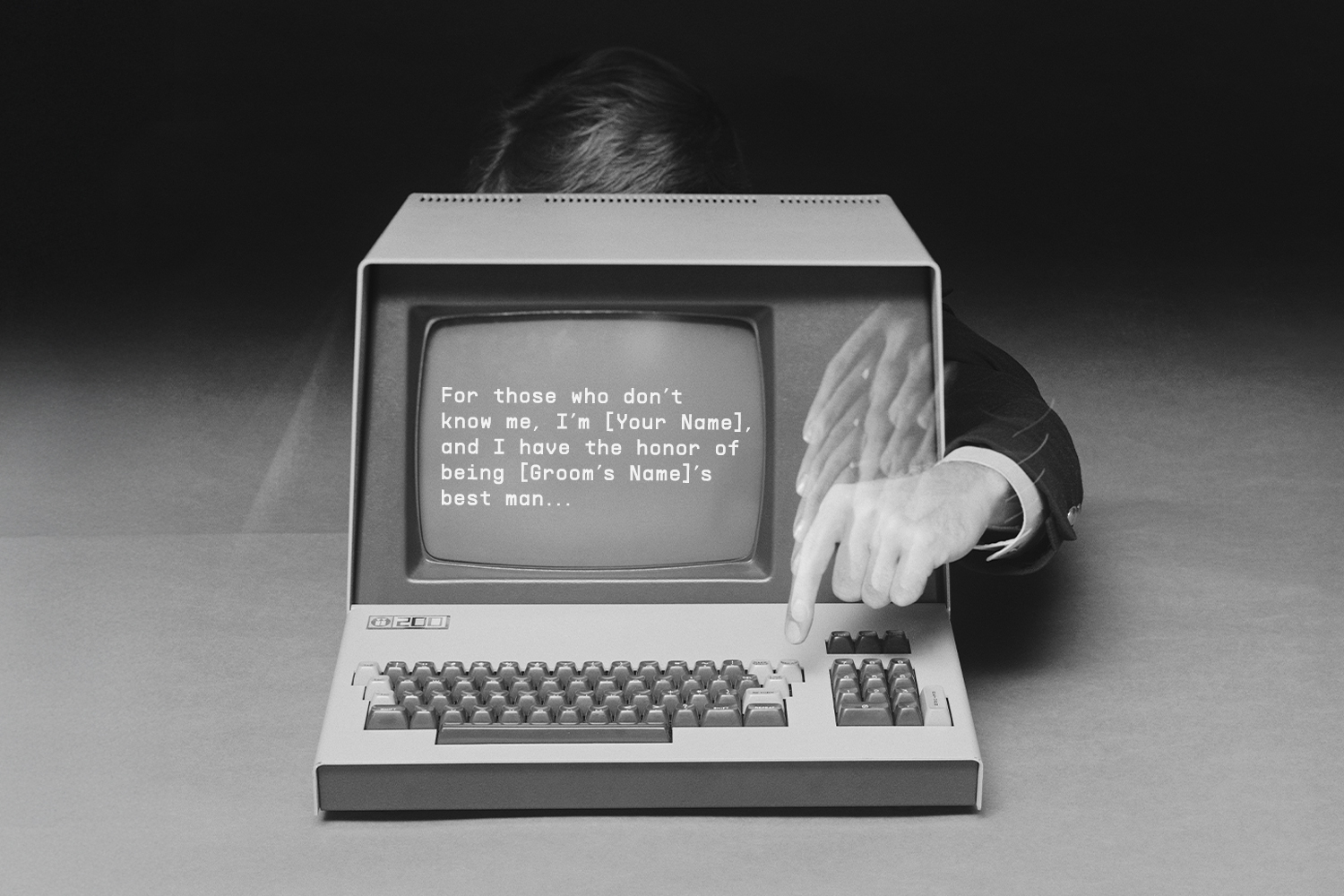
The proliferation of AI chatbots is changing the way people write, from high-school assignments to novels in progress to high-stakes briefings. But Roth is one of a growing number of Americans who are turning to these sophisticated generative tools not for help with humdrum assignments, but with one of the most personal orations a person will give in their lifetime: the wedding speech.
Reports of AI-assisted wedding speeches began to surface almost immediately after the release of these modern chatbots. In late 2023, a Denver woman told Business Insider she and her fiancé were writing their vows using OpenAI’s ChatGPT and an AI assistant created by the wedding platform Joy. Another bride told Yahoo Life that she and her new husband used ChatGPT for the same reason, while also admitting, “It is kind of creepy to use AI to write your vows.” There are also the many anonymous confessions of relationship rifts supposedly caused by this type of AI aid, like the man who wrote on Reddit that his fiancée left him at the altar because she guessed correctly that he had used ChatGPT to write his vows.
Whether you’re the betrothed or a guest at the ceremony, those looking for help with their wedding assignments can treat these chatbots as an all-powerful speechwriter, a heavy-handed editor or, as Roth likes to think of it, a “professor friend to proofread it and change the format.” While she admits she leaned on ChatGPT for help with grammar, structure, cohesion and even jokes, she’s adamant that “it was all my ideas first.”
Her original concept, which she came up with before consulting Chat, was to write the speech from the perspective of her sister’s dog, Luna. “She’s obsessed with her dog, and it’s become a huge part of their relationship,” Roth says. “But I didn’t want it to be confusing. I didn’t want to go into another voice and be like ‘I’m Luna’ or something. So I had to make it make sense. This is when I was like, okay, maybe Chat can help me.”
Roth says the speech was a rousing success. When she confessed that she used ChatGPT to write it, her sister had her own admission: she used the chatbot to organize her vows.
The More Agony, the More Beauty?
Roth says she got a lot of great feedback about her one-of-a-kind speech. There were a few naysayers when it got around that she had called in Chat for assistance, though.
“I did get a couple weird looks,” she says, “you know, that judgment of maybe thinking that it wasn’t genuine, or I cheated the system of how to write it.”
As far as David Murray is concerned, using ChatGPT in this instance is cheating — though as the founder and executive director of the Professional Speechwriters Association, he’s less concerned with rapping the knuckles of people who use AI than explaining the potential that lies in the “agony” of a hard-fought speech.
“They wanted me, because I’m the brother-in-law, to give the speech,” Murray says, referencing a wedding address he once gave. “They want me to sit there and think hard about the people I’m about to say something about. They want me to think hard about the audience.”
“The more a human being really agonizes and thinks about that without the help of something spitting shit out at them,” the better, he says. “The more agony goes in, the more beauty comes out.”
You may expect Murray to give an answer like that, seeing as how he’s got skin in the game. (Among other activities, the global membership group he runs holds an annual conference in D.C. where attendees have run the gamut from speechwriters for the heads of the European Parliament to AARP to Target.) Yet, he’s been reckoning with the proliferation of generative AI for years, and he’s certainly not blind to its capabilities, positive or negative.
“In two weeks we’re putting on a seminar called ‘AI for Speechwriting and Executive Communication,’” he tells me. “So, you know, we’re contending with it. We’re trying to figure it out as a profession.”
When it boils down to it, you’re going to be up there in front of people, and you’re nervous, and you want it to also just come across well.
– Sarah Roth, who used ChatGPT to help write a maid-of-honor speech
His conclusion so far is that AI is a good research tool. Do you have a 300-page document you need to pull insight from quickly? Great, feed it into a chatbot. He also believes these platforms can potentially help find weaknesses in speeches, which gives credence to Roth’s justification for using ChatGPT: that she came up with the anecdotes and singular framing device herself, and the chatbot merely helped her turn it into a coherent speech that fit the allotted timeframe.
Plus, what if you’re not like Roth, who describes herself as “not a shy person”? We’ve all been to weddings where the father of the bride has a hard time reading off his phone between blubbering, or where the bride’s face turns red and hands shake while reading her vows.
“When it boils down to it, you’re going to be up there in front of people, and you’re nervous, and you want it to also just come across well,” says Roth. If you’re just using a chatbot for help structuring your own heartfelt ideas, she says, “you’re getting less involvement from AI than you really think.”

One Thing I’d Change About My Wedding, According to Newly Married Men
Heed these 11 pieces of advice so you don’t make the same mistakes these grooms didLessons From Bobby Kennedy and Pope Leo
One piece of advice Murray gives to professional and amateur speechwriters alike is this: don’t write it like an op-ed. A speech doesn’t need a perfectly structured argument with clear bullet points.
“The main reason for speeches is community,” he says. “It’s emotional. It’s not intellectual. An audience wants to feel while somebody’s giving a speech that only that person could be saying only this thing to only this audience on only this occasion at only this moment of time.”
Take for instance Senator Robert F. Kennedy’s speech on the night Martin Luther King Jr. was killed. “This is a dramatic example,” Murray admits, but he says it also perfectly illustrates his point.
The more a human being really agonizes and thinks about [a speech] without the help of something spitting shit out at them, [the better]. The more agony goes in, the more beauty comes out.
– David Murray, founder of the Professional Speechwriters Association
Kennedy was slated to give a speech in a Black neighborhood in Indianapolis on April 4, 1968 during his campaign to be the Democratic presidential nominee. Before he arrived, he was told that King had been assassinated. Instead of going on with the rally as planned or canceling it altogether, Kennedy gave an improvised address which has come to be regarded as one of the great speeches of American history, partly due to its unorthodox content.
“In the most unlikely, un-ChatGPT thing ever, he quotes Aeschylus to a group of inner-city people in shock,” says Murray. (“Even in our sleep, pain which cannot forget falls drop by drop upon the heart, until, in our own despair, against our will, comes wisdom through the awful grace of God.”)
“No speechwriter or ChatGPT would say that’s a perfect audience for an Aeschylus quote,” he adds. “But he does it, and it’s totally moving.”
It may seem like a stretch to compare a groom mumbling his vows in a suburban hotel ballroom to Bobby Kennedy comforting the Black community, and the country at large, after King’s assassination, but Murray sees a common thread, depending on how prospective speakers answer one simple question: Is the speech sacred to you?
“To me, it’s sacred to be asked by a community [to give a speech like this], whether it’s a eulogy or a wedding toast,” he says. “If you’ve been asked by a person to speak in front of the community that they belong to at an important moment in their life and say something meaningful — Christ, that is worth your agony and worth your time.”
Three hours after I spoke with David Murray, he forwarded me a newsletter he had sent out to members of the Professional Speechwriters Association with news hits about statements made by leaders that were of interest. One was from Pope Leo XIV, who was advising clergy members to not use AI when writing homilies. Among his other comments, the Pope said, “Like all the muscles in the body, if we do not use them…they die. The brain needs to be used.”
On that point, Sarah Roth and the Pope agree. As a regular user, she is acutely aware of the slippery slope that AI presents.
“It’s funny that I rely so heavily on Chat now, because I’m genuinely a creative person when it comes to wordplay,” she said. “But I think I am falling victim to how easy it is to just rely on it, or use it and say, wow, I could have come up with that, but that’s just a way better version of saying something that I would have maybe already said.”
More Like This

This article appeared in an InsideHook newsletter. Sign up for free to get more on travel, wellness, style, drinking, and culture..