
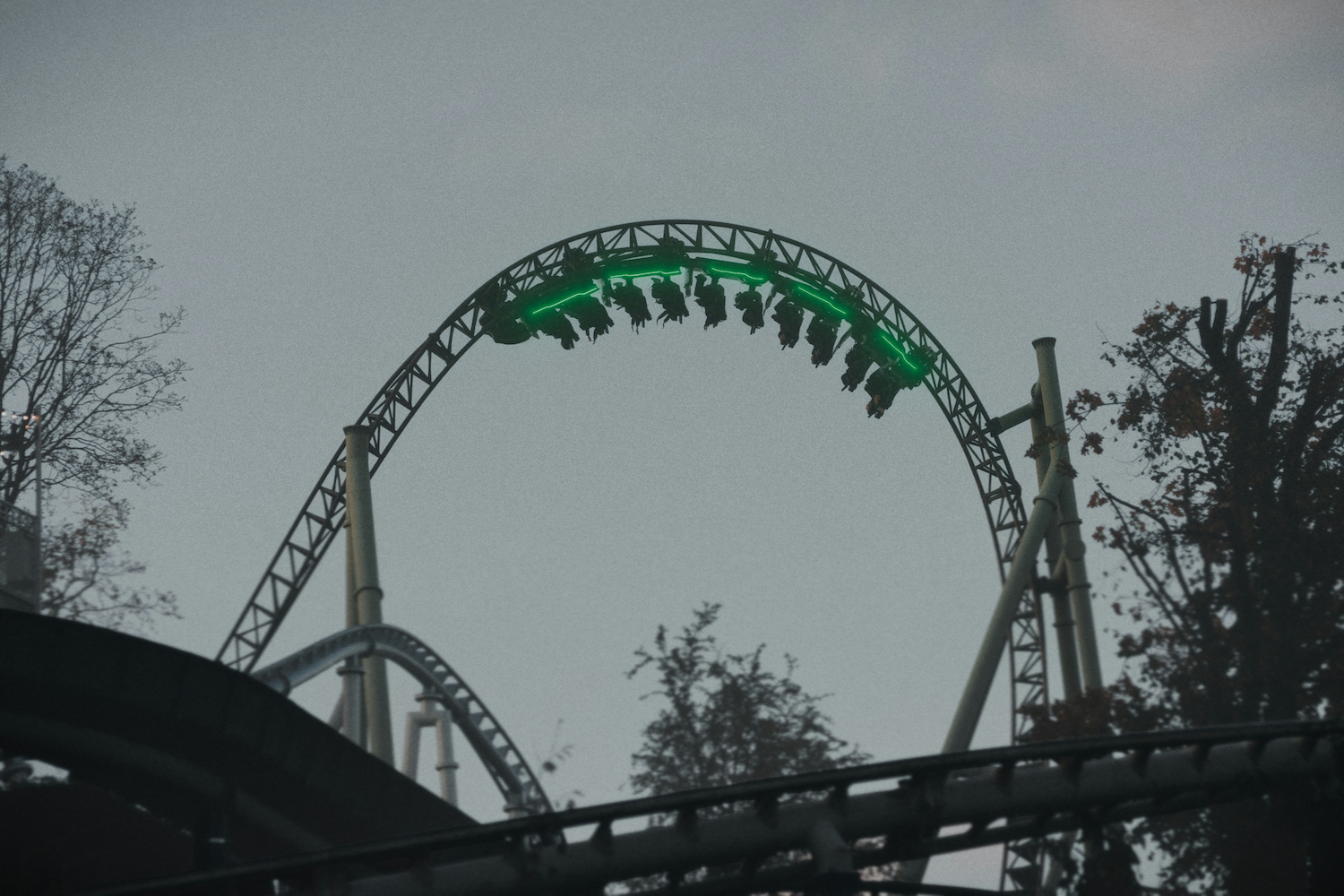
Last year I visited Universal Orlando for the first time. It was a good trip, except my partner was obsessed with riding the VelociCoaster, a Jurassic Park-themed ride. For the uninitiated, this is the first ride to utilize new rollercoaster technology that makes you absolutely certain you’re going to die while riding it. Secured by only a lap bar, we twisted, looped and turned for what felt like three hours but was probably about 90 seconds. It was horrible. I’d rather watch those Chris Pratt movies than go through that again. My partner, on the other hand, couldn’t get enough of it.
It didn’t used to be this way. I used to skate, climb trees and ride my bike (or shopping carts) down wooded hills. Roller coasters were par for the course. But in my mid-30s, I’m finding myself more fearful than ever. I’m not just afraid of physical danger, I’m worried about all sorts of things: of making mistakes while driving, of leaving the burner on, of saying the wrong thing in an email. It’s not that I used to be more certain of myself. I didn’t. I’m just finding that the more beaten down by life I become, the more there is to worry about. I spoke to my sibling about this. At 34, they’ve recently developed a fear of heights. I spoke to my mother, once fairly adventurous, who’s now deathly scared of flying. They both shrugged — that’s just aging. Right?
Of course, some of this seems normal. The National Institute of Mental Health suggests that 19.3 million Americans suffer from specific phobias. But I’m talking about sudden, irrational fears cropping up seemingly out of nowhere. I don’t want to be like this. And if you’ve noticed a similar trend in your own life, I’ll bet you don’t want to, either.
Your Brain on Fear
In order to banish fear, we should probably understand what we’re talking about. Know your enemy and all that. To help me understand what’s going on, I reached out to Erika Kawamura, a licensed psychologist and director of practice initiatives at Equilibria Psychological Services in Philadelphia. She starts with the definition of fear as “a universal emotion that all humans experience whenever we feel there is a threat of potential harm.” This harm can be real or not, but as soon as the fear switch is tripped in our brains, we go into survival mode; our heart rate jacks up along with our blood pressure, sending oxygen to our muscles. We’re pumped full of cortisol and other stress hormones, and our bodies essentially focus everything on fight or flight.
It’s an uncomfortable feeling, but Kawamura says that fear is essential for alerting us to potentially life-threatening situations. It can stop us from doing reckless things and sharpen our senses to keep us safe. That said, too much fear isn’t good for us.
“Fear can start to take a negative toll on our physical, mental and emotional health when it’s frequently experienced in reaction to non-life-threatening circumstances,” Kawamura says. You don’t need to be a psychiatrist to understand that our bodies flooding with stress hormones when there’s no need for them is going to keep us on edge. And the more we react like this to non-threatening behaviors, the more ingrained this response becomes, to the point that it becomes our brain’s go-to response anytime a perceived “threat” pops up.
We know that most fear is just in our heads. Only a few fears are innate in humans (like falling and loud noises), while most are learned behaviors. We also know that we collect fears as we age. Children typically begin to exhibit signs of fear around eight to 12 months. By the time they reach middle age, they’re among the least happy and most anxious age group.
Some of these fears are grounded in reality; obviously we’re more physically vulnerable in our later years, and more likely to develop life-changing illnesses. Not to mention the usual worries of being lonely or overlooked by younger peers. But is this inevitable? Experts say it doesn’t have to be.
As Dr. Sonja Rosen, chief of Cedars-Sinai’s Geriatric Program, has explained, “Anxiety is common with aging, but it’s not a normal part of aging if it’s interfering with your life.”
It doesn’t really make sense, either. Our adrenaline production slows as we age, so in theory, fewer scenarios should set our hearts racing. We’re also living with decades of experience. We know from trial and error that the thing we’re worrying about probably won’t go wrong. It’s unlikely that the car will suddenly break down — and if it does, we have the know-how to fix it. So why do we become more fearful over time?
When Wisdom and Worry Look the Same
Wendy Dignan, a psychologist specializing in anxiety, emotional regulation and behavioral change, says that fear doesn’t necessarily increase as we get older, it just becomes more informed and targeted. In other words, “it gets smarter,” she says.
Our accumulated knowledge can actually work against us. “With age comes experience, which sharpens awareness of risk, and of potential consequences,” Dignan says. “As we move through life stages, increased responsibility — like caring for children or others — naturally heightens your sense of caution.” When you have got more to lose, risk stops looking exciting and starts looking expensive. Again, this is hardwired into us through evolution. “There is a shift toward protecting what we’ve built, rather than seeking reward.”


10 Habits That Redditors Wish They’d Adopted Sooner
A set of commandments for living better as soon as tomorrowWhile this hard pivot into prudence can help us as we get older, it isn’t a scientific inevitability. Natalie Mackenzie, a cognitive neuropsychologist with over 20 years of experience, says the evidence doesn’t exactly support the idea that we do get more fearful as we age. In some respects, the opposite may be true. “Studies using neuroimaging have found that older adults show reduced amygdala reactivity to negative stimuli in some contexts,” says Mackenzie, “suggesting the raw intensity of acute fear responses may diminish with age.”
However, there is another layer to this. “The more interesting part is that older adults also show an enhanced ability to detect and attend to potential threats in the environment,” she says. Through accumulated experience, the brain’s prefrontal cortex becomes better at anticipating risk and consequences.
“So, it’s less that we become more frightened in the deep, amygdala-driven sense, and more that we become more aware, more attuned to danger — better at reading a situation before it fully unfolds,” she explains.
How to Put Fear in Its Place
The distinction between deep fear and danger awareness may help explain another finding: adults on average tend to report less fear of death than younger people, according to Professor Matt Kaeberlein of the University of Washington Medicine’s Healthy Aging and Longevity Research Institute.
All of which sounds like a pretty healthy relationship with fear. So, how can I, as a man approaching middle age, learn to harness my fear when necessary, while still enjoying the occasional roller coaster? “The first step is recognizing that fear isn’t the enemy, it’s a signal,” says Kaeberlein. By reframing fear as an evolutionary tool, it becomes easier to recognize when your alert system is misaligned. “The goal isn’t to eliminate fear. It’s about interpreting it correctly and responding appropriately.”
“If I had to distill it down,” Kaeberlein says, “I’d say the most broadly useful skill is learning to experience fear without overreacting to it. Practically that means: noticing the feeling, asking ‘Is this signal accurate?’ and then choosing your response, rather than letting the response be automatic.”
There’s more than your sanity at stake. Appropriately managing fear is also important for healthspan and longevity; Kaeberlein says that chronic stress and anxiety can actually accelerate the rate at which we age biologically, resulting in more systemic inflammation, impaired immune function, disrupted sleep and metabolic dysfunction, all of which contribute to chronic disease and increased mortality.
Medications like SSRIs and beta-blockers can also help, but our experts agree that when it comes to beating back fear for good, nothing beats facing them head on. Exposure therapy shows good results (a therapist can help there). Start with small bursts. Scared of the VelociCoaster? Spend two minutes per day looking at photos of it, then move onto YouTube videos of people riding it. Your fear will spike at first, but stick with it, and over time, your brain and body will learn that this isn’t actually a threat; you may even become bored thinking about it.
From there, you can try riding in real life, reminding yourself that being occasionally afraid is healthy — and all part of the ride.
More Like This




Twice a week, you'll find guinea pig features, personal essays and expert interviews on living better — for however long you’re here. Subscribe to Champ now.