
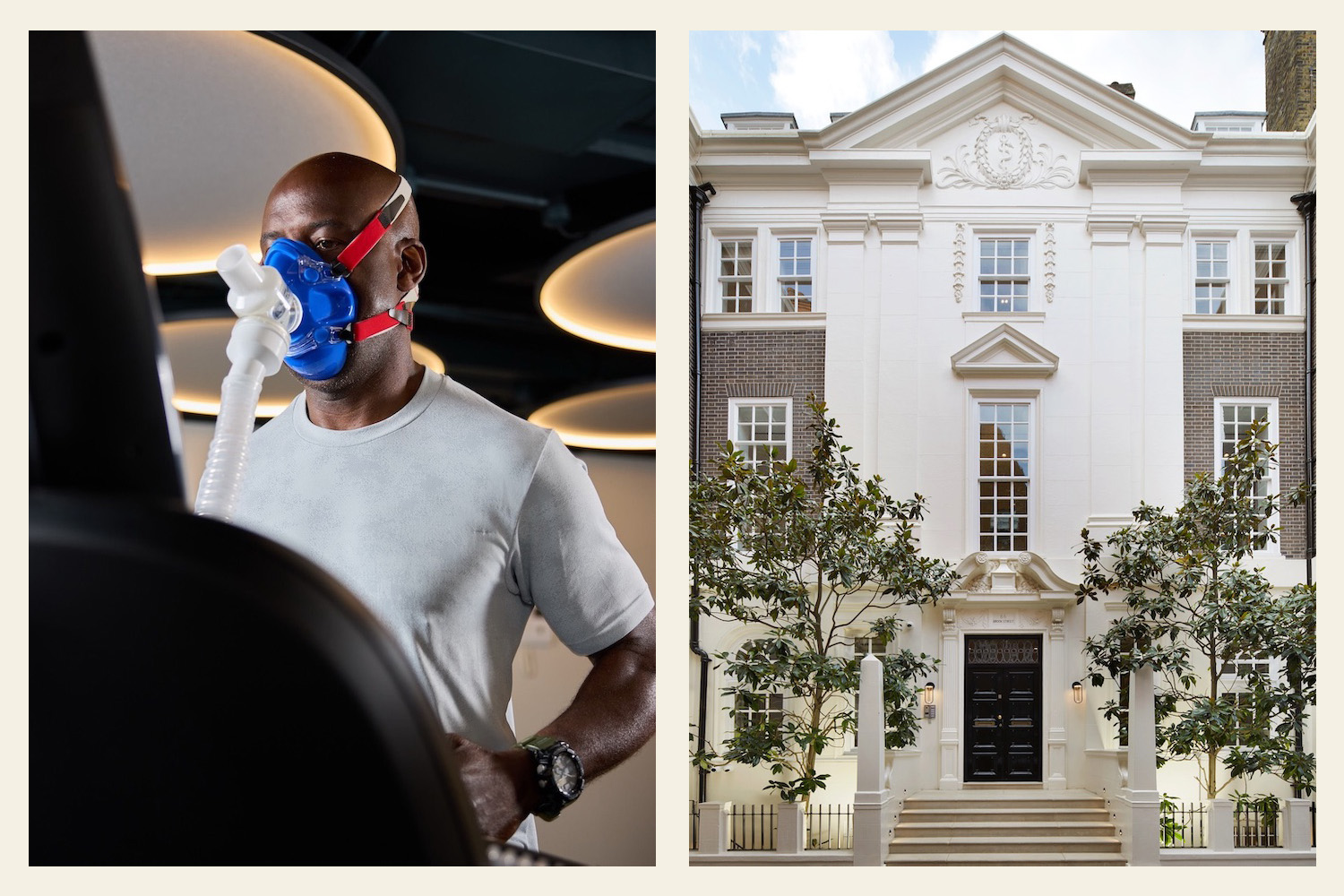
It’s 10 a.m. in London’s posh Mayfair neighborhood and I’m laid out on a bench, breathing through a plastic tube, my nose clamped shut. I haven’t ended up in the emergency room after a heavy night in Soho. Instead, I’m checked in for the morning at Hooke, one of the members-only longevity clinics cropping up across Europe and the United States that cater to the one percent.
Founded in 2019, Hooke’s tagline is: “The true measure of wealth is well-being that endures.” In short, anything a deep-pocketed person is concerned about, they’ve got it covered. I’m here for a baseline test of my body composition and brainwaves. At 36, I’m slightly younger than the average client. According to Hooke CEO Kate Woolhouse, most members are in their late 40s, with a fairly even gender split.
Woolhouse thinks private health clinics like Hooke are booming due to a predictable culprit: COVID, which forced people to “reassess how they invest their time, energy and money.” As health becomes a luxury signifier for many UHNW individuals (industry shorthand for “ultra-high net worth”), she says “health has moved up the hierarchy.”
Ahmed (not his real name) checked into Kuon Healthcare, another private clinic in London focused on blood testing, when he was suffering from low energy and lack of sleep, something he didn’t feel his regular doctor was addressing. He says patients like him don’t want to wait weeks for test results anymore, and that receiving more in-depth information can help them take charge of their health choices.
Dr. Mohammed Enayat, founder of the longevity clinic HUM2N based in the city’s equally-swanky Chelsea neighborhood, agrees with that sentiment. He argues that the popularity of these providers isn’t a response to biohacking trends, or people seeking luxury, but simply represents a gap in the system. He believes most healthcare options are “too reactive, too fragmented and too late.”
Enayat says that improving “healthspan” — the period of life in which we’re fit and healthy, not just alive — requires “a different model of care that combines prevention, diagnostics and targeted intervention into a single, physician-led system.” This level of insight can be difficult to put a price on. It’s also exactly what private clinics like Hooke promise.
Lie Still and Breathe Through This Tube
After I was welcomed into the clinic (which is upscale but relaxing; think: deep cream sofas, earth tones) they hooked me up to the InBody770, a body composition machine which uses electrical currents to analyze your muscle mass and body fat. (If I’m being honest, my local gym has the same tech.) But the next test — the one with the tube — I can’t get around the corner.
Lorenza Amodio, Hooke’s client advisor and nutritionist, explains to me that we’re measuring CO2 over a span of 10 minutes, which will provide a useful indication of how many calories I burn at rest throughout the day. It’s quite a meditative experience, lying there in a dark room, with nothing to do but breathe.
My tube results suggest that I torch 2,250 calories without doing anything. That’s a pretty standard number for men. Pencil in exercise (I exercise at least six times a week, a mix of running, bouldering and strength training) and Amodio reckons I could consume 3,300 calories daily and maintain muscle while still losing weight. That’s about 1,500 more calories than I thought I could get away with. Learning this might just put an end to my crash diets.
There is some bad news, though. Amodio talks me through the results of my body scan. While my skeletal muscle mass is higher than average, so is my body fat mass, at 21.8. Of particular concern is my visceral fat level. This is the fat that cushions your organs. Too much is bad news for my heart, despite all the running I do. Amodio shows me a chart, with age across the X axis and the total square centimeters of visceral fat along the Y. At my age, my score should be below 100. But at 99.8, I’m clearly taking the piss.
“This gets more important as you age,” says Amodio. “This bit around the belly is particularly important to keep an eye on.” It’s honestly shocking. I ponder the results over lunch. I was required to fast for these tests, and I felt a little guilty as I devoured a pastry from a nearby Starbucks.

The Analog Life: 50 Ways to Unplug and Feel Human Again
There’s life beyond the infinite scroll. We put together a toolkit of habits, routines and products to help you live more intentionally.When You Can Afford to Be Proactive
Clinics like this price themselves for a very particular type of clientele. Dr. Dimi Vichas, founder and medical director at Eudai Longevity Clinic, says their clients are predominantly founders, CEOs, investors and “high-performing professionals” — people who tend to tie their health directly to themes of performance. “They come to us not because they are unwell, but because they want to stay exceptional.” Vichas says his clients are starting to realize that “health is not a passive asset. Yes, there is an element of luxury and exclusivity, but fundamentally this is about control — understanding your body and using that information intelligently.”
I have to admit that as someone who grew up in a not-so-wealthy area in the north of England, this type of talk can sometimes set my teeth on edge. In a country with an exceptional yet critically underfunded public health service, it feels like clinics like this are only widening the gap between the haves and have-nots. Even a middle-class journalist like myself could never actually afford to visit one of them.
Simon, a 70-year-old HUM2N client, says his health background is “typical of someone who spent years focused on building a career at the expense of everything else.” With a background in finance, he may fit the model of the typical private healthcare customer in more ways than one. After developing diverticulosis, a hiatus hernia and IBS, he turned to this specialized field as a way of getting a clearer picture of what was going on in his body, and a roadmap for improving it in a meaningful way. He’s now cut out alcohol and uses a wearable to track other health metrics. He’s also more mindful of stress and what he’s eating.
He says the difference between visiting a private clinic and using traditional healthcare is the feeling that “you’re actively doing something positive for your health rather than just reacting to a problem.” In Simon’s mind, traditional medicine is largely reactive, with an emphasis on diagnosing rather than preventing.
I have to agree. The British National Health Service should be protected at all costs, but sometimes it can feel like being shunted from one appointment to another without clear answers. “I trained in hospital medicine, where the focus is often on managing disease once it has already taken hold,” Vichas adds. “What became clear to me is that high-performing individuals don’t want to wait for that moment — they want control, precision and foresight when it comes to their health.”
I bring this up with Dr. Jean-Marc Sobczyk, Hooke’s integrative medicine and longevity physician. “Having a regular doctor that knows your history and can notice subtle changes is important,” he says, adding that ideally this should be accessible to people of any income bracket. The reality is different; even my parents’ small village has seen doctors come and go in recent years. “The type of investigation we do is expensive, but it’s comprehensive,” says Sobczyk. He hopes that as private clinics grow, prices to entry are lowered. “The more we do this kind of thing, the more likely it becomes mainstream,” he suggests.
For now, the cost of such high-end, bespoke care is prohibitive. Hooke charges £300 (about $400) for an initial consultation, with the most expensive membership package setting you back £28,500 per year (roughly $38,000). That’s only seven to nine grand less than the average annual salary in the U.K. But you don’t have to go all out. Sobczyk makes a good point. “This is a great investment. If you can buy a new iPhone every 18 months, you can probably invest the same amount of money in your health.”
What’s Going on Upstairs?
Clinics like Hooke aren’t just for measuring your body composition. After my BMI scan, I’m hooked up to an electrode cap and run through a series of WAVi EEG tests on a laptop. The first involves closing my eyes and clicking a mouse every time I hear a high-pitched beep. Hooke’s brainwave expert Filipa Mateus explains to me that this is less about checking my hearing and more about measuring how quickly my brain picks up on a signal and relays the message to my finger. The next test sees me stare at numbers as they count down from 240. This measures theta and beta brainwaves, the former associated with relaxation and daydreaming, the latter with focus. My mind wanders almost immediately.
In the final assessments, called “Trail Making Tests,” I have to link a sequence of scattered numbers and letters. If you’ve ever done dot-to-dot as a kid, same thing. You need to link 1 to A, 2 to B and so on. The idea is to measure your cognitive processing speed. I enjoy this one, and my score is happily above the target range. For everything else, I’m comfortably in the good range or slightly above. Speaking with Sobczyk later, he says my brain is able to engage a solid amount of neurons when focused on a task. I’m not quite sure exactly what this means, but it sure sounds good.
Other results I take with a pinch of salt. One scale Sobczyk shows me pertains to mental health. My arrow is bang in the middle. Too much one way and I’d show signs of anxiety, too much the other and I might be depressed. According to the chart, I’m fine.
“But this is one of the busiest, most stressful months I’ve had in years,” I say, explaining that I almost always feel anxious and my sleep has been poor. Sobczyk shrugs. He says that the effects may not have caught up with my brain yet. Based on the evidence, I may not be as stressed as I feel. Maybe I need to work on my resilience, or maybe I need to trust my instincts and speak with a mental health professional as well. And that’s the thing: as all-encompassing as these health clinics are, it never hurts to seek a second opinion.
Next, Sobczyk and I finally talk about that pesky visceral fat around my middle. He suggests something interesting. People who overtrain often have too much cortisol in their system. As well as leading to leaky gut in long-distance runners, this can cause the body to hold onto fat around the middle. He suggests I try adding more nutrient-dense food, instead of eating less food — and start taking the following supplements: berberine to help balance blood sugar and fat metabolism, glutamine for my gut health and folate to help cell repair. It’s useful advice. I have a sporadic relationship with supplements and, like Simon said, receiving actionable knowledge like this makes me feel like my destiny is in my hands.
Is Any of This Worth It?
Are health clinics a bit of a scam to make rich people feel good, or are they actually helpful? Personally, I can say it works. A year ago, I had a body scan at a different clinic. The advice was simple: I needed to lose weight and cut down my blood pressure. I decided to give more structure to my workouts; I signed up for a few half marathons and resolved to hit 100 push-ups and 100 sit-ups per day. I also reinvested in CBD oils and beta blockers, and started using free YouTube meditation videos in a bid to lower my stress and blood pressure.
My trip to Hooke showed me that my BMI, at least, is still a work in progress. I’m definitely slimmer than I was, but it’s given me a timely kick to tighten things up again — to eat fewer biscuits throughout the day and indulge in less takeout.
What clinics like this really provide, though, is an individualized sense of well-being, a plan catered exactly to you, which should help keep things on the right track as you age. Like any medical or wellness plan, users benefit most from repeat check-ins so that progress can be monitored, deviations noted and advice readjusted. With a follow-up out of my budget, I hit the nearest pharmacy on my way back to the Tube. There, I loaded up on a plethora of the recommended pills, assured that I was doing my bit.
More Like This






Twice a week, you'll find guinea pig features, personal essays and expert interviews on living better — for however long you’re here. Subscribe to Champ now.