

It seems like every public figure these days likes to describe themselves as “multifaceted.” For Bobbito García, a New York City native who came up during the golden age of hip-hop and had a hand in its dissemination into the wider cultural sphere, the label actually fits. A lifelong basketball enthusiast and streetball player, García has also been a beloved DJ, an authority on sneakers and the founder of an influential independent record label. With the publication of a new memoir, he’s also chronicled the disparate places his passions have taken him over the years.
It’s called Bobbito’s Book of B-Ball Bong Bong! A Memoir of Sports, Style, and Soul, and InsideHook is pleased to present an excerpt from it here. In it, García shares some of his memories of playing street basketball in NYC in the late ’80s, along with his experiences finding common ground with other notable figures who had similar experiences in their formative years, including the rapper Rakim.
“[P]eople customized sneakers before me, so I don’t want to take the credit for being a pioneer, but I certainly was recognized for it in a way that people before me doing it hadn’t been,” García said in a 2019 interview. This excerpt from Bobbito’s Book gives a sense of where that passion came from, and where it took him.
There was a move I developed in the late eighties out of curiosity and a drive to be original. It started with a Pistol Pete Maravich stationary drill where he’d do a V dribble on the side of his body, back and forth while bouncing the ball as hard as he could. I thought, What if I did the same motion, but in between my legs? To achieve it smoothly, I needed to lift my foot for the catch behind my back in my “blind spot.” Once I got that down, I imagined the scheme in forward motion. Took weeks of practice, but I’d fantasize that there was a defender running alongside me on the break who would bite for the fake once I dribbled rigorously between my legs while turning my head in the direction of my teammate trailing. When I caught the rock to go forward, the D would be lost, and I could slide to the hole uncontested. I needed to test this theory out.
The first time I unleashed the move was during a five-on-five at the Goat. I raced downcourt, and at the top of the key I defied conventional basketball with exuberance. The defender was dumbfounded as he kept saying, “What did he just do? What did he just do?!” Shortly after, I had a tournament game in Harlem at PS 194 on 144th. I had a two-on-one fast break with my teammate trailing, and BOOP! When I scored afterward the whole gym exploded. “That’s Soul Man!” I heard two kids shouting in the stands while pointing at me. They were referring to Jimmy Tate, a celebrated Entertainers Basketball Classic (EBC) trickster who caught hood fame while playing at the legendary Rucker. Other than our skin tone, Jimmy and I looked nothing alike. I still took the reference as a compliment. I was being likened to a ball handler who had a rep in the world’s most famous outdoor arena. That became aspirational.
I’d never seen anyone attempt what I had invented, not even close. I pushed the envelope, and that just cracked open my brain to explore more. I started wondering why I’d even wasted my time playing college ball. Don’t get me wrong, had I had a different experience I would have never thought that. I did realize that organized sports were not for everyone. And that was okay. For me, uptown was where the life of the party was, where I felt most comfortable, and where I wanted to stay. I didn’t mind jumping downtown to go clubbing, though.
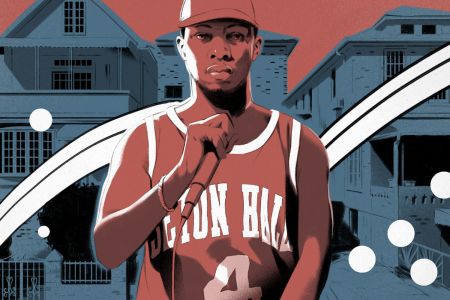
The Mystery of the Rarest Basketball Jersey in the Hip-Hop Canon
In 1991, Phife Dawg wore an obscure Seton Hall jersey in a music video. Where the hell did he find it?… My favorite hip-hop-meets-b-ball moment of the early nineties was when Def Jam flew me to the BRE Convention in New Orleans. The biggest names in rap were on the bill — Public Enemy, LL Cool J, Run-DMC, Big Daddy Kane, and … Rakim. The next day, I went searching for pickup and landed at a local Y. The gym was so hot that they had fans the size of airplane propellers blowing in each corner. The “God” walked in with his crew, then we picked sides and ran a full. The tone was “nobody’s smiling,” just like his “In the Ghetto” song lyric. I went to the Baja and pulled off the same signature V-dribble fake to the trailer I’d first debuted at the Goat and then PS 194. Bong bong! Two of Ra’s teammates snapped their necks in the wrong direction and I scored.
After the five-on-five, he gave me a pound while saying, “You got a nice game, g,” and yo, I kid you not — Rakim let out a smile. I never even knew he had teeth. I returned the compliment then asked him if he had played in school before he became the world’s most influential lyrical architect. “Football was my sport…” he shared. “But, you know, I played a little ball, too. Everybody did.”
The above is excerpted from Bobbito’s Book of B-Ball Bong Bong! A Memoir of Sports, Style, and Soul by Bobbito García, published by Akashic Books/Edge of Sports.
More Like This

Twice a week, you'll find guinea pig features, personal essays and expert interviews on living better — for however long you’re here. Subscribe to Champ now.