
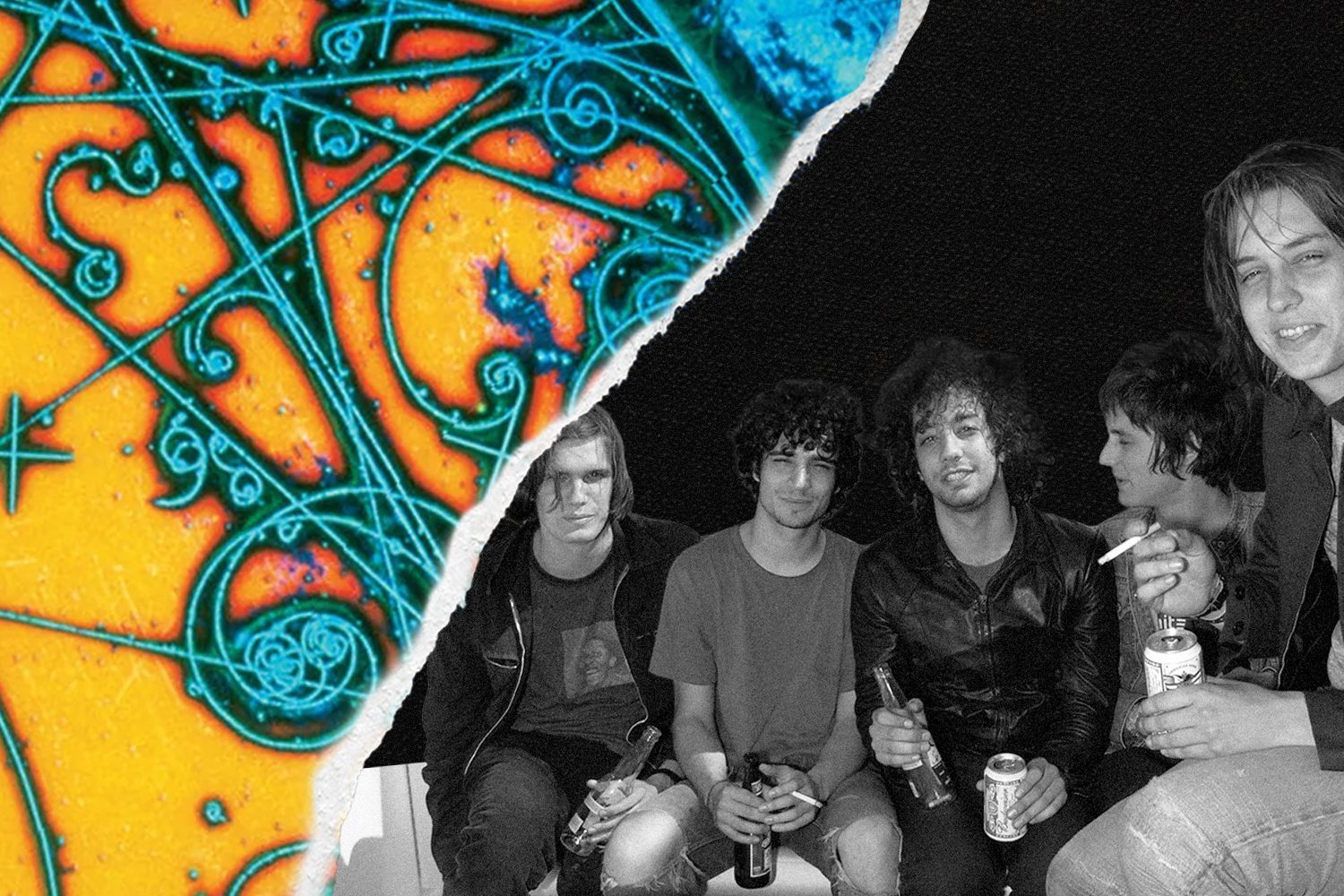
The Strokes were the definitive rock band at the turn of the millennium. Despite never reaching the band that “saved” rock ‘n’ roll, we can’t stop thinking about them. In this excerpt from Steven Hyden’s new book, Is This It: The Never-Ending Rise and Fall of the Strokes (and Rock ’n’ Roll), he delves into the history and legacy of the greatest song that never made it onto their debut album.
The version of Is This It that New Yorkers heard blasting out of neighborhood jukeboxes in the weeks and months after September 11 is not the one the rest of the world heard, looked at, and sometimes bought.
The most obvious difference is the cover image. The American cover originates from 1988’s The Nature of Things, an album by the obscure California New Age artist Bruce BecVar. A portion of the image, which depicts subatomic particles floating in a bubble chamber, also appears on the cover of Graffiti Bridge, the soundtrack to Prince’s misbegotten 1990 movie musical. (You can see it just to the left of Prince’s head.) Casablancas later explained to the radio host Matt Pinfield that he picked the image because “I thought it was cool,” as it looked “almost like a painting.”
Outside of the United States, fans of The Strokes did not ponder subatomic particles when they looked at Is This It. Instead, they were greeted by a stylish black- and-white photo showing a woman’s naked torso from the right side. Her black glove- covered hand is placed gently on her backside, an image that positively exudes sexy sleaze. It was taken by Colin Lane, an English photographer who unofficially documented The Strokes from 2001 to ’06, although the Is This It photo was snapped at least a year before he met the band.
“I had just done a fashion shoot for The Observer Sunday magazine,” he later explained, “and the stylist had left all of the clothes at my apartment to be picked up the next day. I saw the black Chanel gloves and asked my girlfriend to pose for some pictures with them. She had just gotten out of the shower and was like, ‘No I’m tired I’m going to bed.’ I pleaded a bit and convinced her to do ten pictures.”
Casablancas later picked the so-called ass shot out of Lane’s portfolio in the spring of 2001. “[Julian] was like ‘That would be a cool cover. Would you mind if we used that?’ Obviously, I said of course not and so everybody was happy.”
It’s been widely assumed over the years that the cover was changed for the American market because the image on the international release was too salacious. But in a 2024 interview with Matt Pinfield, Casablancas insisted that “the art changing was our doing.” For Julian, putting out a record in England and elsewhere “didn’t seem as real,” which emboldened him to switch up the cover. “People thought it was too controversial to have an ass, which I think is fine. It also had a Spinal Tap vibe.”
The “ass” image is certainly more rock ’n’ roll than the American cover. Whether Julian’s aversion to “rock” posturing was a factor in him going the more scientific route is unclear. But I don’t think it’s an exaggeration to suggest that the international cover sets the listener up for a different experience than the stateside one. The “ass” cover reiterates the idea of The Strokes being in the lineage of rebellious five-piece rock bands. It evokes classic “dirty” album covers like Sticky Fingers by the Rolling Stones, designed by Lou Reed’s Velvet Underground–era patron, Andy Warhol. Though on the Stones cover, the stylish black- and- white photo depicts a man’s fully clothed (and possibly erect) midsection rather than a nude female profile. Still, the same “naughty” idea is conveyed. The American cover, meanwhile, doesn’t have the same attitude. And I think that’s to the album’s detriment, though admittedly I am more of an AC/DC guy than Julian Casablancas.
The album cover was an obvious cosmetic change. But the more substantial alteration to Is This It was musical— the replacement of “New York City Cops,” one of the greatest Strokes songs ever, with “When It Started.” This change was directly related to September 11, given that the chorus— which proclaims that the city’s police officers “ain’t too smart”— landed awkwardly in the aftermath of the tragedy.
This was the right choice in terms of sensitivity and public image management. But artistically, it made the album worse. I believe that Is This It is more aesthetically exciting with the “ass shot” cover. And I also think it is more musically satisfying with “New York City Cops” situated on side two between “Hard to Explain” and “Trying Your Luck,” as originally intended. As a live performance, it is the most visceral track on Is This It, with the band exploding out of their usual self- imposed robotic restraints. And lyrically, it’s the most genuinely edgy part of the record. Removing it took away some of The Strokes’ bite.
Behind the scenes, “New York City Cops” immediately stood out. For producer Gordon Raphael, “it shines as one of my favorite songs I have worked on,” he writes in his book. He loved the massive- sounding floor tom and tambourine at the start. He adored the conversational opening lines— that emphatic “ow!” coupled with the sarcastic laugh, followed by the offhanded “No, I didn’t mean that at all”— which he claims he insisted Casablancas keep after the singer initially thought about changing it. And he loved the “sniff” inhalation sounds, which suggested that Julian was snorting Dickey Betts–sized lines in the studio. (This was not the case, Raphael assures us.) In the end, he declared that “New York City Cops” is “a very perfect rock song.”
Raphael loved “New York City Cops” so much that when James Endeacott, the A&R man for The Strokes’ UK label Rough Trade, stopped by the sessions, he picked that song specifically to bowl him over. And it worked. “I screamed with joy when I heard it,” Endeacott told the NME.
American listeners knew they were missing “New York City Cops” on Is This It. Leaving the song off the record became part of the album’s media narrative. A factoid mentioned in every article about fearful record executives and feckless radio programmers shielding the public from any song that might offend fragile post- 9/11 sensibilities. Though the decision to excise the song, like the move to change the cover, was ultimately approved by the band.
It all came down to that chorus. At any other time in history, sarcastically mocking New York City’s finest for their lack of mental acuity would not send pulses racing. Besides, as Gerald Marzorati argued in The New York Times, “the song is not about cops actually, but about a kind of girl who keeps saying stuff like that— and, perhaps, a kind of girl who you should know better than to find yourself alone with deep in the night, but there you are.”
I agree with that reading— the chorus doesn’t strike me as a comment on low- IQ policing but rather sounds like the sort of thing people say when they’re talking shit at the bar after several drinks. “New York City Cops” actually takes place after the bars have closed, and Julian is in a bedroom with some girl named Nina. “Time to go now,” she says. But for Julian, hopeless nineties rock romantic, “it ain’t easy” to leave. But he knows he must let it go, even though he can’t get “that thing” she keeps saying every night out of his head.
When I listen to “New York City Cops,” I don’t hear anything political. And I certainly don’t discern any ideology when I look at the lyrics. However, at least one person would disagree: Julian Casablancas.
“‘New York City Cops’ was an overtly political song,” he says in a 2018 Vulture interview, the one where he also asks if you can “make complex truth sexy.” He goes on to claim that the song was inspired by instances of police brutality in the city generally and the 1999 killing of Amadou Diallo specifically. But even if we take Casablancas at his word, I can’t really discern an anti–police brutality message in “New York City Cops.” It’s simply not there in the lyrics. Compare it with “American Skin (41 Shots),” a Bruce Springsteen song also inspired by Diallo’s death that debuted in the Boss’s live sets in 2000. The “message,” as it were, of “American Skin” is impossible to miss. Whereas with “New York City Cops,” if you never read a Julian Casablancas interview, any political content would be next to impossible to hear. Nevertheless, for Casablancas, taking “New York City Cops” off Is This It also meant “the political element got removed from the band’s narrative.”
Although I don’t agree with him on the particulars of this song, I do think he’s getting at a broader truth about The Strokes and how futzing with Is This It in small but significant ways changed their trajectory. If their career can be viewed as a series of successes and failures— or successes and failures happening concurrently— taking “New York City Cops” off Is This It must be counted among their earliest misfires, even if it was politically wise and professionally expedient. The decision affixed a permanent compromise to what should have been an inarguable triumph. It put The Strokes behind the eight ball right as they were being introduced to millions of listeners for the first time.
What would have happened had “New York City Cops” been on Is This It? Here are some educated guesses. One, the media would have focused on the song out of proportion to the rest of the record. Two, police unions would have issued sternly worded public releases. Three, some retailers might have refused to sell the album.
These are problems. But they aren’t long-term problems. It’s likely over time these controversies would have passed. And what would have remained is the sense that Is This It with “New York City Cops” is a slightly more dangerous, confrontational, and (yes) political album than the record without it. Is This It would have been closer to the ideal for Julian Casablancas, the underground rock record that takes over the mainstream and challenges audiences with uncomfortable but important ideas. It would have shifted— again, in a small but significant way — how The Strokes are perceived. Detractors would have less ammunition when dismissing them as shallow wannabes. They would have to be viewed, undeniably, as courageous.
The American version of Is This It is still a great record. It’s just slightly less great than the record The Strokes actually made.
PERMISSIONS LANGUAGE:
Excerpted from IS THIS IT: The Never-Ending Rise and Fall of the Strokes (and Rock ’n’ Roll) by Steven Hyden, published on September 8, 2026. Copyright © 2026 by Steven Hyden. Used by arrangement with Da Capo Publishing, a division of Hachette Book Group. All rights reserved.
More Like This



This article appeared in an InsideHook newsletter. Sign up for free to get more on travel, wellness, style, drinking, and culture..