

The current Department of Health and Human Services appears to have a real fondness for elementary school PE.
In July of last year, President Trump signed an executive order to bring back the Presidential Fitness Test, which Health and Human Services Secretary Robert F. Kennedy Jr. called “a huge item of pride when I was growing up.” This week, Kennedy resuscitated the food pyramid, that triangular cornucopia that hung for decades in classrooms and nurses offices across America.
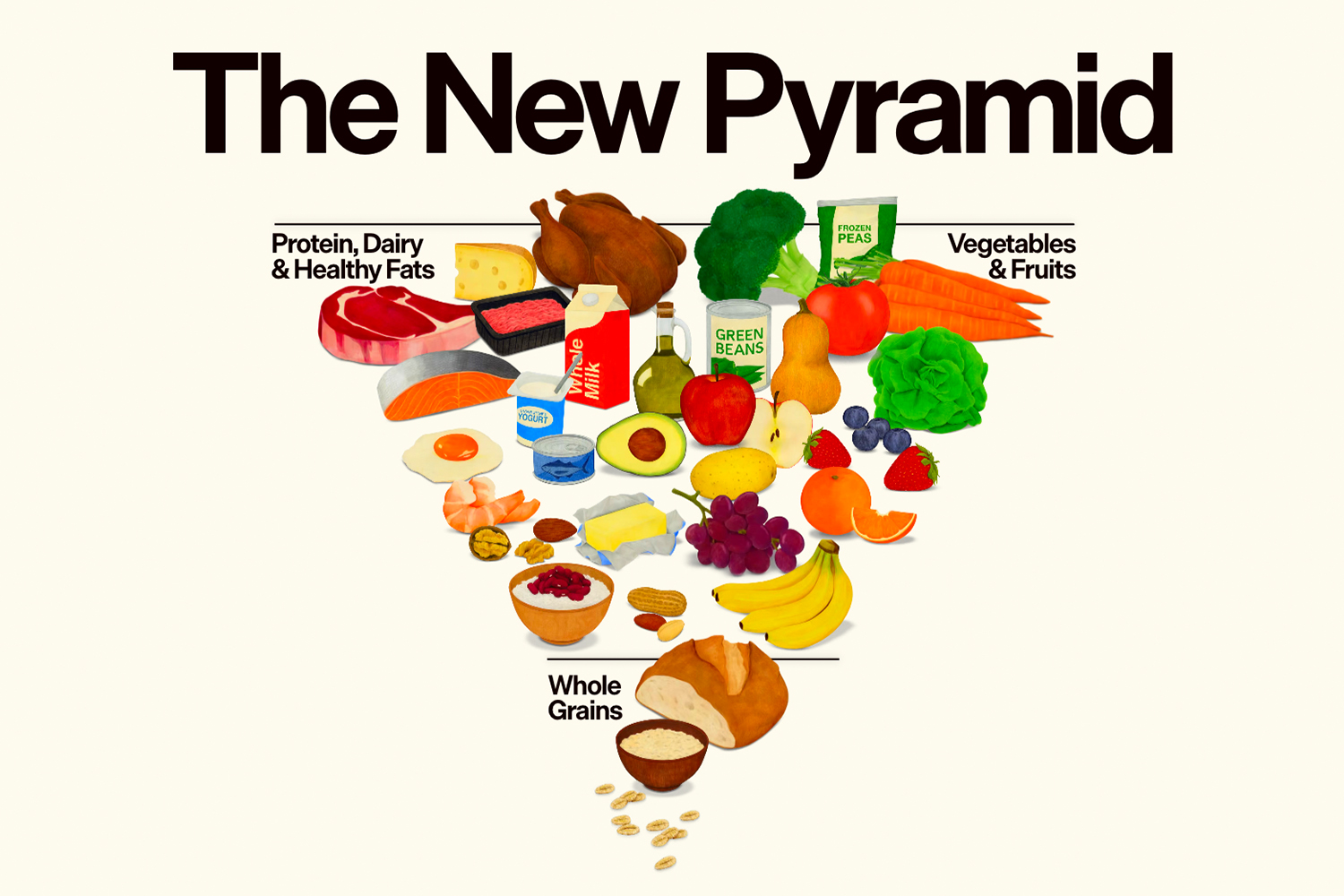
Only Kennedy and his team of 10 self-selected experts have flipped the pyramid on its head. The new illustration puts protein, dairy, healthy fats, vegetables and fruits at the top (if we’re getting technical, the “spire” of a rotisserie chicken reigns above all) and whole grains at the bottom.
I stared at this new pyramid for five minutes before concluding the grains section has bread, a bowl of rice and a handful of cereal that someone dropped on the ground. I guess the lack of clarity is a message in itself: the Department of Health wants you to eat fewer carbs.
Other changes? They’ve cut out the “Use Sparingly” section, which comprised the tippy-top of the old diagram, and usually depicted chips, cookies or other processed junk. Finally, oddly, wedged between a vine of grapes and a single almond is a big stick of butter. I would’ve been a real smart-ass if this chart had dropped in 2004. Raises hand: “So butter is now healthier than bananas, Mrs. Walsh?”

A Nasty Phone Habit We All Need to Retire This Year
Put it away — you’re on the stairsDid They Get It Right?
By the standards of Kennedy’s expansive “Make America Healthy Again” agenda, these updates to the food pyramid are pretty tame.
Earlier this month, his team dramatically reshaped federal vaccine policy, axing six vaccine recommendations from a list of 17. Medical experts are concerned: vaccine hesitancy is already surging — and so are cases of preventable diseases. Last year, the U.S. recorded the largest number of measles cases in 30 years.
But the response to these new dietary guidelines has been measured, because for the most part, the guidelines aren’t that crazy. At his press briefing yesterday, Kennedy said, “My message is clear: Eat real food.” That is good advice on its own. I wasn’t surprised to see that the new pyramid receiving (tepid) backing from the American Medical Association and the American Heart Association. Kennedy even secured support from the American Academy of Pediatrics, who are currently suing him over vaccine changes and extensive funding cuts.
It’s now estimated that up to 58% of the average American diet is comprised of ultra-processed foods. As I outlined last year, UPFs are cheap, addictive and more prevalent than most of us realize; they’re not just Oreos and Doritos. They’re also Bertolli pasta sauces and Nature Valley granola bars. If you leaf through the updated recommendations from HHS, you’ll find disdain for added sugars and highly-processed refined carbohydrates, “such as white bread, ready-to-eat or packaged breakfast options, flour tortillas, and crackers.”
If these new guidelines can help steer Americans away from ingredients that would survive the apocalypse, that’s a win. Still, there’s a big caveat to consider here.
“Meatmaxxing”
Take another gander at the pyramid. Look at all those animal products: milk, cheese, the aforementioned chicken, a slab of steak, a carton of ground beef — in case you didn’t get the message. While fruits and veggies funnel down towards the middle, red meat, poultry and dairy linger firmly at the top, ranked above even salmon, shrimp, tinned fish, eggs and yogurt, all hallmarks of the celebrated Mediterranean diet.
Kennedy loves animal products. He’s never been shy about that, having long advocated for more saturated fat consumption. His devotees include a number of “carnivore influencers,” while five of the 10 experts who helped him create the revamped pyramid have disclosed “recent financial relationships with beef, dairy or pork industries, or food, infant formula, supplement or pharmaceutical companies.”
Commentators online are accusing Kennedy of “meatmaxxing,” pointing out that this chart aligns with the preferred diets of Rogan-coded internet personalities. They’re definitely onto something; at the very least, it’s clear that Kennedy is baking the country’s current protein craze into policy.
A Survivor’s Guide to Ultra-Processed Foods
They’re cheap, convenient and wrecking your health. Here’s how to spot them, what they’re doing to your body and the smartest ways to cut back.The Protein Problem
Though America’s love affair with protein has waxed and waned for decades, last year was when it “jumped the shark,” to borrow some analysis from Stuart Philips, a respected professor of kinesiology at McMaster University. In 2025, protein started appearing absolutely everywhere: in coffee, in cereal, in pancake mix. Slop factories like Chipotle began unveiling “high-protein menus.” Depending on the product (and the demographic of the reader), protein consumption is a silver bullet for weight loss, weight gain, hormone balance, more efficient sleep, anything.
Yet, as Philips explains: “Protein does not bake the cake; exercise does. Protein is the (thin) layer of icing (or the sprinkles on the icing). Once the cake is properly iced, adding more icing does not turn it into something else. At some point, you are just decorating.” It’s unrealistic to expect protein to transform your body if you’re not training in tandem with it. And stuffing your plate with ever more protein is a waste of time and calories.
Kennedy’s pyramid is high on a high-protein diet. And the accompanying literature even spells it out, advising adults to consume 1.2 to 1.6 grams per kilogram of body weight per day. The “old” standard was 0.8 grams per kilogram of body weight per day. I’m 170 pounds, which equates to 77 kg. That’d put me at an expectation of 62 grams per day. But Kennedy wants me consuming 92-123 grams of protein a day. Personally, I have no problem with that — as an athlete, I already hit those numbers daily.
But if you’re not familiar with training or fueling, this ask — by which the average American leaps well into the protein triple digits — could create confusion in your diet, and lead to negative health outcomes. Especially if it leads to you wolfing lots of steak and cheese on a regular basis. I’m not here to demonize red meat; beyond protein, it provides the body with iron, zinc and B vitamins. But it’s important to remember that red meats are high in saturated fat, which raises cholesterol levels, and eaten in high quantities, can increase your risk of colorectal cancer.
Similar to vaccine hesitancy, I’m sure that this sort of blanket advice will have an impact on everyday Americans. Fortunately, it’s not like Kennedy told everyone to start eating more Big Macs. His endorsement of high-protein dairy products isn’t a simultaneous endorsement of highly-processed crap. That’s something. But I’d firmly expect our obsession with protein to persist throughout this year, and perhaps well after Kennedy’s out of power.
More Like This






Twice a week, you'll find guinea pig features, personal essays and expert interviews on living better — for however long you’re here. Subscribe to Champ now.