

If there’s one term that can define the economy in 2025, it’s “K-shaped.” Wealthy Americans are having a great year as their home values and the stock market spike, while those in lower income brackets are struggling under the weight of rising prices and stagnating income.
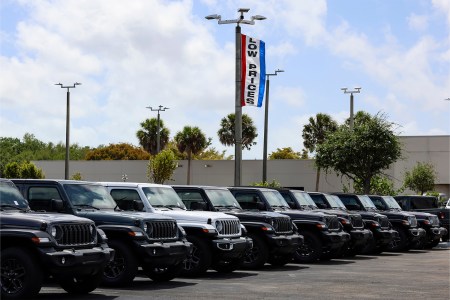
It’s no different in the car market. While automakers are estimated to sell over 16 million new vehicles this year, which would top last year’s figure of 15.9 million, that growth gives a false sense of security about the state of car-buying heading into 2026. Counter to President Donald Trump’s claims Wednesday night that prices are “all coming down and coming down fast,” new cars entered uncharted territory this year: they are now luxury goods.
“I think a new-car purchase has been trending towards a luxury for a while now,” Kevin Roberts, the director of economic and market intelligence at CarGurus, tells InsideHook.
One of the most shocking automotive headlines of the year came in September when the average transaction price for a new vehicle passed $50,000 for the first time, according to data from Kelley Blue Book. That figure alone may have convinced people that new cars had reached luxury territory. But the reality is more complex: a variety of factors, including a surge in EV sales as federal tax credits expired at the end of September, helped push this number to new heights.
Overall, average prices for new cars might actually hold steady between 2024 and 2025 when the final numbers are crunched. That’s not to say things are normal. As Roberts notes, new-vehicle prices are still outpacing inflation, a situation that has been the norm since the pandemic. The key factor that’s squeezing Americans right now can be found in a different statistic: total cost of ownership, which includes sale price and financing as well as expenses like insurance, maintenance, repairs, fuel and registration.
“Where we’ve seen the total cost of ownership really catch up is those insurance costs are now up dramatically [since 2022],” Roberts explains. “And maintenance costs are going up and are likely going to continue going up because now we’re seeing the auto parts be impacted by tariffs,” he adds.
Say Goodbye to the Entry-Level Car
President Trump’s automotive tariffs could deal a killer blow to an already shrinking section of the market. There are other potential outcomes, but none of them mean cheaper vehicles.Compared to an average of 5% inflation over the last five years based on the Consumer Price Index, costs for parts and equipment rose 5.4%, maintenance and repair costs rose 8.7% and car insurance rates rose a whopping 13%, according to data compiled by Cox Automotive, which owns Kelley Blue Book. Insurance appears to have stabilized, though it remains far above normal levels, while the other costs are expected to continue rising in 2026.
“The cumulative weight of all these increases has pushed total vehicle ownership costs beyond reach for many middle- and lower-income households, constraining market access and accelerating the affordability crisis,” said Jeremy Robb, interim chief economist at Cox Automotive, during an industry insights and forecast presentation on Wednesday.
Welcome to the K-shaped economy.
Sales Are Solid, So What’s the Problem?
The good news from 2025? The sky didn’t fall because of tariffs. In fact, Kelley Blue Book estimates that new-vehicle sales will hit 16.3 million in 2025, which would make it the best sales year since 2019. So what’s the missing piece of the puzzle? How is there this much demand if low- and middle-income Americans are supposedly being pushed out?
“Here’s the paradox: We have inventory under $40,000, it’s just not moving the way it used to because the buyers who would’ve purchased it can’t afford new vehicles anymore,” said Erin Keating, an executive analyst at Cox Automotive. “This isn’t everyone suddenly preferring SUVs. The people who can still afford new vehicles are buying what they want: larger, premium vehicles. Everyone else, they didn’t downgrade to a compact car; they left the new market entirely, buying either used or hanging onto what they’ve got.”
The under-$30,000 vehicle looks to be on the path to extinction, just like the under-$20,000 vehicle.
– Kevin Roberts, director of economic and market intelligence at CarGurus
Keating cited major shifts in which income brackets are opting to buy new cars. In 2019, households with income under $75,000 made up 37% of new-vehicle sales; in 2025, they made up just 26% of the market. Meanwhile, households with income above $150,000 went from 30% of sales to 43% of sales in the same timeframe.
“The new-vehicle market became a luxury goods market,” she said. “The consensus is that this shift isn’t temporary. The U.S. market at current pricing dynamics may only support a steady state volume of 15 to 16 million units annually, representing a fundamentally smaller, wealthier market.”
The 2026 forecast from Roberts at CarGurus backs up this claim, with estimates that the new-car market will decline next year while the used-car market will grow significantly.
What’s Affordable vs. What’s Profitable
One major factor that helped keep middle-income, if not low-income, buyers in the market this year was a greater array of new cars, trucks and SUVs at various price points.
“We did see more, I would say, $30,000 to $50,000 vehicles produced this year, and consumers are very interested in those,” says Roberts. “The downside is that the under-$30,000 vehicle looks to be on the path to extinction, just like the under-$20,000 vehicle that used to exist that is now gone.”
Out of the 25 best-selling vehicles in the first nine months of the year, 12 of them had starting prices of under $30,000 — though fees and basic upgrades would quickly tack on thousands to those MSRPs, and likely did. Still, whether it’s a compact Ford Maverick pickup truck or recognizable Honda Civic or family-friendly Subaru Forester SUV, the fact remains that Americans are as interested as ever in reliable, modern lower-priced vehicles.
The question, according to Roberts, is “can they make them at a profitable level for the automaker?”

What Elon Musk Doesn’t Want You to Know About Tesla’s White House Stunt
Is Trump’s recent EV promotion the same as Biden’s? Not by a long shot.Put another way, can they make them profitable enough? The top-line story of the car market in the 21st century is that automakers have been shifting their focus to larger, more profitable vehicles in the U.S. at the expense of smaller, more affordable models. Trump’s tariffs seemed poised to exacerbate this trend earlier this year, though they haven’t yet had a significant impact on new-vehicle prices. But if tariffs don’t ease in 2026, the dam might finally break.
According to Roberts, the trade data shows that there are “billions of dollars in added costs” on imported vehicles in the U.S., but automakers have so far been reluctant to hit car buyers with noticeable price hikes. That’s partly because the tariff policy has seen wild swings throughout the year, and there are more on the horizon as the U.S.-Mexico-Canada Agreement that President Trump signed into law in his first term is up for renegotiation in 2026.
“It could be a situation where they’re trying to wait until they can see where things land before you potentially increase prices,” he adds.
One group that’s not optimistic about the road ahead: the people hoping to sell you a car next year.
“Dealer sentiment hit its lowest level since the pandemic” in the final quarter of 2025, noted Robb of Cox Automotive. “Both franchise and independent dealers signal caution, reflecting persistent economic uncertainty and fading consumer confidence.”
So what are you, the person in the market for a 2026 model year SUV, to do when you hit the brick wall of high sticker prices, astronomical insurance premiums, exorbitant loan payments and reservations about making a big purchase in an unstable economy? Well, Roberts has one idea.
“The used vehicle market, I think, is the off road if you wanted a potential new vehicle but can’t find it.”
More Like This




We're always on the scene eating, drinking and traveling near and far to bring you the best of what's happening out in the real world. Sign up for IRL now.