

There’s a great Seinfeld episode where Jerry’s dad introduces us to his buddy Izzy Mandelbaum, who’s “80 years old and strong as an ox.” It’s a Mandelbaum tradition to assert strength by chanting their last name, and there’s something particularly funny about an octogenarian in a sweatband bragging about how buff he is.
As people get older, stereotypes suggest they should become more frail and delicate. Grandparents start unleashing groan-inducing lines like “I don’t know if you’re getting taller or I’m shrinking” to their grandkids. To be fair, people can get smaller with age because of sarcopenia, the age-related loss of muscle mass. But a growing body of research suggests that the secret to living a long life might be to live more like a Mandelbaum. A meta-analysis of 16 studies on the topic found that “[m]uscle-strengthening activities were associated with a 10-17% lower risk of all-cause mortality, cardiovascular disease (CVD), total cancer, diabetes and lung cancer.”
The benefits of getting and staying jacked as you age go beyond reducing your risk of falls. More muscle also means better organ function throughout the body.
“Skeletal muscle is an endocrine organ that secretes signaling molecules communicating with your brain, liver and immune system,” explains Jordan Weiss, an assistant professor in the Division of Precision Medicine and Optimal Aging Institute at NYU Grossman School of Medicine. “When it declines, that signaling degrades system-wide.”
That’s why maintaining your strength as you enter your 30s isn’t enough; the smarter strategy is to actively build it, creating a reserve for the years when decline becomes harder to avoid. Or as Weiss puts it: “Think of muscle mass as your longevity reserve tank. The more you build going into older age, the more you can afford to lose before hitting the threshold of real functional impairment.”
The prospect of entering your 60s in better shape than your 20s might seem as absurd as a ’90s sitcom plot. But your long-term health is at stake here, so it’s a goal you should take seriously sooner rather than later.
How to Build Strength With Age
One potential problem? Most workouts are marketed to the young and hot. This gap in the fitness industry inspired Kris Herbert to open The Gym Venice, a strength-training center for people 40 and up. “After 40, the conversation shifts,” the strength and longevity coach points out. “Muscle mass becomes something you have to protect. The problem is most people were never taught how to do it properly.”
The biggest difference Herbert has seen between training people in their 20s and 40s is that younger people train with more urgency and intensity. With older people, it’s a longer game that requires more recovery. “A lot of the fitness industry still promotes intensity, variety and fatigue as the goal,” he explains, which can be effective when you’re younger. “After 40, it usually leads to stalled progress, nagging injuries or both.”
Instead of focusing disproportionately on cardio or other high-intensity workouts, Herbert recommends a more structured routine that prioritizes strength training — specifically, foundational movements like squats and hip hinges, as well as pull and carry exercises.
“Strength does not come from randomness. It comes from consistency and progression over time,” Herbert says. “After 40, the people who see the best results are not the ones working the hardest, they are the ones training the smartest.”
Weiss agrees that the key is training smarter, not harder. Outside of that, he says, “The fundamentals don’t really change much with age.” Progressive overload, compound movements and adequate protein are all best practices. While effort alone can make all the difference in the gym when you’re younger, recovery can make or break your progress as you become older. “A 25-year-old recovers from a heavy leg session in 48 hours. A 60-year-old may need 72 to 96,” Weiss explains.
Since older muscle can become less responsive to protein over time, upping protein intake also helps support late-life gains. “Many longevity-focused physicians now recommend 1.6 to 2 grams [of protein] per kilogram [of body weight] for active older adults, roughly double the federal guideline,” Weiss says. Likewise, sleep is “nonnegotiable” because sleep quality and duration significantly influence growth hormone and testosterone. “Training hard on six hours of sleep is like watering a plant and leaving it in the dark.”
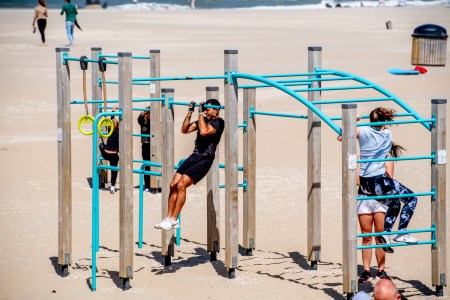
Your Neighborhood’s Best Gym Is Down the Street
Head to the fitness park, where pull-ups, dips and legs raises are effective and freeHow to Test Strength With Age
If you’re looking for an age-appropriate feat of strength to try, you’ve got options. For instance, being able to go from a seated position on the floor to standing without using your hands, known as the sit-to-stand test, can be used as an indicator of strength, balance and potential longevity. Standing on one leg can serve as a similar indicator.
“These tests are elegant because they’re so simple and remarkably predictive,” Weiss says, noting that grip strength is another one of the best indicators of longevity because it shows how muscular you are. One large study across 17 countries found that grip strength was a stronger predictor of death caused by cardiovascular diseases than systolic blood pressure.
“It’s a reliable proxy for total lean muscle mass, neuromuscular integrity and overall physical reserve,” Weiss explains. While these tests are not substitutes for seeing a doctor regularly as you age, they do give people something small and actionable to practice at home. Depending on your family setup, Weiss recommends gently encouraging your aging parents and in-laws to take part in these tests. “They correlate directly with fall risk, hospitalization and whether you’ll be living independently at 80.”
It’s Never Too Late
Whether you’re trying to build up strength in your 30s and 40s, or getting a later start, Herbert and Weiss agree it’s never too late to get off the couch and into shape. Research on adults in their 70s and 80s shows we have a surprising capacity for getting jacked at the buzzer. Some studies even prove that people can build muscle as late as their 90s. Of course, that doesn’t mean you should punt on training right now. “Build the reserve now,” says Weiss. “You’ll need it later.”
In the end, the stereotype that old people are supposed to be small and frail doesn’t come out of nowhere, and you can’t blame pop culture alone. Rather, it comes from outdated ideas that even experts held until they learned more about the science of nutrition, exercise and aging. Yes, these stereotypes persist — and they have consequences.
“The jolly, round grandparent is partly a cultural softening of a very real and very common pathology. The frail-thin image is more insidious,” Weiss explains. When frailty is treated as an inevitable part of aging, older people may be less likely to prioritize maintaining muscle and strength. They might simply seem “thin,” but in reality they’re losing muscle while accumulating visceral fat — a combination that carries serious health risks. And the consequences of these beliefs aren’t purely physical; research out of Yale has found that negative views of aging are associated with shorter lifespans, slower recovery from illness and worse cognitive outcomes.
“The stereotype becomes self-fulfilling,” Weiss says. One of the best ways to resist that is with literal resistance training. More gains, less pain — in your 30s, 40s and beyond.
More Like This

Twice a week, you'll find guinea pig features, personal essays and expert interviews on living better — for however long you’re here. Subscribe to Champ now.