

Austin, Texas’s 1972 Pub opened its doors as March Madness kicked off, hosting a bursting-at-the-seams event with lines out the door. In the buzzy state capital, new bars always elicit interest, but excitement around 1972’s opening was about more than just another cool new watering hole: Austin had its first women’s sports bar.
Hundreds of happy guests queued politely for handcrafted cocktails named things like Billie Jean and Simone and pitchers of light lager with a palpable buzz of contentment and community. Fans of all genders were welcomed into the bright space, decorated with women’s sports memorabilia, to watch women’s matches on their many indoor and outdoor screens. Everyone, it seemed, was in a fantastic mood.
“We believe sport is for everyone and offer an open, diverse space, which builds community,” says founder Debra Hallum, who opened 1972 with her partner, Marlene du Plessis. “We wanted Austin to have a space for women’s sports because it is difficult to watch women’s sports in Austin.”
Hallum and du Plessis were inspired to open 1972, named for the year Title IX was signed into law, after visiting other women’s sports bars, including Seattle’s Rough & Tumble, Minneapolis’s A Bar Of Their Own and The Sports Bra in Portland, OR. The latter was the first women’s sports bar in the United States, now seen as the game-changing institution that kicked off a nationwide movement.

Owner Jenny Nguyen opened The Sports Bra just three years ago in 2022, and in that short time, her vision for “a fun, communal and welcoming gathering place that highlights girls and women in sports” has kick-started a zeitgeist that has ushered in places like Phoenix’s Title 9 Sports Grill, Raise The Bar in Columbus, OH, Set The Bar in Omaha, NE and Denver’s The 99ers.
“There was no way I could ever imagine the bar I was hoping to open would spark a movement,” says Nguyen, who successfully crowdfunded to open The Bra (as it’s affectionately known) after being denied SBF funding. “I had hoped to bring women’s sports fans together to celebrate, to give athletes their much-deserved attention, but I had no idea The Bra would blow the doors open on a whole new segment of the hospitality industry.”
The doors are certainly blown open. In March, NBC reported a projected quadrupling in the number of women’s sports bars in 2025. But this femininomenon hasn’t come from nowhere. Interest in local, national and international women’s sports has been brewing quietly — and sometimes not so quietly — for some time. While women’s sports have jumped from just 5% of television airtime to 15%, this is not reflective of their popularity among fans. The 2024 NCAA women’s basketball championship between Iowa and South Carolina attracted 18.9 million viewers, surpassing viewership for the men’s final. Last year’s WNBA drew a record 54 million viewers, while the 2023 Women’s World Cup broke attendance and viewing records.
Add in a four-year, $240 million National Women’s Soccer League television contract, with total viewership up 95%, in 2023; a massive 40 million views for the Professional Women’s Hockey League’s inaugural 2023 season; and a huge uptake in sponsorship for NIL women college athletes, and the times really are a-changin’ for women’s sports. Stars like Serena Williams, Caitlin Clark and Megan Rapinoe are household names, no longer niche figures. Reflecting this reality is where women’s sports bars come in.
Nguyen was the first to create a space where fans could watch women’s sports without prejudice or stress, but word spread quickly, and what had been a silent frustration became a roar. In Minneapolis, Jillian Hiscock was observing The Bra from a distance, planning how to build her own despite having no hospitality background. Like Nguyen, Hiscock built a community of like-minded fans to launch A Bar Of Their Own.
“Spirited Women” Is the Best Drinks Book of the Year
A beautifully illustrated ode to trailblazing women in the drinks industry also serves as an excellent cocktail tome“From the beginning, I wanted to create a space that was inclusive, family-friendly and finally gave women’s sports the platform they deserved,” Hiscock says. “We worked hard to start building our community long before we had a physical space, as we knew this would need support from a broad community to be successful.”
Community, safety, inclusion and accessibility are at the core of the women’s sports bar ethos. “People are tired of not seeing themselves reflected in traditional sports bars,” says Chelsea Fishman, owner of Atlanta’s recently opened Jolene Jolene. “Women’s sports bars are answering that call by creating inclusive, intentional spaces for fans who’ve always been here but haven’t always felt welcome.”
At Watch Me! Sports Bar in Long Beach, CA, owner Jax Diener agrees. “We offer a safe place to just be: age, gender, race,” she says. “All are welcome.”
The importance of that sense of welcoming and belonging has shown itself culturally and financially. Nguyen proved demand for The Bra, as it hit nearly $1 million of revenue in its first eight months and has since secured funding from Reddit founder and Serena Williams’s husband Alexis Ohanian’s nonprofit, enabling The Bra to open up for franchising. A Bar of Their Own is doing so well that Hiscock has launched an attached nonprofit, A Fund Of Their Own, to support girls and young women who want to play sports. “We know that girls who play sports become women who lead, and too often participation is limited by financial constraints,” she says.
All owners have positive stories of being part of a community that values them, bringing people together and setting a new normal for the younger generation. “We had an elderly woman here watching LSU during March Madness — her grandson brought her,” Hallum says. “She teared up and thanked us, saying she never thought she would see a place like this in her lifetime. She held my hand for a long time.”
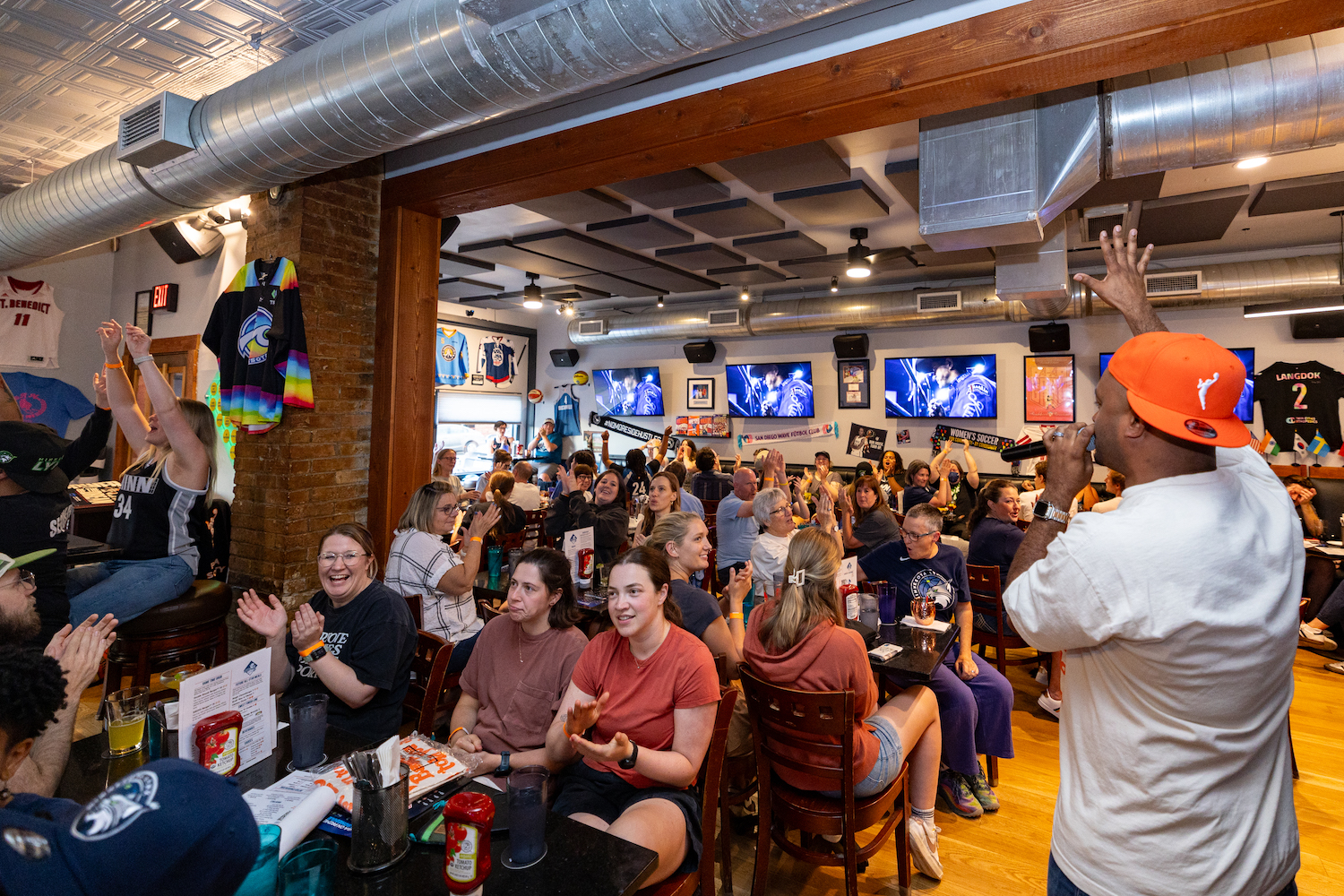
At A Bar of Their Own, Hiscock agrees. “It never gets old to have parents tell me — often through tears — how much it means to them to have their children experience a place like A Bar of Their Own,” she says. “It’s incredible for young kids to be growing up in a world where it is normal to see women celebrated on our televisions and memorabilia covering our walls.”
As well as supporting fans, women’s sports bars are also supporting athletes. As the battle for equal pay accelerates, more spaces for viewing translates into greater viewing figures, giving female athletes a platform to push for greater compensation. “Creating spaces for fandom is so important in the spectrum of women’s sports ROI,” Nguyen says.
“The more people exposed to and appreciating women’s sports, the more conversations folks are having about the value of their performance, the importance of their fan bases and the long-term viability of their place in the sports landscape,” Hiscock says.
That viability is now proven. “Filling women’s sports bars confirms the demand is there,” Diener says. “People are hungry for what we’re offering.” The Bra has already received more than 1,200 franchise applications, and new businesses are opening up nationwide. Women’s sports bars are here to stay — and to a new generation of fans, they will be completely normal.
More Like This


We're always on the scene eating, drinking and traveling near and far to bring you the best of what's happening out in the real world. Sign up for IRL now.