

A meandering drive west from the town of El Calafate takes you through the scenic environs of Argentine Patagonia, with its milky pale glacial lake waters, fjords and mountains. Upon entering Los Glaciares National Park, a monster soon appears, as if you came upon an enormous movie set wherein the stage designer was the full force of mother nature deployed on a time scale of eons.
Witnessing the spectacle of The Perito Moreno Glacier is to be in the presence of something powerful and immense, alive even, and wrought with brutal dynamism. The glacier roars as a beast would, with its calving and creaking. Its colors and contrasts are fierce and captivating. It emerges from the shadows all at once and then can’t be unseen, everything falling under its domain. At three miles across and extending more than 200 feet above the waters of Argentino Lake, it’s but the tip of the iceberg, the advancing edge of a vast ice formation and field that’s among the largest on the planet.
“This glacier is the reason why people travel to southern Patagonia,” says Francisco Vosso, who’s been a Patagonia tour guide for the past two decades after relocating from Argentina’s capital. “It’s one of the most famous glaciers in the world and the most accessible. It has every single thing that people expect to see about glaciers. It’s a must.”
“Perito Moreno is larger than Buenos Aires city,” Vosso adds, part in apparent awe, part with pride.


Heading to Patagonia
Perito Moreno was one of the main must-dos for my trip to Patagonia, an itinerary that was put together by Abercrombie & Kent. Glaciers? Check. I also aimed to tick off some serious world-class hiking with unbeatable views and environs, and after long days in the national parks, I wanted to rest up in the region’s finest luxury lodges.
The operator put together one of their tailor-made Patagonia adventures for me to meet those demands. The trip began in Buenos Aires and ended in Santiago but was centered on moving from El Calafate to Torres del Paine National Park, and therefore experiencing the best of Patagonia’s two halves in Argentina and Chile.
Patagonia is garnering more interest and demand from travelers than ever before. And it’s only been in the past quarter century that modern tourism in earnest began in the region. “2000 was the year that real tourism started here,” Vosso says, referencing when El Calafate’s new airport opened. The lodges, restaurants and Patagonia tour companies have followed suit in the decades since.
In addition to the sheer beauty of the region, Patagonia offers a stark reminder about the state of the planet. “The front of the glacier has receded by half a mile in the last two years,” Vosso says, holding up photos against the backdrop of the glacier as it exists now to demonstrate his point. “Year after year, the glacier is changing. It’s a critical moment now.”
As with visiting someplace such as Svalbard, which is farther north than however far north you’re conjuring, a Patagonia tour is an opportunity to witness firsthand the way humans have wreaked havoc on our home. Maybe, the idea goes, visitors will come away motivated to take more action to prevent the devastation from becoming worse, beginning an irreversible descent into a forever-changed and scarred planet, stripped of so much of its beauty along with its own restorative powers.


Patagonia Pro Tips
And if Patagonia doesn’t inspire you, then indeed, all may be lost. But before you make the trek for yourself, get started with a few essential tips:
- Patagonia’s peak tourist season is the height of its summer, aligning with winter in North America. December to March are the busiest months, but the season has expanded in both directions as demand has increased, now lasting from November through April.
- Much of the region’s tourism infrastructure takes a pause in winter, but a shoulder season stay may offer the best of both worlds for many travelers. “Autumn is my favorite time of year in Patagonia,” Vosso says, citing the changing colors of fall, aligned to late spring (April and May) for those in the United States.
- If there’s no such thing as luck, only the meeting of preparation and opportunity, then there’s no such thing as a good or bad weather day in Patagonia. It’s about gearing up, and being ready for anything. “Layers are everything here,” Vosso says. The only weather certainty in Patagonia is uncertainty.
- In addition to El Calafate and Torres del Paine, Argentina’s El Chaltén makes up the third destination that many visitors tack onto a trip, time allowing. It’s a hiking and mountaineering wonderland and the home of Monte Fitz Roy, the sight of which you’ll recognize even if you didn’t know you would, as it serves as the logo for the Patagonia brand.
- El Calafate has its own airport, and Puerto Natales is the gateway closest to Torres del Paine, though longer journeys may also begin in Punta Arenas, Chile or, down farther yet, Ushuaia, where the majority of Antarctica voyages begin.

The Peaks and Valleys of Patagonia
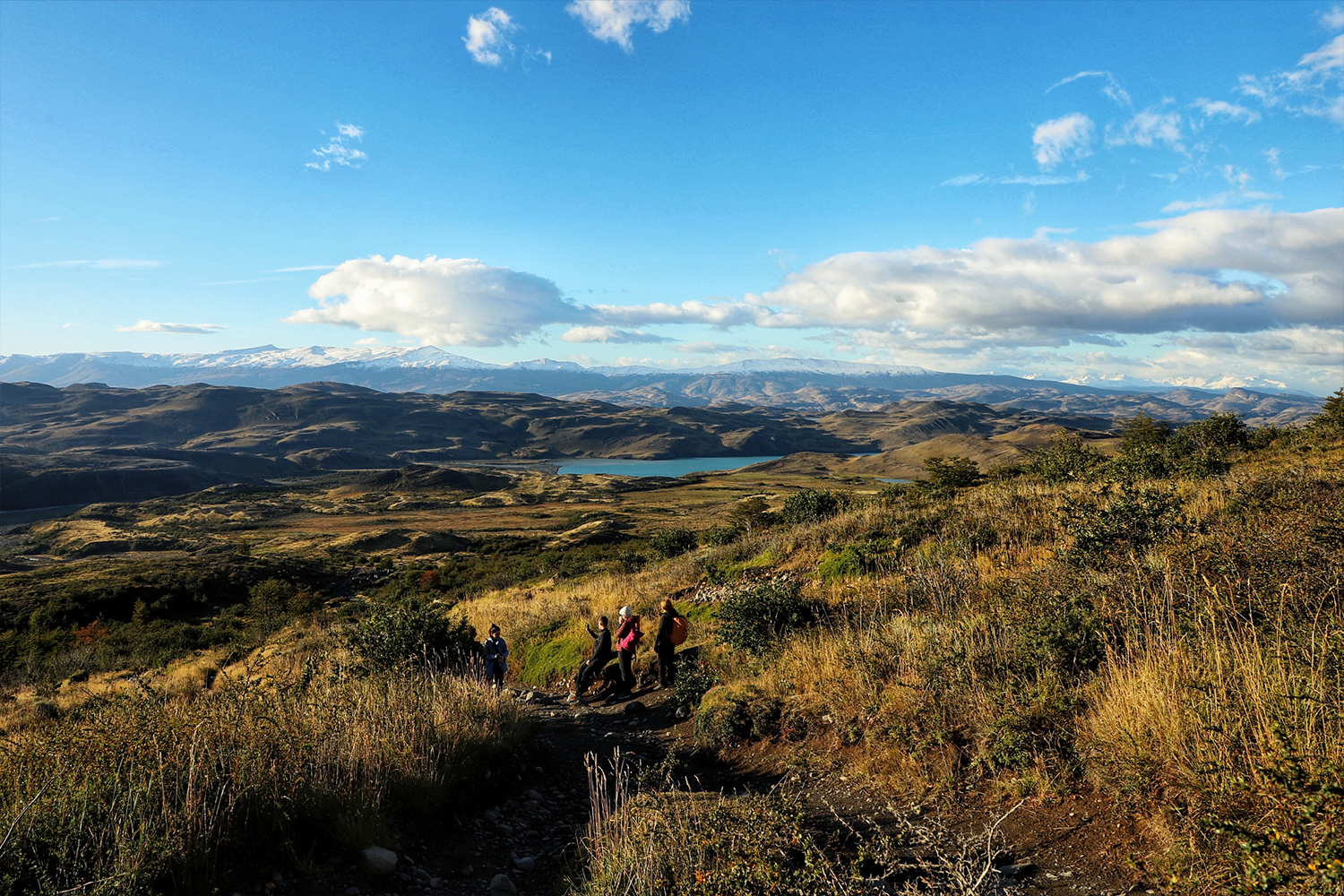
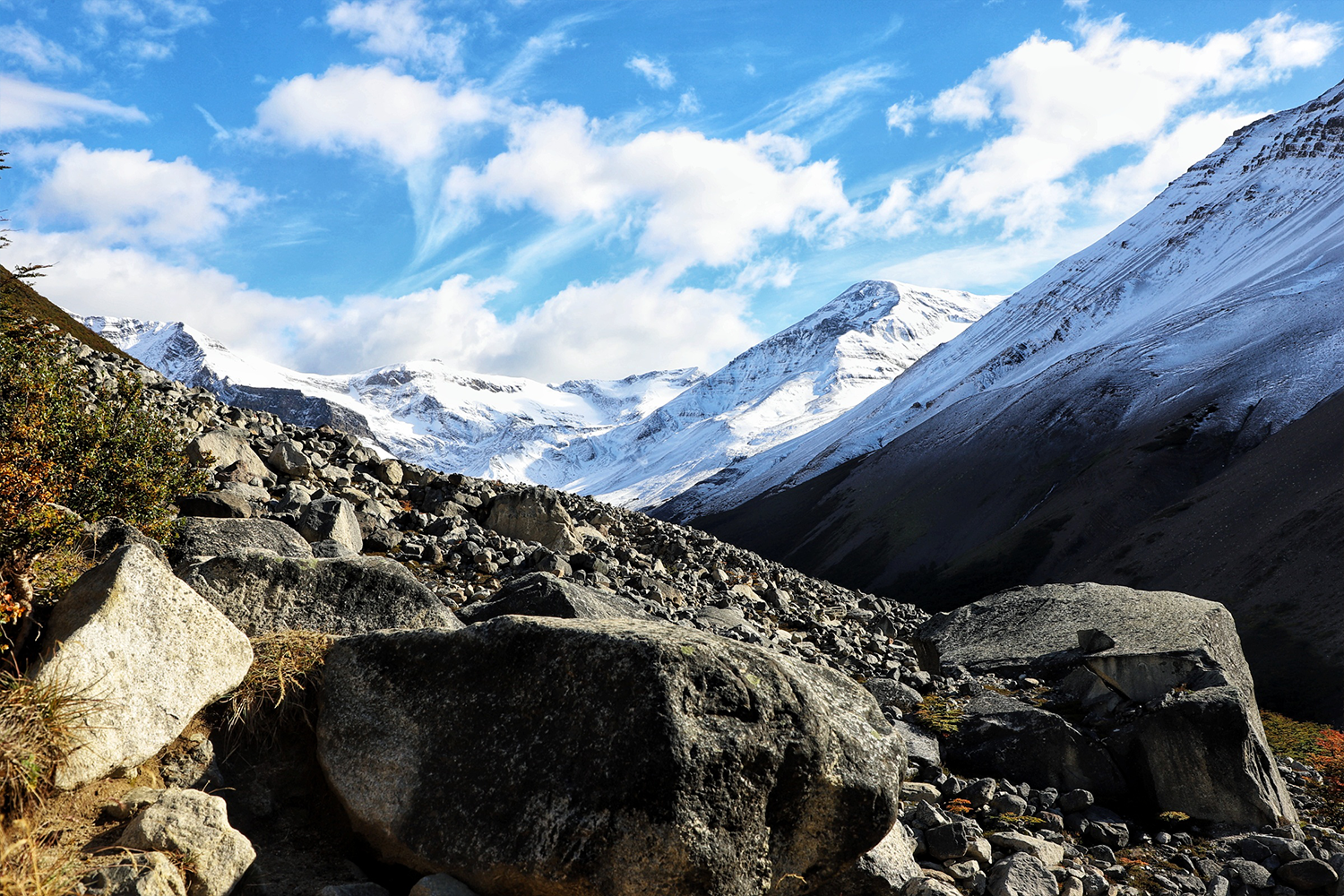
El Calafate’s glaciers and glacial lakes were marvelous, but soon it was time to continue onto the looming Andes, a shift in tone and tenor as you cross over from Argentina and approach Chilean Patagonia’s Torres del Paine. Check right into Tierra Patagonia, a picture-perfect base of operations abutting the national park with an unmatched view of its glory, as if the whole of Patagonia had been dropped into your private backyard.
Tierra Patagonia was built into its environment with the idea of being as unobtrusive as possible. Each of its 40 rooms looks out upon Sarmiento Lake and the snow-capped mountains beyond, and when you’re graced with a clear day, the view incorporates the park’s full iconic mountain formation. It’s every bit the bucket list property worth making this type of trip for, and the experience incorporates bespoke adventures, dedicated guides and lavish on-site amenities.
If there’s a better way to recover from a few intensive days of hiking than lounging by the heated indoor pool, then popping in for a sauna session and massage incorporating healing local herbs and botanicals, I have yet to find it. The gourmet, inclusive food and beverage also provided me with much needed sustenance as I prepared to embark on the hike of a lifetime, the Base of the Towers, also known as Mirador los Torres.
It’s no hyperbole to call this one of the world’s most sought-after daylong hikes — for the views, the terrain, the locale, the perhaps delicate, just-right combination of difficult yet achievable challenge. There’s also some suspense involved in the ordeal: Will or won’t the jagged namesake trio of Towers be visible? Weather forecasts be damned, this is Patagonia, and you won’t know until you’ve hiked out there, crossed around one final obstacle and then gazed ahead.
Only the sharp, pinpoint peaks of the granite Torres del Paine can be viewed as you traverse your way around the national park. The full splendorous scene, the towers jutting up from a pristine glacial lake, has to be earned with a round-trip 13.5 mile hike, incorporating 3,500-feet of elevation gain and culminating in a punishing final push.
Bolivia’s Uyuni Salt Flat Offers One of the World’s Most Epic and Surreal Adventures
Take a Travesía from the Atacama Desert to Uyuni in Bolivia for an otherworldly and inimitable getawayI started the pre-sunrise morning confident, moving with purpose, making my way ahead of dozens of hikers impeding my indefatigable pace. But after several hours only got me to the halfway point of the outbound segment of the hike — a resting stop and campground known as the Chileno Refuge — the realization of the task at hand was sobering. Nothing some trail mix and redoubling my mental focus couldn’t conquer, or so I told myself, with no other tricks up any of my assorted sleeves remaining to deploy.
It’s not that you experience four seasons in a day during a hike like this. It’s that you experience the four seasons two or three times in succession, and the careful choreography required in the removing and re-donning of layers along the way is a thing to behold. “Bring all your weapons,” Luis, Tierra Patagonia’s lead guide, told me about the requisite attire and gear to bring on the hike. He wasn’t joking. Between track pants and quick-dry windbreaker pants, a beanie and a baseball hat, a neck gaiter, a t-shirt, hoodie, long-sleeve, quick-dry button-up shirt and a jacket — yes, sigh, it was a Patagonia puffer — the permutations were boundless.
It was a daunting task, taking me about six hours of active hiking and seven and a half hours total to complete. Total, muscle-aching exhaustion awaited. But she was a stunner, and the big reveal was well worth the effort, not to mention the still-purple toenail I’ve sported courtesy of my less than perfectly fitting hiking boots ever since. It was a thrill to complete the hike, and the sense of accomplishment was perhaps even better than the awe-inspiring view itself. Best of all was the charcuterie spread and cold beer the Tierra crew had waiting at the van when we returned from the hike.

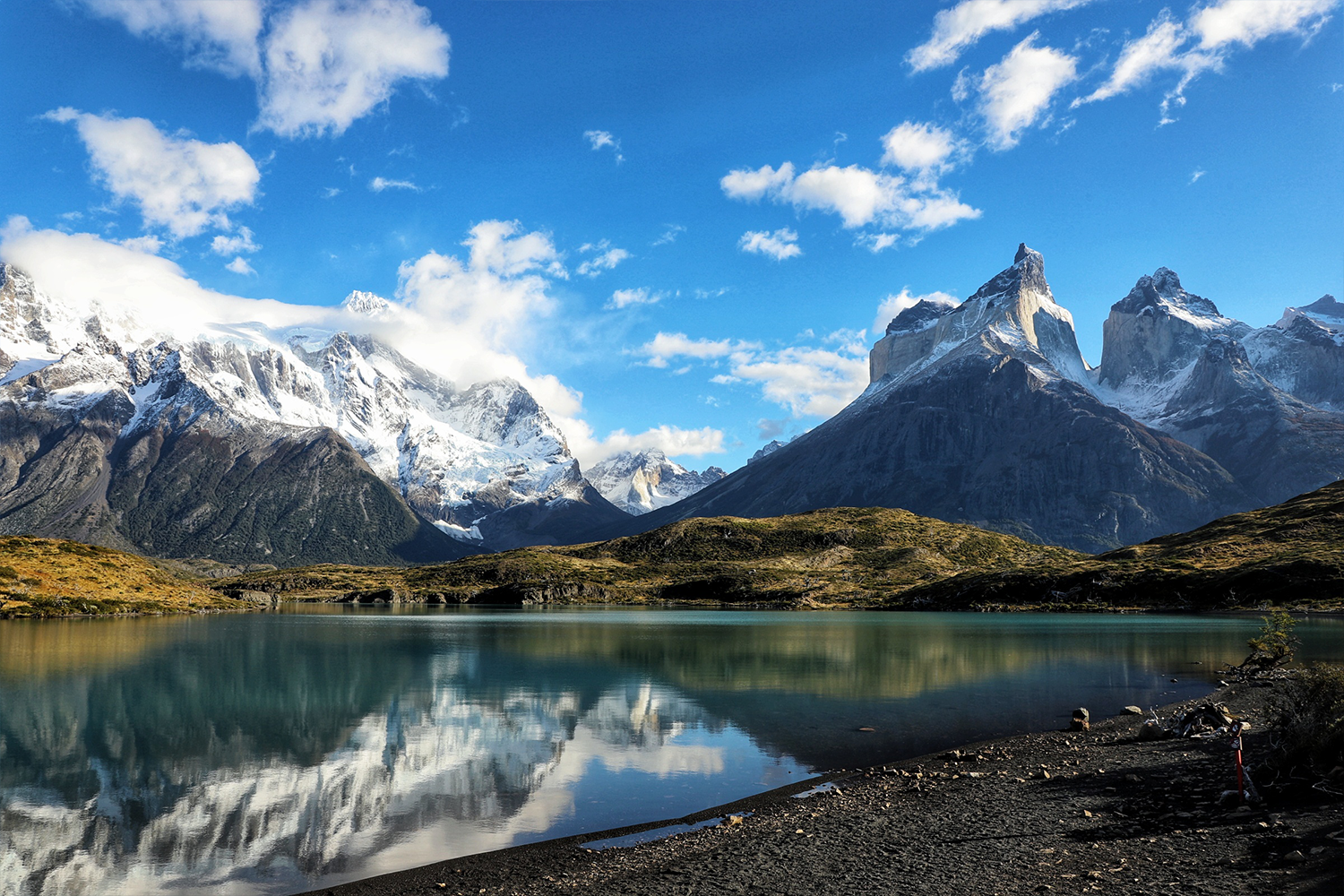

A shorter hike and easier day that offered more of a metaphorical than literal breathtaking view was a visit to Los Cuernos, a formation that’s considered the heart of Torres del Paine, replete with its many myriad components: lakes, waterfalls, the famed French Valley and the namesake mountainous triple horns of this particular viewpoint. It’s the type of view that might occupy the monitor on a treadmill taking you on a scenic virtual walk in order to coax yourself into some exercise for the day, and if that’s what you could queue up every morning, I guarantee you’d hop back on the hamster wheel once more. It was a stunning sight and every fresh step, every slight adjustment of perspective, provided another unforgettable vantage.
Back where we began in El Calafate at the start of the trip, Perito Moreno proved to be sensational and invigorating. After recharging overnight at Xelena Hotel & Suites, which had the feel of a comfortable, Alpine mountain lodge and boasted a lakefront position just outside the tourist town, I prepared to set out the next day for a visit to the supremely secluded Glacier Grande. “You’re going into the middle of nowhere,” says Martin, my guide for the day. The glacier is found right at the Chilean and Argentine borders and would require a full day to reach, incorporating a van transfer, two boats and two hikes.
We got underway in the early morning and drove for 90 minutes before an hour-long boat ride across Brazo Sur. The short hike took about half an hour, and the shorter boat ride on Lago Frias perhaps 10 minutes. This was all to get to the place where we’d begin a three-hour hike to the payoff, the purpose of the expedition, the epic glacier view, where we’d enjoy a picnic and then reverse the whole operation and arrive back at the hotel about 12 hours after we left.
It was a rainy day, and after beginning on the second, longer hike, we came to a path that was washed out in entirety — as a stream overflowed into a rushing torrent, the trail flooded by the cold rain that had been pelting us for hours. There was no way across without wading through frigid chest-deep waters and then hoping the rest of the way would somehow be dry. The excursion was a bust and needed to be abandoned. But the locale within Los Glaciares was magnificent, and our crew of a dozen didn’t see another person or group for the full duration of the experience. It was real edge-of-the-world-type stuff, even if it necessitated a helluva lot of time and logistics and cold wetness to not even be able to fulfill the objective of the day. So it goes. A guy with a tattoo saying “it’s better to travel well than to arrive” on his arm better be able to center himself on the idea that it’s about the journey and not the destination. And beautiful, unpredictable, wild, rugged, remote Patagonia might be a destination that’s more about the journey than any other on the planet.
More Like This

We're always on the scene eating, drinking and traveling near and far to bring you the best of what's happening out in the real world. Sign up for IRL now.