
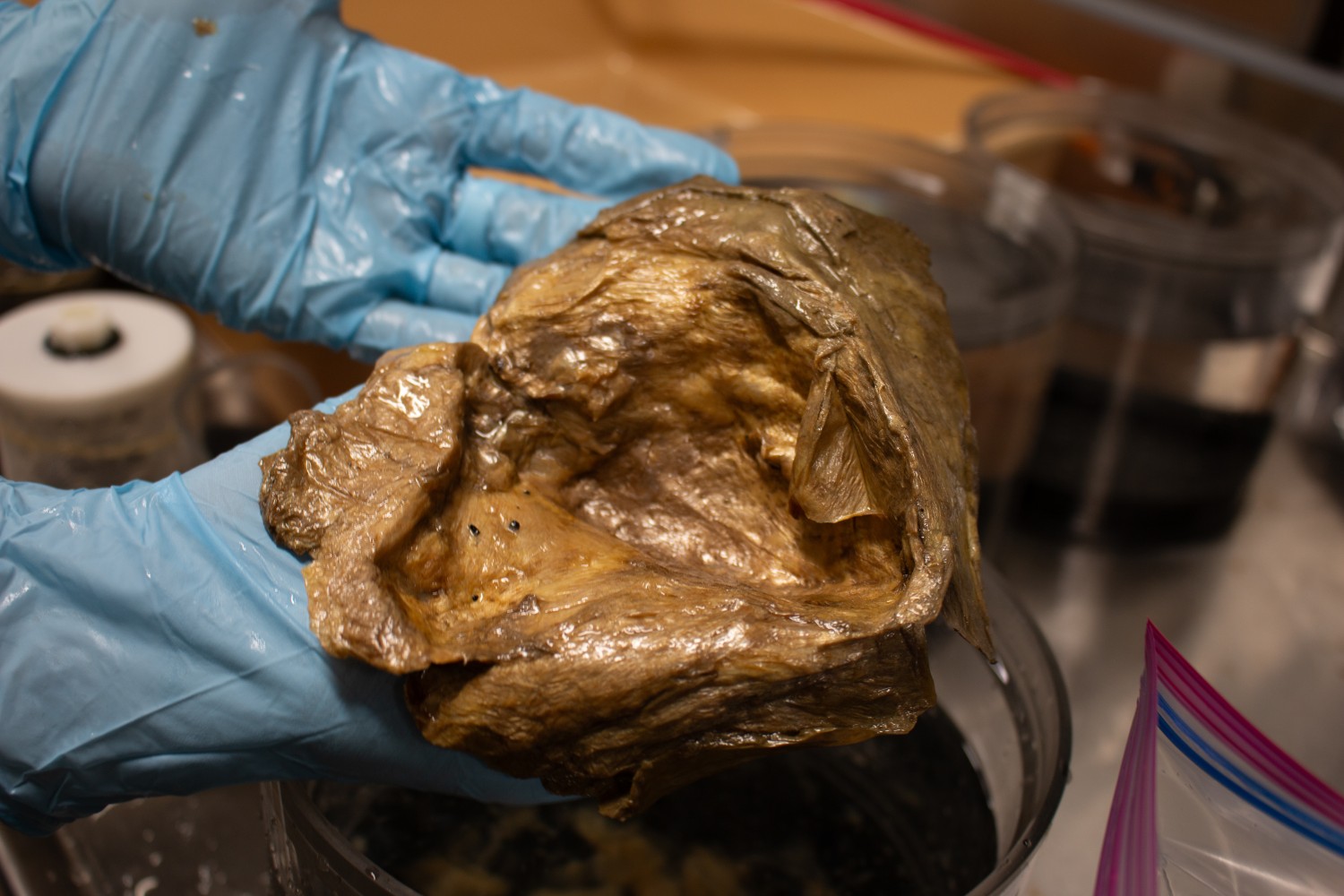
Let us know if you’ve heard this one before: a scientific expedition ventures below the surface of the water and finds a mysterious round object that defies any understanding. Yes, that is the basic plot of Michael Crichton’s novel Sphere — later adapted for film — but it’s also a description of something found in 2023 in the Gulf of Alaska. At the time, The Guardian‘s Hannah Devlin described the discovery as a “smooth object with an intriguing hole at the center.”
Now, the mystery of what this bizarre object is has been solved. According to the National Oceanic and Atmospheric Administration, the discovery made in 2023 is part of a massive sea anemone, Relicanthus daphneae. How massive are we talking about? Reportedly, the tentacles of the species can extend to seven feet long — so, either a surreal underwater sight or the genesis of nightmare fuel, depending on the observer.
As the NOAA explained, the orb is part of the body of this type of anemone; specifically, it’s what the creature uses to attach itself to a hard surface. The fact that it took several years to determine what this was is illustrative of the challenges that the NOAA’s scientists faced in researching it.
“[T]his turned into a special case that required focused efforts and expertise of several different individuals,” explained Allen Collins, Ph.D. “This was a complex mystery that required morphological, genetic, deep-sea and bioinformatics expertise to solve.”

A Chat With the Scientist Living Underwater for 100 Days
Dr. Joseph Dituri is in the midst of Project Neptune 100. He’s really happy about it.The researchers faced several challenges in determining what this object was, including the fact hat DNA barcoding was ineffective in corresponding to any one species. Scientists were finally able to find similar structures in the orb to a sample of the same species acquired during an expedition launched by the Schmidt Ocean Institute in 2021.
In scientific terms, the species of anemone represented here is a relatively recent discovery. As the American Museum of Natural History pointed out in a 2019 article on the creature, humans have only been aware of Relicanthus daphneae for around 50 years, and debate over how best to classify it has extended until recently. Had this orb been found a few years or decades earlier, the process of identifying it might have gone very differently.
More Like This





This article appeared in an InsideHook newsletter. Sign up for free to get more on travel, wellness, style, drinking, and culture..