
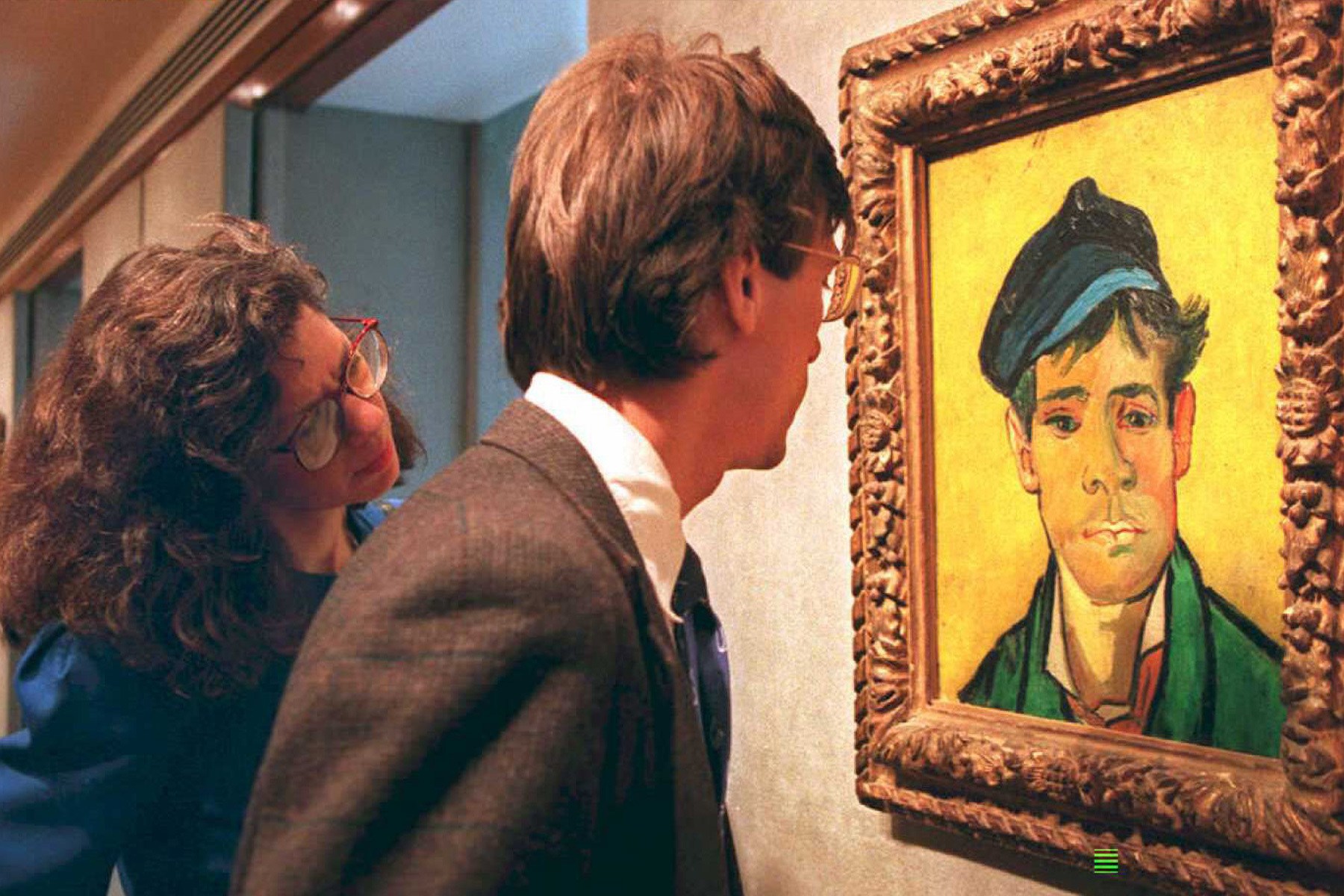
A couple Tuesdays ago, I crossed the few blocks from IH HQ to MoMA with the grim gait of someone who regrets signing up for the marathon. You could also picture an 11th grader about to sit his first SAT. My eyes were sore, my stomach was growling and, like most Midtown-based staffers around 5 p.m., all I really wanted was to teleport home.
I pulled my phone out as I entered the stanchion corral. Bringing it along was originally unplanned and less than ideal, given the task at hand, but Apple Wallet had my MoMA membership card. I flipped through digital credit cards and expired boarding passes until I found the mint-green MoMA stub. Ah, dammit. That was expired, too — last April. So now I had to pay the $30 entrance fee, one dollar for every minute that I’d stare at a painting, as my phone whispered from my pocket.
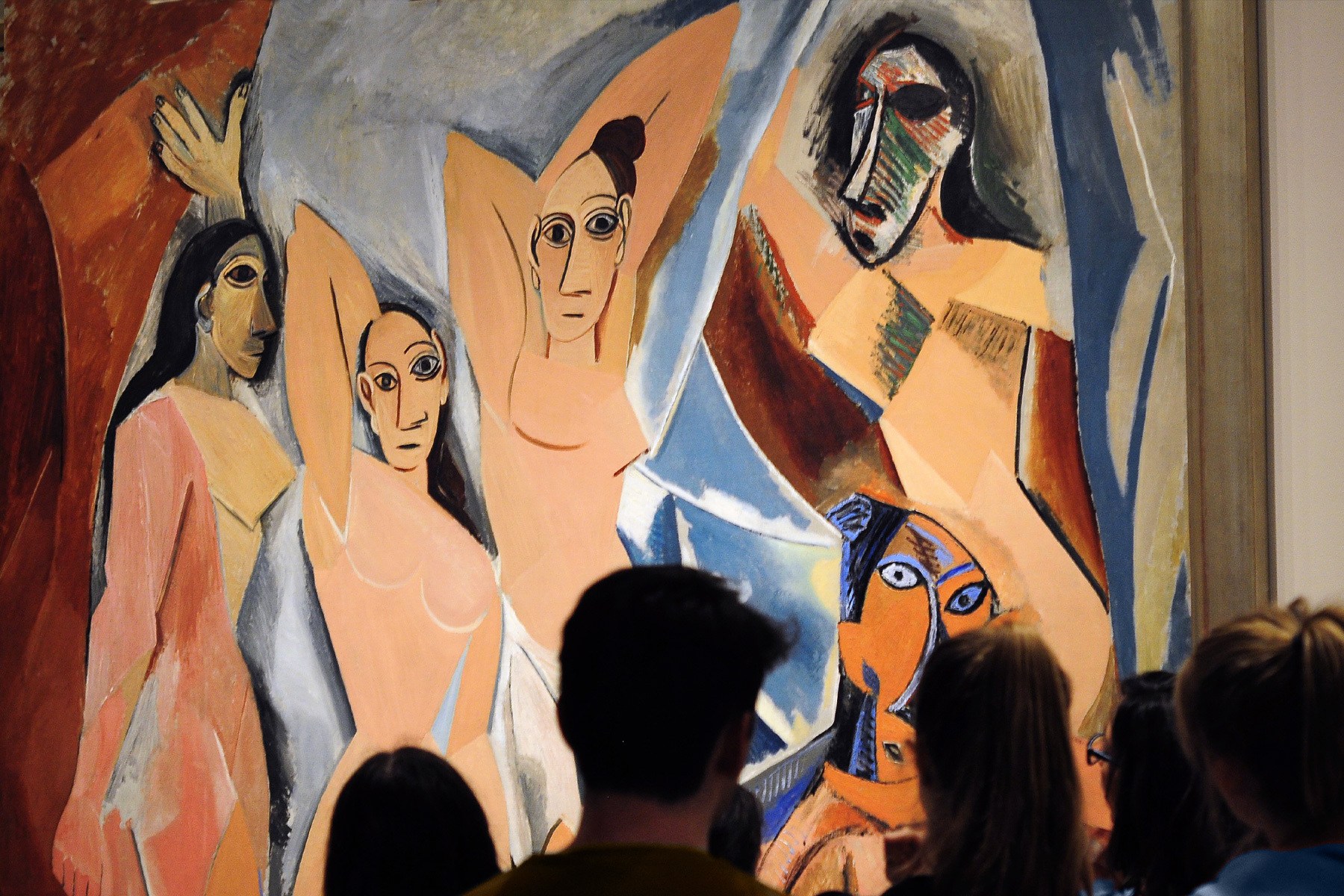
Upping the stakes, the ticket attendant told me there were only 33 minutes until the museum closed. Now or never. I hustled up the escalators all the way to the fifth floor, home to Collection 1880-1950, which includes Matisse’s Dance, Monet’s Water Lilies and Van Gogh’s The Starry Night. I zipped by ’em all, hardly giving these priceless works of art a second glance, until I arrived at my destination: Room 502, with its eight-foot-tall Picasso. Les Demoiselles d’Avignon.
There was a bench in front of it, three padded squares, and I took the one to the right out of deference to a potential couple. I needn’t have bothered. This late in museum hours, with perfect September weather outside, no one was coming to join me. For the next half hour, I was the only person in the world left to stare at the young ladies of Avignon. Could I actually last a half hour? I put the over-under at 10 minutes.
Why Stare at a Work of Art?
If you end up in one of Professor Jennifer Roberts’s art history courses at Harvard, expect to start your semester by staring at a single work of art for three hours straight.
Roberts was pushing “attentive discipline” long before it was cool. Now, everyone’s interested in attention as techno-pessimism soars and brains degrade daily into Play-Doh (just look at the podcasts and manifestos dissecting the attention economy, or offline zoomers and their “Summer of Ludd“). But as early as 2013, in a speech later adapted for Harvard Magazine, Roberts spoke passionately for “deceleration” and “strategic patience.”
“During the past few years, I have begun to feel that I need to take a more active role in shaping the temporal experiences of the students in my courses,” she explained, “that in the process of designing a syllabus I need not only to select readings, choose topics, and organize the sequence of material, but also to engineer, in a conscientious and explicit way, the pace and tempo of the learning experiences.”
This, she decided, would include sitting in front of art for an insane amount of time. And she knew three hours sounded insane. “The time span is explicitly designed to seem excessive,” she said. She figured students would rebel. But she also strongly agreed with the art historian David Joselit that paintings were “exorbitant stockpiles” — that, in staring at them for long periods of time, we derive nourishment through both admiration and investigation. As the seconds tick by, a student might even find time stop.
Roberts’s syllabus-week challenge has gone viral (academically, at least) in the 2020s. It was referenced in Jonathan Haidt’s The Anxious Generation and inspired a take-home test in The New York Times. The latter was a cool idea, but reminded me a bit of an online eye exam. When I rallied the courage to attempt a version of this, I wanted to look a real masterpiece right in the eye.
How Did I Do?
My fiancée suggested Picasso’s masterpiece on the merit of its size and complexity. She knows her art history. Mine is pretty iffy. Believe it or not, I had zero prior knowledge of Les Demoiselles d’Avignon before I sat down in front of it. But that also means I carried no preconceptions into the experiment — only a passing understanding of cubism and a philistine’s reverence for Picasso’s characterization in Midnight in Paris.
The first couple minutes were weird. I kept hearing the buzz of foreign languages behind my ears, and the footfalls of curators on their rounds. I was very aware of the idea that I, Tanner, was staring at a painting, doing a thing. Sort of like bringing your book to a bar and reading the same page over and over again. I tried to look at the painting the way I always look at paintings, to simply wrap my arms around it, but it was too much for me to hold — a riot of pink and blue, rust and shattered glass, tribal masks and disappearing limbs. Five women in total, but who were they? Where were they?
Then, right around the two-minute mark (if I had to guess), my gaze committed, seemingly of its own volition, to the woman at the very middle of the composition. I stared at her a long time. Then I went to another face. And soon I’d looked at all five faces for a decent amount of time. I did the same thing for their legs, their hips. Their breasts — some rounded, some cubed, some nonexistent. Then I went back to the faces and isolated features one by one: their mouths, their hair, their eyebrows, which I noticed sometimes turned into their noses.
I started coming up with all sorts of questions, and with nobody there to tell me the answers, all sorts of crazy theories. Stuff I’m sure would make a dinner table of art docents laugh at me, but I’ll share them anyway, for the sake of transparency. (Here’s the painting again, so you can follow along.)
Some of My Theories
- The woman on the far right (with features like a tribal mask) is being born — that’s why she’s “prying open” the world. Meanwhile, the woman on the far left is dying — that’s why her face is resolute and dark, and her leg is ossifying into what looks like a cave.
- These women are all various goddesses. This one came to mind, I think, because the relaxed pose of the center woman reminded me of Botticelli’s The Birth of Venus.
- This is the same woman seen five different ways (or experiencing five different emotions) on the same day.
And so on. I wondered about the hyperextended elbows, the cracks in what looks like the sky, the head turned 180 degrees, the difference in detail on the apparent tribal masks, the repetition of a horn/boomerang shape, the slashes of green, the oozy armpit (?!), the fruit bowl. I spent a lot of time on that fruit bowl.


Watching Sports Has Somehow Become a Special Skill
In an era of betting sites, fantasy leagues and group chats, most of us are “second-screening” our favorite pastime
I Made It to 30 Minutes
At 5:20 p.m., the PA announced it was time to get the heck out of MoMA. So I’d made it 30 minutes. I was flabbergasted. I hadn’t reached for my phone. I hadn’t fretted much since those early minutes. Where had the time gone?
For the record, at no point was I floating a few inches off the bench. I always knew where I was. And it was an effort, as my brain started to fatigue, to return to any one of those ladies for the 14th time. But every time I did rally, there was some small reward. Some stone to turn over. Even as I write this article, and take turns looking at the painting again, I’m spotting things I didn’t notice back at the museum. For instance, the far left woman’s hand against the rock, so bizarrely realistic compared to the rest of the painting’s anatomy — what’s going on there?
As Roberts noted in Harvard Magazine, “[W]hat students learn in a visceral way in this assignment is that in any work of art there are details and orders and relationships that take time to perceive….just because you have looked at something doesn’t mean that you have seen it.”
After the fact, I learned some fascinating truths about that painting. The big reveal being that these women are actually imagined sex workers, who Picasso sketched after inspecting objects, sculptures and masks from multiple civilizations (Greece, Egypt, South Asia) across hundreds of centuries. I guess I got nowhere close. But that was never really the point.
Don’t Fret the Duration
Technically, I only made it through a sixth of Roberts’s challenge. Three hours still sounds Herculean to me (I ran a marathon in less time). Maybe it’s easier as part of an assignment at an elite university, with a professor and peers to impress? It takes a whole lot of discipline to commit to the full challenge as an ordinary citizen. (Even I couldn’t simulate the experience properly; I knew I’d be writing about it for work.)
All that said, I wouldn’t sweat the length too much. If you show up to a museum and give this an honest try, you’re already doing more for your attention than most. An ultra-long look might yield more questions (and more fun theories), but too much focus on endurance here risks missing the point of the exercise, or reducing it to just another mode of “rawdogging.”
I haven’t minded that trend so much (neither, apparently, have others; find Big Think’s supportive explainer on it here), but it did seem to get increasingly performative and suffer-coded, as influencers went from braving distraction-free flights to staring at clocks for hours on end. Perhaps there’s some sort of zen in the practice, regardless of the procedure. But staring at a painting felt to me like a more proactive application of one’s attention reserves, an exercise that naturally made use of both creativity and critical thinking.
“Boredom Bootcamp”
A couple things in closing here. I know how lucky I am to live near the best museums in the world (I also considered heading to the Met or the Frick Collection). I also don’t have any kids, and when I left MoMA that day, there wasn’t a single notification waiting for me on my phone.
But if you can find the time to get to a museum of any kind, I think it’s completely worth the effort. I’ve thought about the experience at least once a day since I did it, and it’s put an attentional spotlight on the many smaller routines of my life. In fact, if the painting challenge isn’t in the cards for you, those routines might be a good place for you to start.
Here are a few, plus my personal experiences trying to create more space for attention and appreciation within each. I consider this a mini “boredom bootcamp,” though with practice, a bored shuffle through life is the very thing it works to alleviate.
Waiting in Line
Specifically at Whole Foods, where I find myself a few times a week, extremely tired and cognizant of the fact that I still need to cook dinner. I think this situation is life’s clubhouse leader in unconscious phone “pickups.” But let’s call it what it is: a lunge for dopamine in a zone where everyone’s mood is the absolute pits. You’ll take whatever the phone has over the experience in front of you. I just stuff the phone in the backpack so I can’t get to it, and then I people-watch instead. I can’t say this comes with too many intellectual rumblings, and there’s definitely some misanthropy involved, but I also saw a dog in a Jalen Brunson jersey last time, which made me smile. Sometimes the eavesdropping is good too, though you’d be mostly shocked by how quiet a grocery store is at 6 p.m.
Commuting
A screen-less, AirPods-less commute is so hard to commit to at the beginning of the day, with sunlight, caffeine, post-run endorphins and typical work-life dread doing their thing. Give me the emails and give me the podcasts. Still, sometimes I’ve found the itch really can be scratched with a book. It depends on the day, how late you’re running, what’s expected of you, etc. It might help to take a quick self-audit on what sort of commute you should have. (Switching up your commute, meanwhile, could help avoid the usual trap of hating it.) All that said, I think a commute home is the perfect time to just give the eyes and brain a complete rest. A chance to put the pencil down, so to speak, and embrace the finitude of your day.
Eating a Meal
This is a tricky one. If I’m home alone for dinner (which means I’m way more likely to be cooking some sort of bogus “man dinner”), it would feel crazy to sit in a chair at a table and intermittently stare out the window as my fork scrapes a plate. I don’t think a life of attention has to mean living like Rodion Raskolnikov. In that vein, it feels fine to watch a bit of TV if you’re eating dinner alone, especially if you normally eat dinner with loved ones. I think the real battle here is lunch. I’ve had success, especially when the weather is decent, just hiking my lunch to Central Park and watching the world go by. Sitting on a bench eating a wrap or salad feels like the most normal thing in the world, and offers my day a much-needed intermission. On the flip side, eating at the desk, spilling quinoa on my keyboard, can leave me feeling oddly depleted.
Watching Sports
The MLB postseason started this week, which means every game and at-bat are currently consequential to a casual viewer. I love it and I’m locked in. But I’ve always been a baseball fan, period. And it’s sucked, over the last few years, to realize I can’t focus on regular-season games the way I once did. I wrote an essay about this experience last year, titled “Watching Sports Has Somehow Become a Special Skill.” We’re all second-screening our favorite pastimes. A couple weeks ago, over a night to myself, I watched all nine innings of a Yankees-Rockies game of indeterminate significance, muting the commercials and performing odd jobs around the apartment when I got a little restless. It was blissful. I didn’t feel alone on the couch. I felt like I’d spent the night with an old friend.
More Like This



Twice a week, you'll find proven advice and tips, expert interviews, deeply reported features and personal essays on living better — for however long you’re here. Subscribe to Champ now.