
Warning: This story contains major spoilers for The Drama.
For the first 20 or so minutes of director Kristoffer Borgli’s The Drama, the action unfolds like a run-of-the-mill romantic comedy: Charlie (Robert Pattinson) spots Emma (Zendaya) reading a book in a coffee shop and approaches her, falsely claiming to have read and loved the same book. Unbeknownst to him, she’s deaf in one ear and has an earbud in the other, so she’s unable to hear him. Adorable awkwardness ensues. Once our meet-cute is out of the way, we’re treated to a series of flashbacks to various milestones in their relationship — first date, first kiss, first declaration of love — as Charlie runs through his speech for their upcoming wedding. If everything you know about The Drama comes from its mysterious marketing campaign, you might think you’re in for a lighthearted comedy where the biggest sources of strife are cold feet or an untrustworthy DJ.
If you’ve poked around a little further on the internet (or perhaps even read some of the spoilers), you probably know that the movie involves a major twist, but even that knowledge likely won’t prepare you for the big reveal.
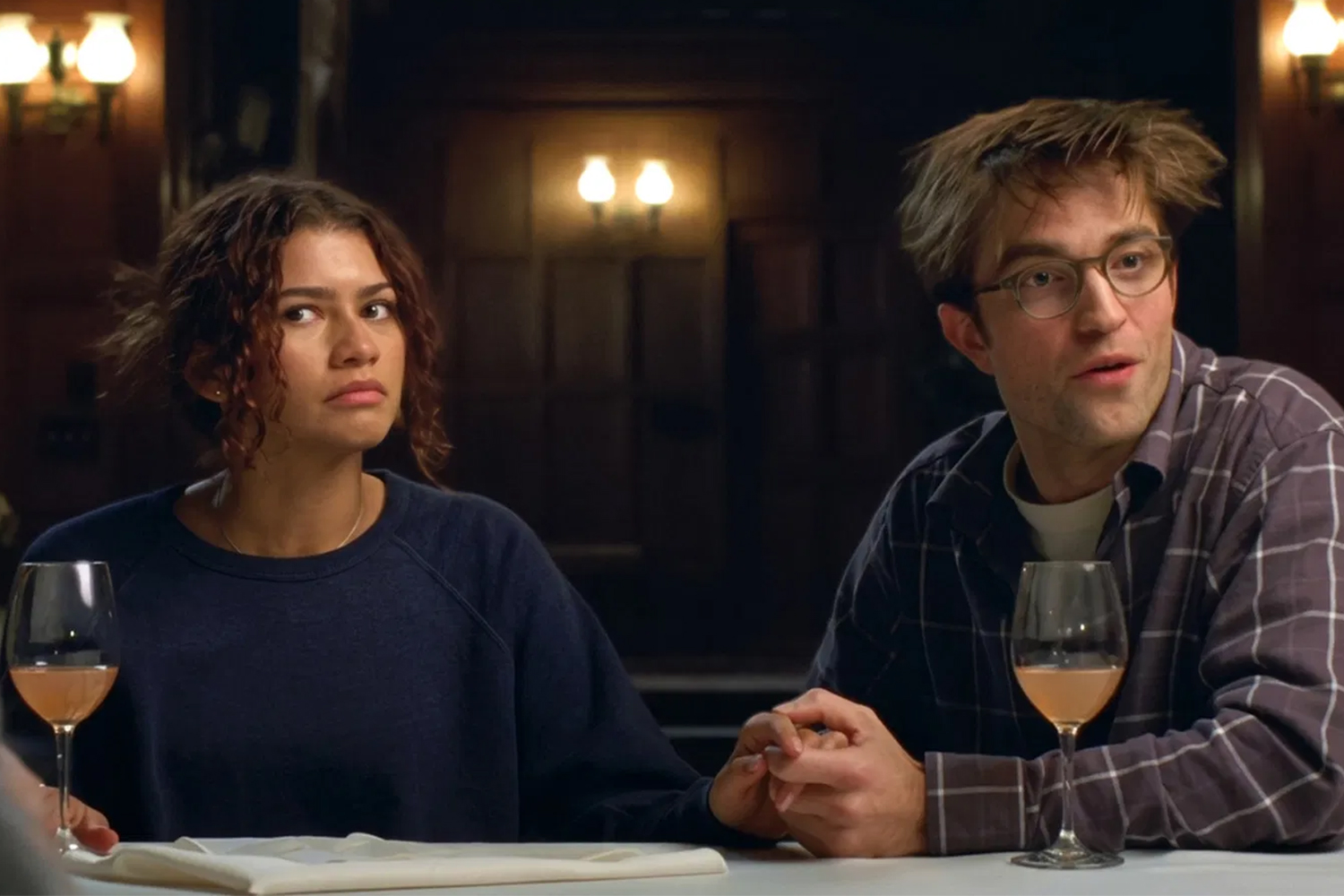
At a drunken tasting dinner with their best man Mike (Mamoudou Athie) and his wife and the maid of honor Rachel (Alana Haim), the group winds up playing a game where they each divulge the worst thing they’ve ever done. Most of the answers are objectively bad but kind of goofy — using a girlfriend as a human shield during a dog attack, locking a “slow” neighbor in a closet — but Emma brings things to a grinding halt with the revelation that as a troubled teenager, she planned a school shooting, getting as far as practicing with her father’s hunting rifle and recording a video manifesto. Ultimately, she had a change of heart and didn’t go through with it, eventually doing a complete 180 and becoming a gun-control advocate, but the fact that she could even consider committing such a horrifying crime leaves everyone shaken. Charlie spends the rest of the movie trying to decide whether he can still go through with marrying her.
Surprisingly, much of this is played for laughs. The Drama is, at its core, a cringe comedy, one in which we’re supposed to find humor in things like an anxious Charlie throwing away a novelty mug in their cabinet that reads “Coffee or I’ll Shoot!” or a young Emma having to pause and update the settings on her computer while in the midst of rattling off which of her peers she plans on killing first.
But is the world really ready for a school-shooting comedy? Survivors and family members of people who have died in mass shootings — like Tom Mauser, whose son Daniel was killed during the 1999 Columbine High School shooting — have spoken out against The Drama, accusing it of “humanizing” shooters and normalizing school shootings. (Sadly, these events have become such a regular occurrence in this country that we barely bat an eye when the latest one happens.) Others have taken issue with the fact that they were misled by the film’s marketing, arguing that a movie that deals with such a sensitive topic should have some sort of trigger warning attached to it.

See/Hear: The Best Movies, TV and Music for April 2026
This month delivers the final season of “Hacks,” a controversial A24 film, a new album from Noah Kahan and much moreThose are all valid criticisms. For one, it’s jarring to have such a heavy topic thrust onto you unexpectedly. But what’s so frustrating about The Drama is that it feels like a missed opportunity to address some big questions about what motivates a child to fantasize about committing such a horrible crime and whether or not it’s fair to have empathy about the many factors that so often contribute to these tragedies, like untreated mental-health issues (not to mention a prefrontal cortex that hasn’t yet finished developing), a lack of proper gun control and a society that glamorizes gun violence.
There’s nothing wrong with introducing a controversial topic or an ethical dilemma into a film, but The Drama barely scratches the surface here. Borgli’s script reassures us that Emma isn’t a monster. She was bullied, we learn, though we don’t ever get any details beyond a flashback of a girl sneering at her and asking if she’d ever heard of deodorant. She never actually carried out her plan, and in fact she quickly recognizes the error of her ways, dramatically tossing her father’s gun into a lake and joining a group of students fighting for stricter gun control. The reason the movie’s main comic conceit works at all is because there’s never any real fear that Emma may be a murderer. Slate’s Dana Stevens nailed it when she described the character as “a manic-pixie school shooter.” Her character is charismatic, and it must be said, a woman — which only 5% of mass shooters are in real life. Would we be as sympathetic if the roles were reversed and Charlie was the would-be shooter?
The movie’s planned shooting is simply a plot device, one that could have just as easily been something like a drunk-driving incident or adultery. The Drama goes out of its way to remind us of this fact when Charlie, still distraught over what he’s learned about Emma’s past, kisses a coworker and then later admits to it in his wedding speech, prompting the coworker’s boyfriend to attack him and turning the whole event to chaos. The movie ends with a bloody Charlie and Emma, still in her wedding dress, meeting at their local diner and introducing themselves to each other as if they were meeting for the first time.
It’s the ultimate do-over, and it mirrors their very first interaction in that coffee shop, where Emma realizes she didn’t hear Charlie, extends a hand and insists they start again. It’s a nice message, that people are deserving of second chances and no one should be defined solely by their single worst mistake, but the implication — intentional or not — is that the pair are on equal footing now, that Charlie’s transgression has somehow erased any concerns over Emma’s troubled past. Surely it’s not Borgli’s intent to imply that cheating is as reprehensible as planning a school shooting, but the whole thing feels tied up a little too neatly.
The real shame is, in a movie that purports to be about complex characters, there’s no real effort to explore them. We barely know why Emma considered murdering a bunch of her classmates, and we don’t know whether she’s done any work as an adult to address her adolescent trauma. The Drama chose to tackle a controversial issue with comedy, but none of it feels earned. Emma could be anyone; and while that may very well be the point, ultimately the movie feels more like a hastily drawn sketch than anything of substance. Borgli’s got big ideas, but The Drama is firing blanks.
More Like This


This article appeared in an InsideHook newsletter. Sign up for free to get more on travel, wellness, style, drinking, and culture..