

In 1910, automobiles still looked like rolling Edwardian furniture: upright, spindly and about as fun to drive as a mahogany dresser. While race cars were nothing new at that point, a competition at the beginning of the century inspired what would later be considered the world’s first true sports car.
The prestigious Prinz-Heinrich-Fahrt, or Prince Heinrich Tour, was organized by the German Imperial Automobile Club starting in 1908. The aim? To put four-wheelers through their paces on a 1,200-mile route from Berlin to Bad Homburg over the course of a week, the grueling course emphasizing endurance and reliability over pure speed. The rules? The competitors couldn’t be race cars, and they had to have four seats.
The ever-innovative Karl Benz invented the automobile in 1886, but only reluctantly steered his Benz & Cie manufacturing company into racing with the outrageous Blitzen Benz which packed a mammoth 21.5-liter four-cylinder beneath its hulking snout. The powerplant produced 200 horsepower by cramming the equivalent of a small block Chevy in each combustion chamber, making it more blunderbuss than precision weapon.
Inspired by the so-called Prince Heinrich Tour, Benz had his team feverishly build 10 new competition cars, four of which had 5.7-liter engines producing around 80 horsepower; the other six had 7.3-liter powerplants churning around 100 horses. The vehicles were technological masterpieces, featuring then-revolutionary innovations like four valves per cylinder, dual ignition (two spark plugs per cylinder) and a Cardan shaft (or shaft drive) as opposed to the more ubiquitous chain drive. The 5.7-liter’s power density was particularly remarkable, given that the Blitzen Benzes required nearly four times the displacement to produce a little over double the power.
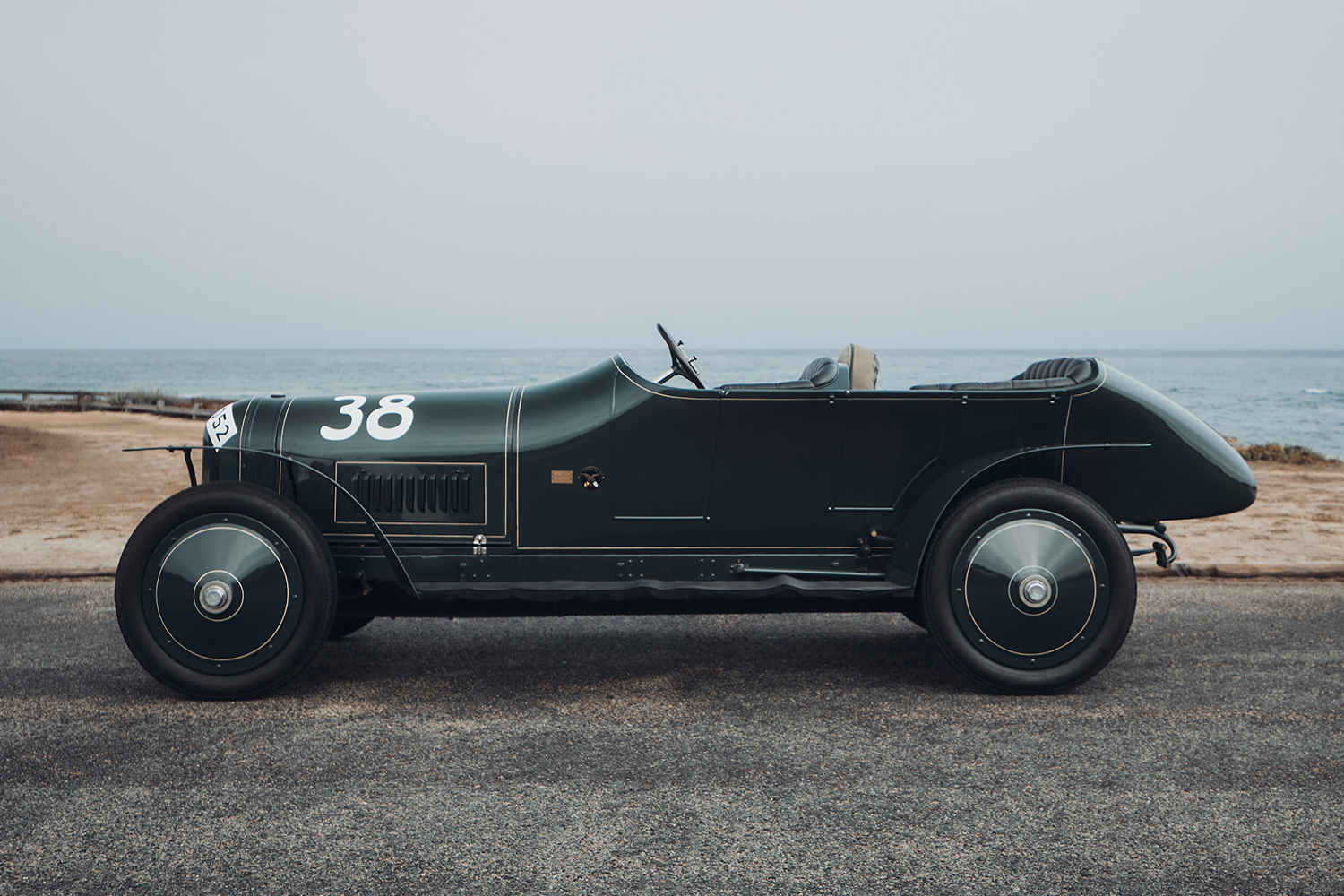
These cars looked radical, too, appearing less like a stodgy motorcar of the day and more like a backwards torpedo. Their upwardly curved bodies and bullet-shaped tails made early attempts at aerodynamic efficiency, but in typical Teutonic form there was also a functional aspect to the tapered rear ends as they housed massive fuel tanks.
Of the 10 originally built, only two “Prinz Heinrich” 1910 Benzes still exist, one belonging to the Mercedes-Benz Museum collection in Stuttgart, Germany, and the other to the Louwman Museum in the Hague, Netherlands. Mercedes-Benz entered their dark green 21/80 Prinz Heinrich car into last weekend’s 2025 Pebble Beach Concours d’Elegance, which requires every entrant to complete a drive up and down the California coast in the so-called Tour d’Elegance.
I was floored to be invited by Mercedes-Benz on a ride and drive in the Prinz Heinrich. Here’s what it was like to pilot this rolling piece of automotive history on one of the most iconic routes on earth.
115-Year-Old Driving Lessons
Driving a vintage car is like learning to speak a different language, and the 1910 Benz Prinz Heinrich was no exception. I was grateful that the Mercedes-Benz team organized a private tutorial with the beast ahead of the big event.
Mike Kunz and Nathanael Lander from Mercedes-Benz’s U.S. Classic Center walked me through what it takes to get this purpose-built roadster running — which it turns out is far more involved than you might expect.
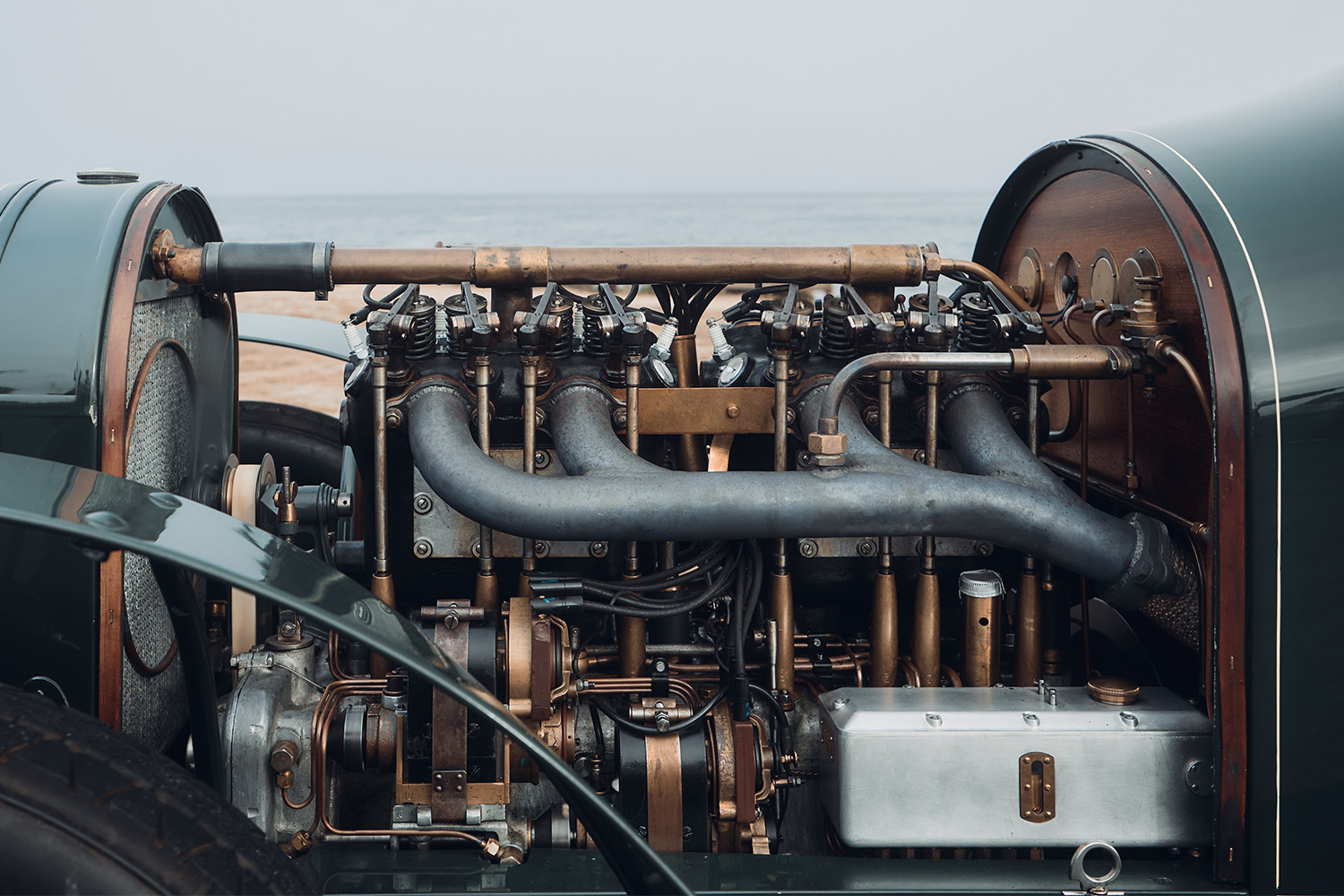
For starters, one does not simply turn a key to fire up the big four-cylinder. Because the Prinz Heinrich lacks an onboard starter motor and its engine’s relatively high compression ratio would make hand-cranking all but impossible, the Mercedes team uses a battery-powered external starter to get things going. This not a garden variety starter, either, but rather the very same piece of equipment used to start up the ultra-rare Mercedes-Benz W196 grand prix race car, which is sort of like using the Olympic torch to light your fireplace. The cylinders must be individually primed prior to spinning the engine, requiring fuel to be manually injected into each cylinder one by one. While a fuel can would have sufficed, we used a giant syringe for safety.
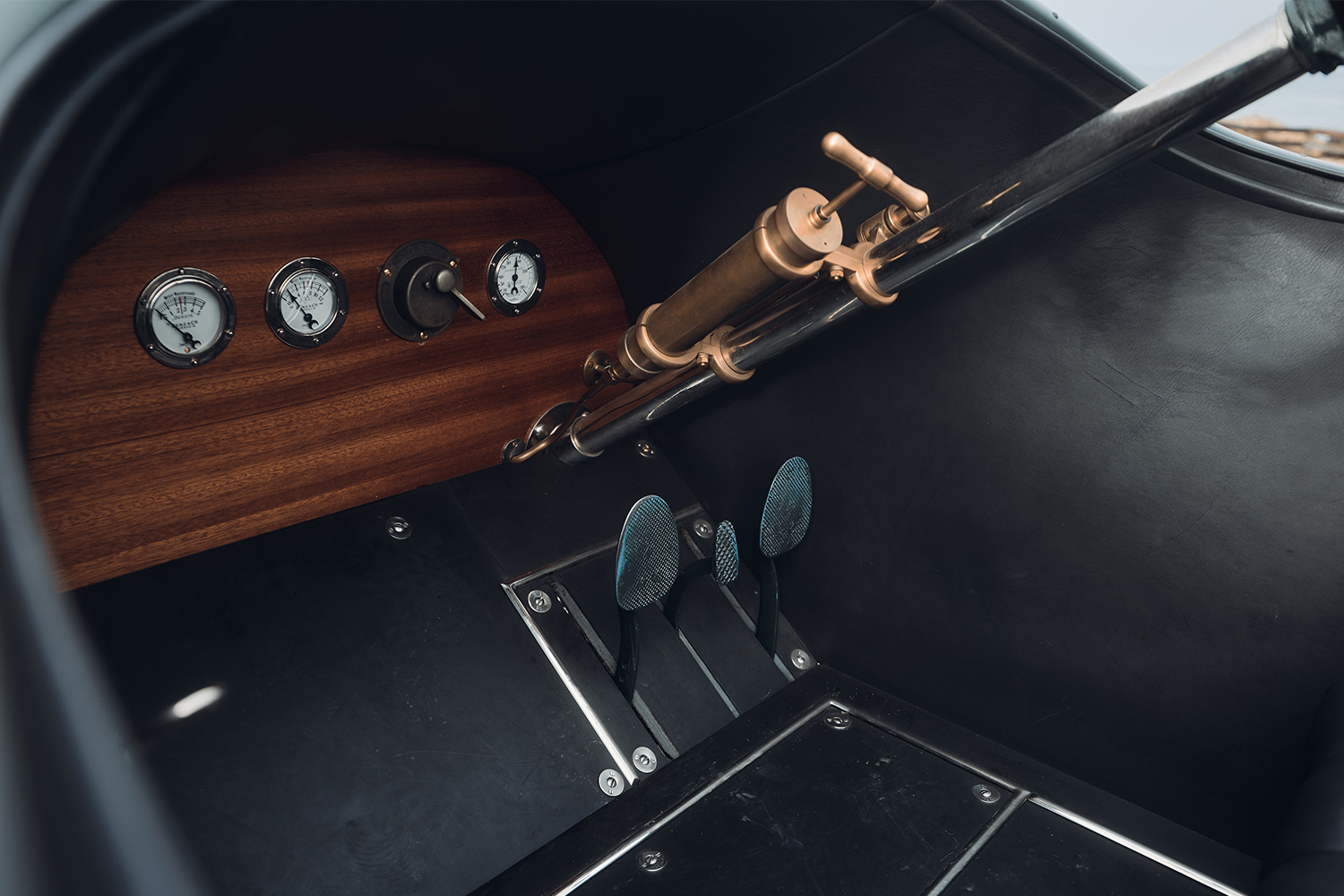
Successful combustion requires a perfect storm of stoichiometry as it relates to air-fuel ratios, temperatures and pressures. As such, while the external electric motor is spinning the crank, the driver must dial the ignition advance/retard to the appropriate setting on the steering wheel, ensure that the throttle is allowing just enough — but not too much! — fuel into the engine, and, perhaps most importantly, make certain that the gated shifter is in neutral and the handbrake is in place, lest this unwieldy torpedo attempt to mow down objects in its immediate path.
Once the Prinz Heinrich is successfully started you most certainly don’t want it to stall, which can happen quite easily because it lacks a conventional fuel pump. Rather than independently circulating fuel to keep the engine running, it uses exhaust pulses to leverage that pressure into getting fuel back into the engine.
Trouble is, when the engine is idling, that pressure can weaken enough to make the whole combustion process collapse, an issue resolved by a hand pump situated just under the steering column. Easy, right? Except there’s a good chance your right hand will be occupied with holding the handbrake, especially on the off chance that the foot brake (which is, disconcertingly, to the right of the clutch and the accelerator, not in the middle) isn’t sufficient to hold the vehicle in place. Remember that bit of engineering — it’ll come into play later.

Where the Skinny-Tired Rubber Meets the Road
The Pebble Beach Tour d’Elegance is where the gorgeous competitors in one of the world’s most prestigious concours prove their roadworthiness, bringing everything from feisty Ferrari race cars to opulent early American grand tourers together in an eclectic cavalcade that spans the stunning California coastline from Pebble Beach to Big Sur. The 229 participating cars this year were led by a police escort on motorcycle; our 115-year-old sled followed just behind the lead car, the same 2026 Mercedes-AMG GT63 APXGP Edition featured in the film F1.
I obliged to Mercedes-Benz Heritage boss Marcus Breitschwerdt to drive the first leg of the tour, squeezing into the cramped rear section of the Prinz Heinrich with my adventurous wife. Breitschwerdt is a stoic yet witty soul, and his command of the towering vehicle was absolute. I’ve rallied with him before in a maharaja’s priceless 1930 Mercedes SS Cabriolet, so we’ve both got familiarity on our side — though he did conclude dinner the night before with a droll announcement: “You scratch it, you buy it.”
High Speeds, Piazza Pit Stops and a $2M Jaguar: Welcome to Italy’s Modena Cento Ore
Our correspondent recounts his four-day drive behind the wheel of a D-type Continuation in the latest entrant into the pantheon of road ralliesMoving through the damp, cool coastal air in this hulking machine feels like nothing else. There’s no windscreen to shield the breeze, and the vehicle’s tall stance and elevated seating yields a refreshingly clear view of the surroundings. As we wound down into the oceanfront stretches of Highway 1, those views became downright staggering. In a regular car, the most immediate vistas of the ocean would be blocked by guardrails and trees. In here, you peer directly down to the edge of the water, presenting an entirely different field of vision to the horizon. More immediate were the crowds of enthusiasts camped by the roadside. Armed with cameras, handwritten signs (“Honk!”) and unbridled enthusiasm, their infectious cheer brought a human element to this otherwise mechanical endeavor.
At one point en route to the turnaround point, our colleagues behind us in a Mercedes-Maybach SL pulled alongside us, screaming something about smoke. We looked back and, sure enough, we were leaving a trail of white smoke as we barreled down PCH at about 40 mph. Gulp. Our Benz’s powerplant thankfully still felt grunty, but when we stopped at the turnaround point Breitschwerdt announced that the foot brake no longer worked, and that I’d have to rely entirely on the handbrake. Double gulp. (I’d later learn that the oil spray from the engine lubricated the leather brake strap that grabs the rear axle, rendering it useless.)
“Want to try your luck?” Breitschwerdt asked before relinquishing the driver’s seat.
“Absolutely,” I answered, not entirely sure if my cavalier response was de rigueur or just plain dumb.
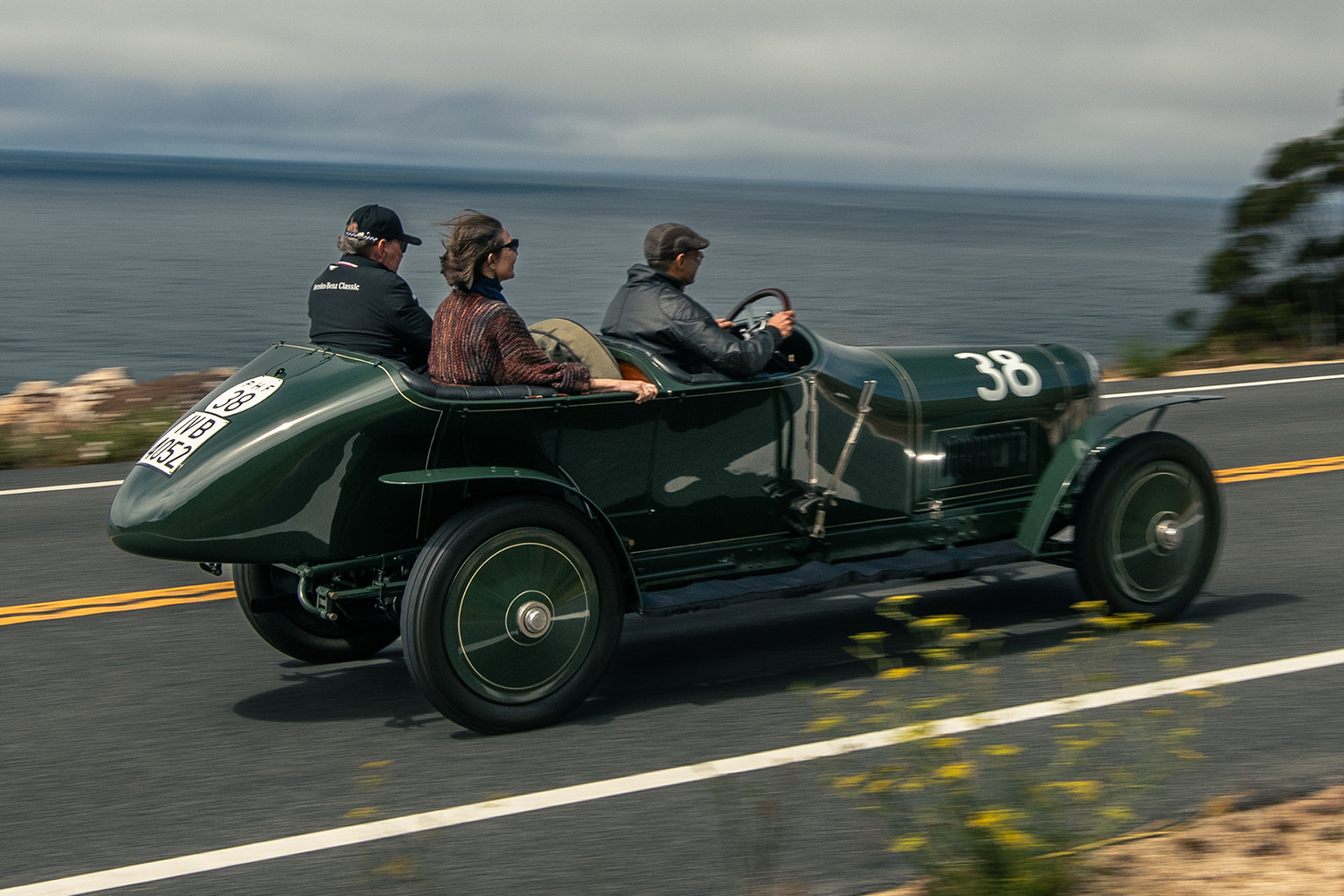
As I climbed into the windscreen-less, seatbelt-less driver’s seat, I underlined and boldfaced my mental note that the clutch pedal on the left and the gas pedal in the middle were the only pedals that mattered. As heavy as the unassisted steering wheel may have felt, I absolutely needed to make sure my right hand was ready to yank on the handbrake at a moment’s notice. No pressure.
The Prinz Heinrich moved forward with confident progress, though it required attention to shift into each gear since the manual transmission lacks synchronizers which keep the cogs from grinding loudly with each gear change. Owning a 1960s-era Land Rover with a non-synchromesh gearbox has taught me to double de-clutch and match revs to avoid crashing, but regardless of my technique (and Breitschwerdt’s as well), all this clunky four-speed wanted to do was grind.
Our magisterial steed moved back up the coast with incrementally more caution due to the dubious brake situation, but that didn’t diminish the pleasure of taking in these stunning surrounds in such a new and unfiltered way. I might have faced serious problems if the last remaining braking system failed while we were barreling down the highway — but hey, what a way to go, right?
When the stunning stretches of Highway 1 merged into 17-Mile Drive, those sinewy coastal views gave way to a potentially harrowing feature: steep downhills that strained the already-fading brakes. While I downshifted to leverage engine braking in order to slow down the bulky Prinz Heinrich, I still needed to pull on the brake lever in order to keep from rear-ending the vehicle ahead — no small feat, since this vehicle’s weight appeared to be gaining on its stopping capabilities.
By the time I returned the Prinz Heinrich back to the Mercedes-Benz stand before it was driven onto the lawn at the 74th annual Pebble Beach Concours d’Elegance on Sunday, I was exhausted, thrilled and mighty relieved all at once. Losing the foot brake was only one of many things that might have transpired during the 70-mile drive; working around it renewed my respect for the drivers who wrangled these beasts over the original 1,200-mile competition.
The 1910 Prince Heinrich Tour was won by Ferdinand Porsche in an Österreichischer Daimler while our particular steed finished in 11th place; the top Benz & Cie teammate landed in the 5th spot. The disappointing finish only galvanized Karl Benz to build better, stronger and more competitive vehicles that would pave the way to a universe of future Mercedes-Benz race cars encompassing everything from semi-trucks to rally machines to Formula 1 cars.
Benz would surely be pleased to know that his 1910 Prinz Heinrich racer drove up the Pebble Beach ramp on the 18th hole that Sunday to receive a Charles A. Chayne Trophy, acknowledging it for being the most technologically advanced car of its time.
More Like This
This article appeared in an InsideHook newsletter. Sign up for free to get more on travel, wellness, style, drinking, and culture..